Activism and the history of graphic design: the 1960s generation of Arab artist-designers
Zeina Maasri
29.06.2026
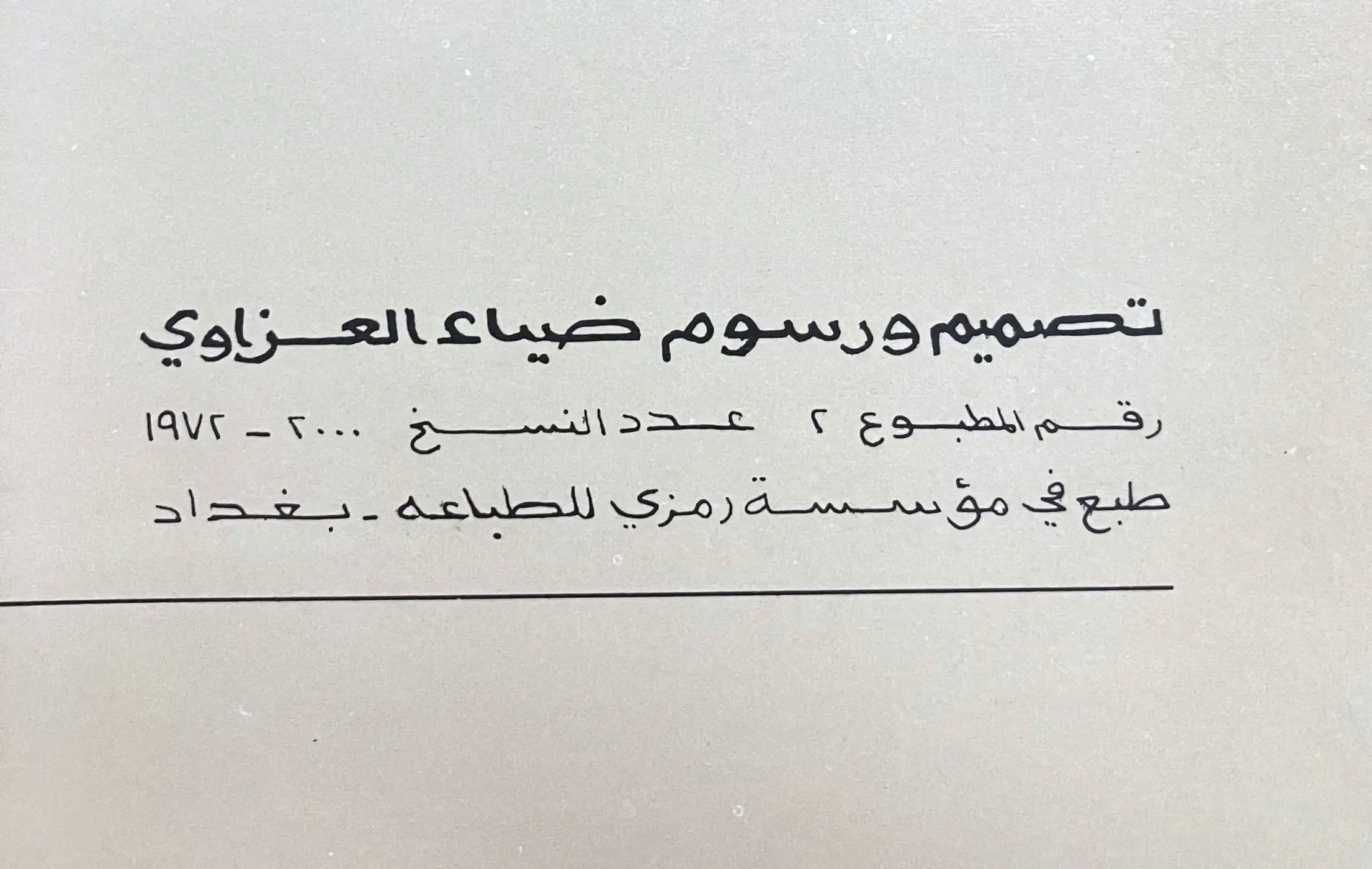
Graphic design has long been framed as a commercial offshoot of a supposedly autonomous artistic practice, with advertising cast as the ‘mother of graphic design’, in the formulation famously advanced by Steven Heller.1 Yet the Arab historical context suggests otherwise. Many of the books published between the 1950s and 1980s and exhibited in Decolonizing the Page bear the imprint of a generation of now well-known Arab artists. Here, more interstitial relations prevailed, as artists moved fluidly between art and graphic design practices. During this period, the Arabic term tasmim (‘design’) slowly emerged in book credits, marking the recognition of design as a distinct practice alongside other book arts, including illustration and calligraphy. What, then, drew these artists to graphic design and book arts at this historical juncture?

The ‘1960s generation’2, as Arab artists on the Left came to be known, represents a radical turn in postcolonial artmaking that is marked by the ebb and flow of the political vicissitudes of the long sixties.3 This generation came of age with the inauguration of Afro-Asian anticolonial solidarity in Bandung in 1955, the Algerian war of independence (1954–62) and the nationalization of the Suez Canal in 1956 Egypt. They witnessed, with great hopes, the 1958 revolutionary coup that overthrew the British-installed Hashemite monarchy in Iraq and the union between Egypt and Syria in the same year. Both were seen as first steps toward realising their collective dream of pan-Arab unity, dissolving the borders carved up by European colonial powers, and—not least—reclaiming Palestinian land annexed by the state of Israel in 1948.
Their early hopes, however, were dashed just as they were embarking on their artistic careers. They experienced the humiliating Arab military defeat in the 1967 war against Israel, while coming to grips with shifting imperial powers in a global Cold War order. And yet, as they reckoned with the failed promises of post-independence Arab states,4 their hopes were soon reignited by the rise of the Palestinian liberation movement as a popular armed struggle, modelled on the Cuban, Vietnamese and Algerian anticolonial wars of national liberation.5 The latter’s unfolding on a global terrain of Tricontinental solidarity, and converging with New Left politics and radical civil rights and student movements globally,6 gave a renewed impetus to this generation’s contestation, and offered them a new horizon of radical possibility. Yet these same years were also shadowed by the tightening grip of authoritarian rule in Egypt, Iraq, Morocco, and Syria, and by counter-revolutionary state violence in Jordan and Lebanon, culminating in the outbreak of Lebanon’s long civil war (1975–90), alongside continued Israeli military assault and occupation.
The interlocking of global and regional politics in this revolutionary conjuncture galvanized the sixties generation and politicized their artmaking. Indeed, Arab artists produced work that gestured to both the horizon of emancipatory dreams and the violence of their undoing. Many chose printed media—posters, cards, periodicals and books—as their canvas for political action.7 As the Palestinian artist and critic Kamal Boullata observed in 1970, Arab art was reconceived along revolutionary lines that displaced artmaking to the surface of the reproducible democratic print:
‘Paintings which used to hang in Beirut’s galleries now shrank to the size of a postcard or poster, to be sold in hundreds in support of the war victims. […] Beirut’s art galleries began to transform into a body without a soul, for the soul was freed in the streets, refugee camps and guerrilla bases’.8
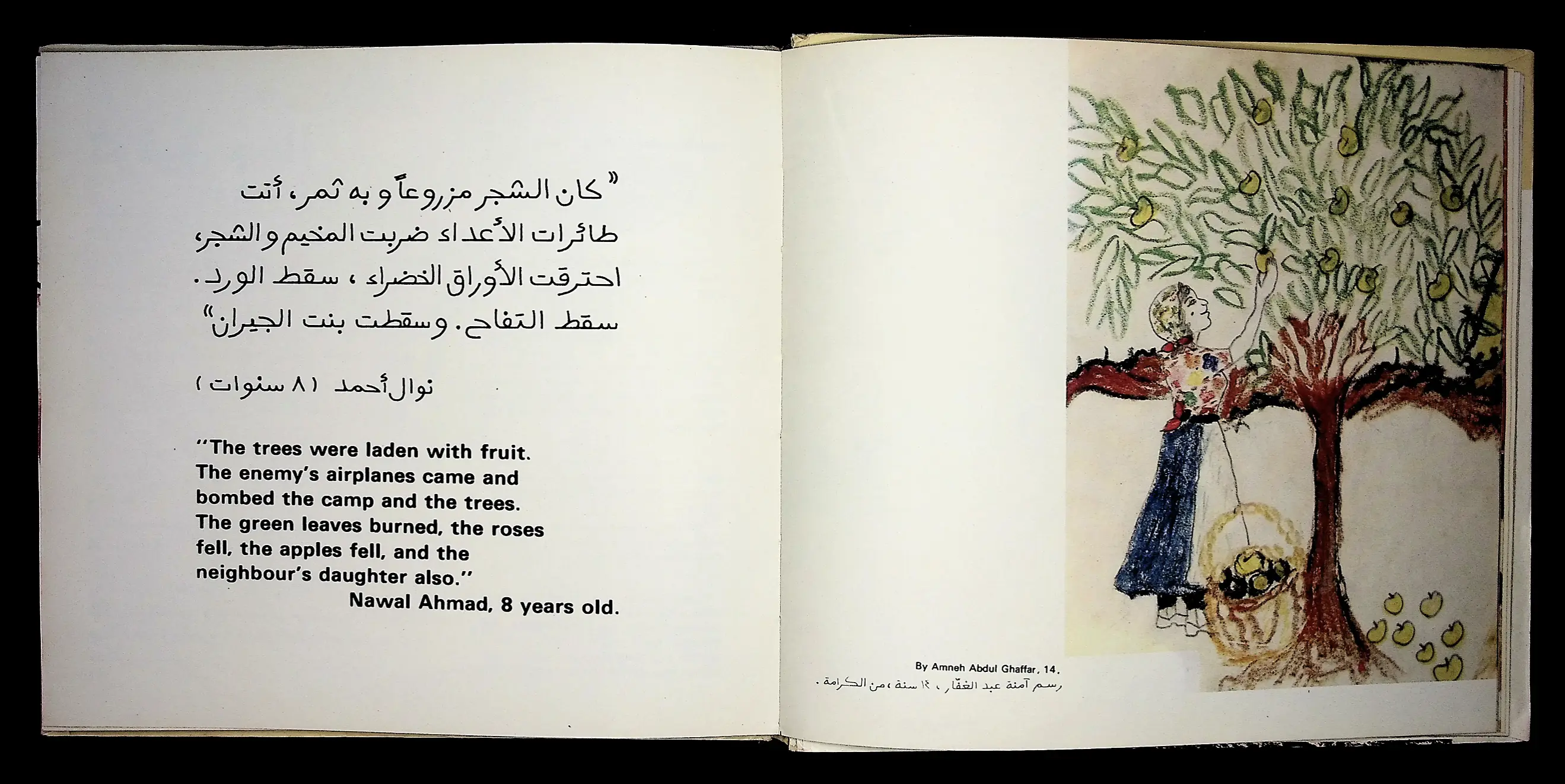
Mona Saudi (1945–2022), who was completing her studies at the École des Beaux-Arts in Paris when the May ‘68 student and worker uprisings erupted, recalled how these events transformed her.9 She returned to her native Jordan to work with Palestinian children displaced by the 1967 war and living in the Baqaa refugee camp. Through drawing, she encouraged them to tell their own experiences of loss and life in exile, creating space for their hopes and dreams as well as their fears. The resulting drawings, produced by children as witnesses to their own dispossession, offer a powerful testimony to the violence and injustice that have long structured Israel’s settler-colonial project in Palestine.10 Saudi compiled their drawings into a bilingual Arabic and English book, In Time of War Children Testify (1970), that she co-designed with Palestinian artist Vladimir Tamari (1942–2017), using a bespoke Arabic typeface he created that was inspired by children’s handwriting (Fig. 2).11 Distributed internationally through the Parisian publisher François Maspero— the publisher of Frantz Fanon’s The Wretched of the Earth and a radical node of Third Worldist militancy and solidarity—the book sold out instantly. Proceeds from sales were to be invested in developing art and literature centres in Palestinian refugee camps. Saudi moved to Beirut in 1969, where she later headed the PLO’s Plastic Arts Department, organising many art activities, designing and illustrating publications related to Palestine, alongside her work as a sculptor. She notes that Arab unity may have remained an unfulfilled dream that Arab states had failed to deliver, but that nonetheless ‘the cultural unity of the Arab world was a vivid, continuous reality’.12
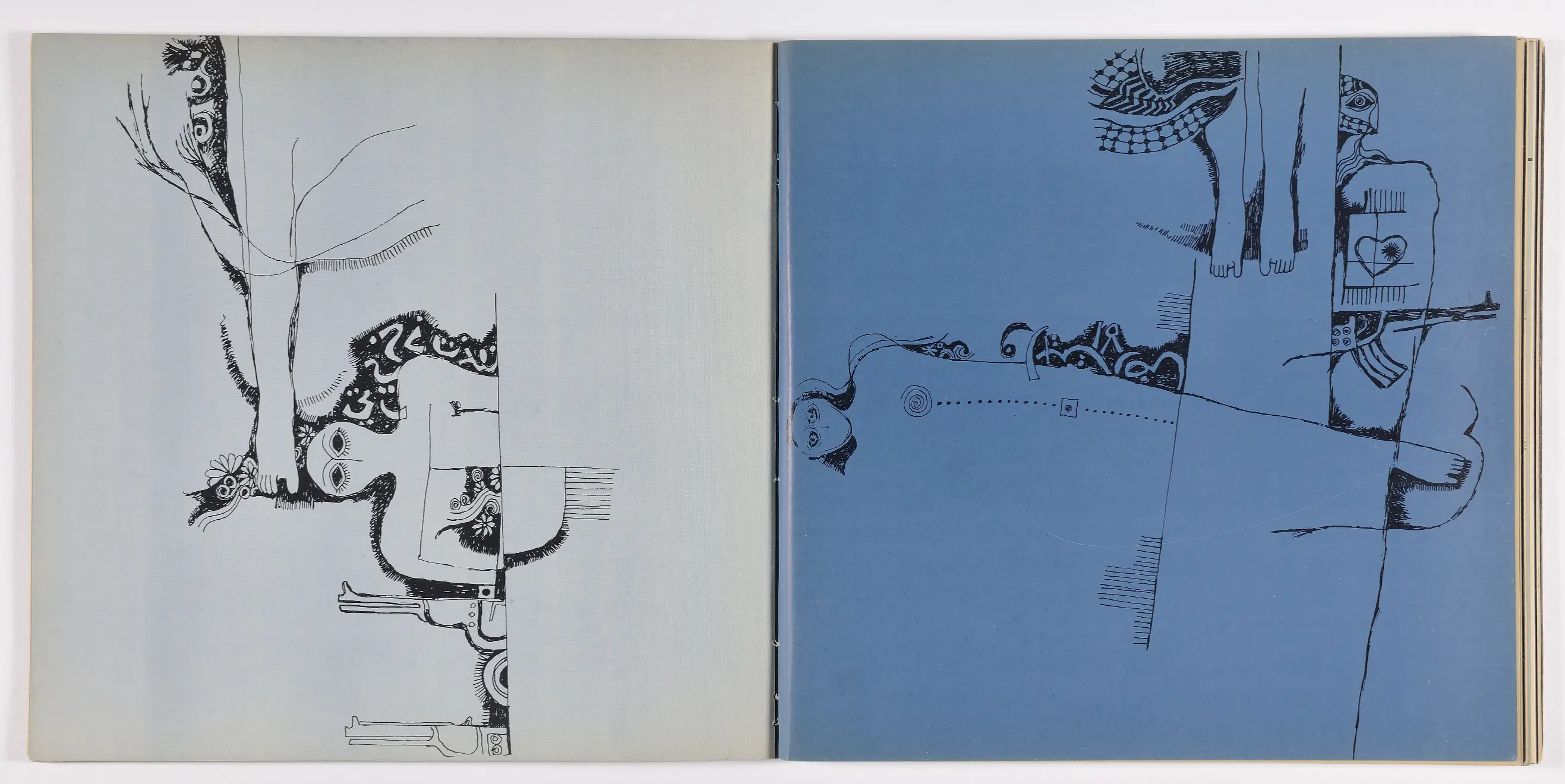
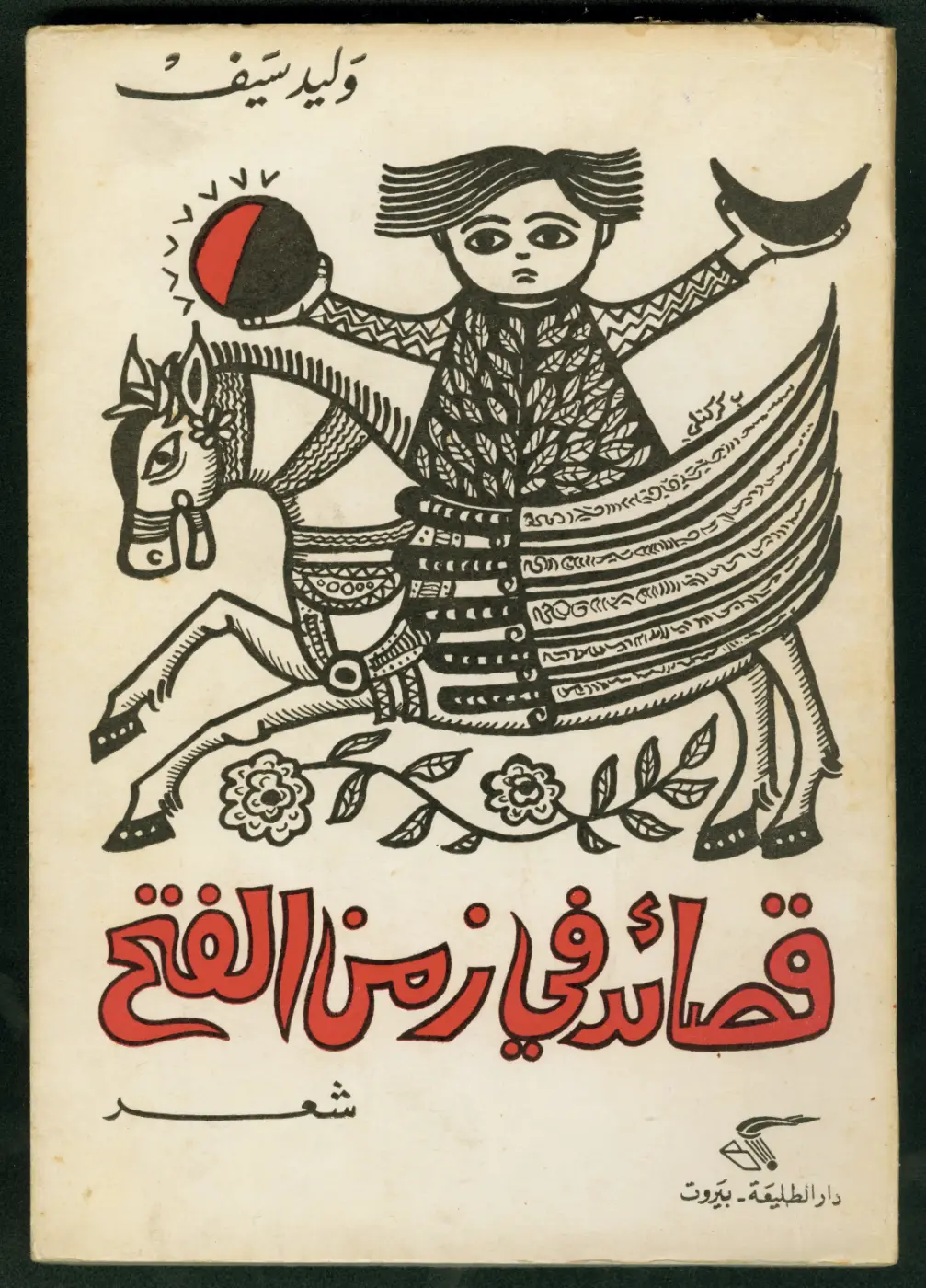
The Iraqi artist Dia al-Azzawi (b.1939) took a leading role in the New Vision Group, a collective of Iraqi artists formed in 1969, that proclaimed in a manifesto that modern art realizes its revolutionary promise by responding to political conditions with renewed aesthetic sensibility.13 Azzawi thus set about new experiments with image and text, extending his artwork to include posters and books.14 This exhibition features many of the books he designed and illustrated, as well as his independently conceived artist’s books made in solidarity with Palestine and Palestinians: from the diary of a fidaʾi (freedom fighter) fallen in Black September in 1970 Jordan (Fig. 3) and the short stories of the assassinated Palestinian novelist, literary critic and activist Ghassan Kanafani, to the poetry composed as ode to the victims of the Tal al-Zaatar massacre in 1976 Lebanon. While he pays homage to the figure of the fida’i as the anticolonial revolutionary Arab subject, his books also bear witness to the violent betrayals and silencing of a revolutionary promise at the hands of compliant regimes.
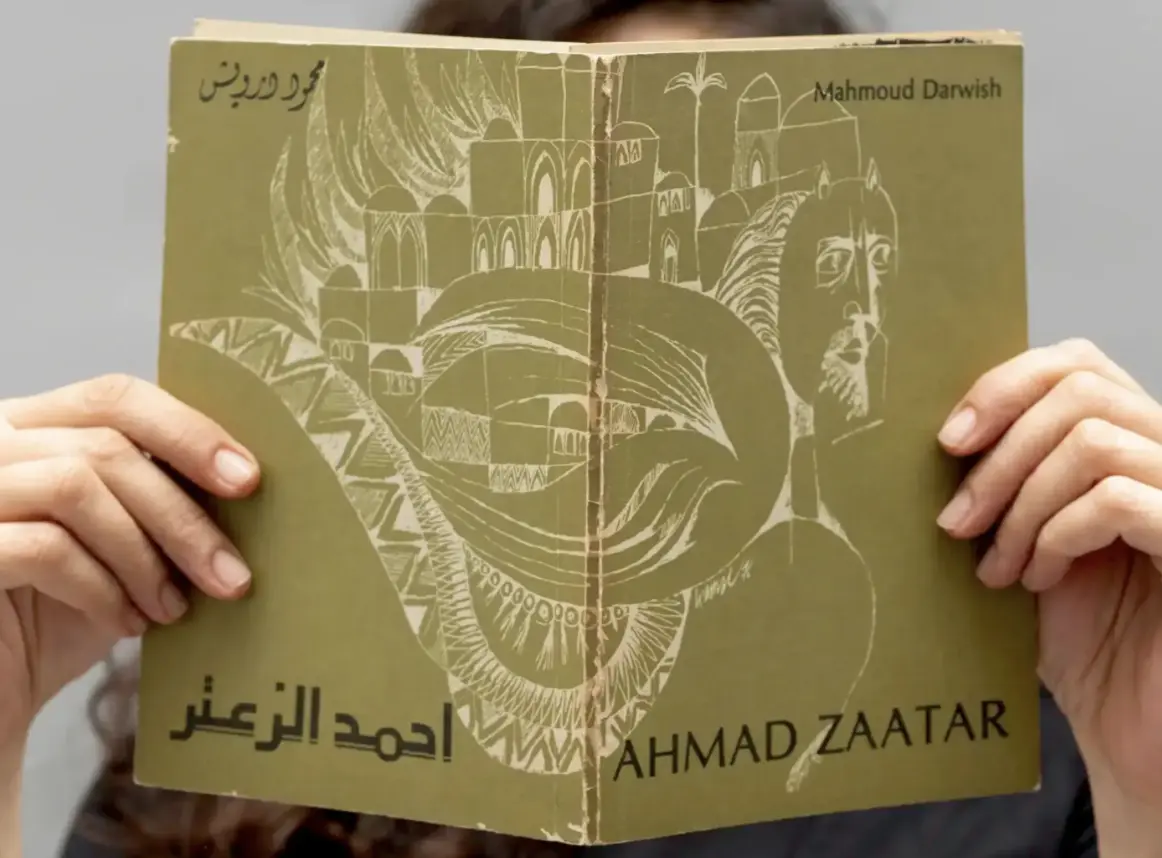
Similarly, Kamal Boullata (1942–2019), states that it was his activism in support of Palestine from his exile in the US—at the height of the country’s African-American civil rights movement and student protests—that drew him into graphic design early in his artistic career, designing and illustrating political posters, periodicals and books (Fig. 4). It is this voluntary training that, as he recalls, ‘would reconnect me with the homeland and bring me back among my own people in Beirut’, to become the founding art director of Dar al-Fata al-Arabi.15 This revolutionary publishing house, affiliated with the PLO, emerged from the need for a radical pedagogy grounded in the experience and aspirations of anticolonial struggle (see Room 4: ‘Postcolonial Futurity’ in this exhibition).16 In a manifesto-like essay, ‘Art in the Time of the Palestinian Revolution’, Boullatta stressed in 1971 the need to prefigure a revolutionary art outside of the Western model of the art market: ‘That kind of artistic production’, Boullata protested, ‘is an accessory for bourgeois salons, a luxury to be enjoyed by one class of Arab society while remaining beyond the reach of others’.17 Likewise, the Syrian artist Burhan Karkutli (1932–2003) wrote in 1971, while pressing the newly founded Union of Arab Artists to set up a printing press: ‘If painting reflects revolutionary values, its dissemination in print across the Arab world will bring these values to every home and within the sight of every citizen’.18
In his book, Min al-Ard al-Muhtalla: Maa’rid mutajawwil (From the Occupied Land: a mobile exhibition), Syrian artist Nazir Nabaa (1938 – 2016) applied his generation’s political turn to print by publishing an artist book (Fig. 6). Produced in the aftermath of the 1967 Arab-Israeli war, it was formed of 64 pages, bringing a collection of Nabaa’s drawings into conversation with seminal Palestinian resistance literature, such as the poetry of Mahmoud Darwish and Tawfik Zayyad. That the book was conceived of as a ‘mobile exhibition’, as declared in its cover subtitle, clearly indicates Nabaa’s insistence on exhibiting his art beyond the confines of gallery walls: the artist’s book as a ‘democratic multiple’19 offered a new horizon for art in this Arab conjuncture. Unlike a painting, the artist’s book takes on the democratic characteristics of the free circulation of books.
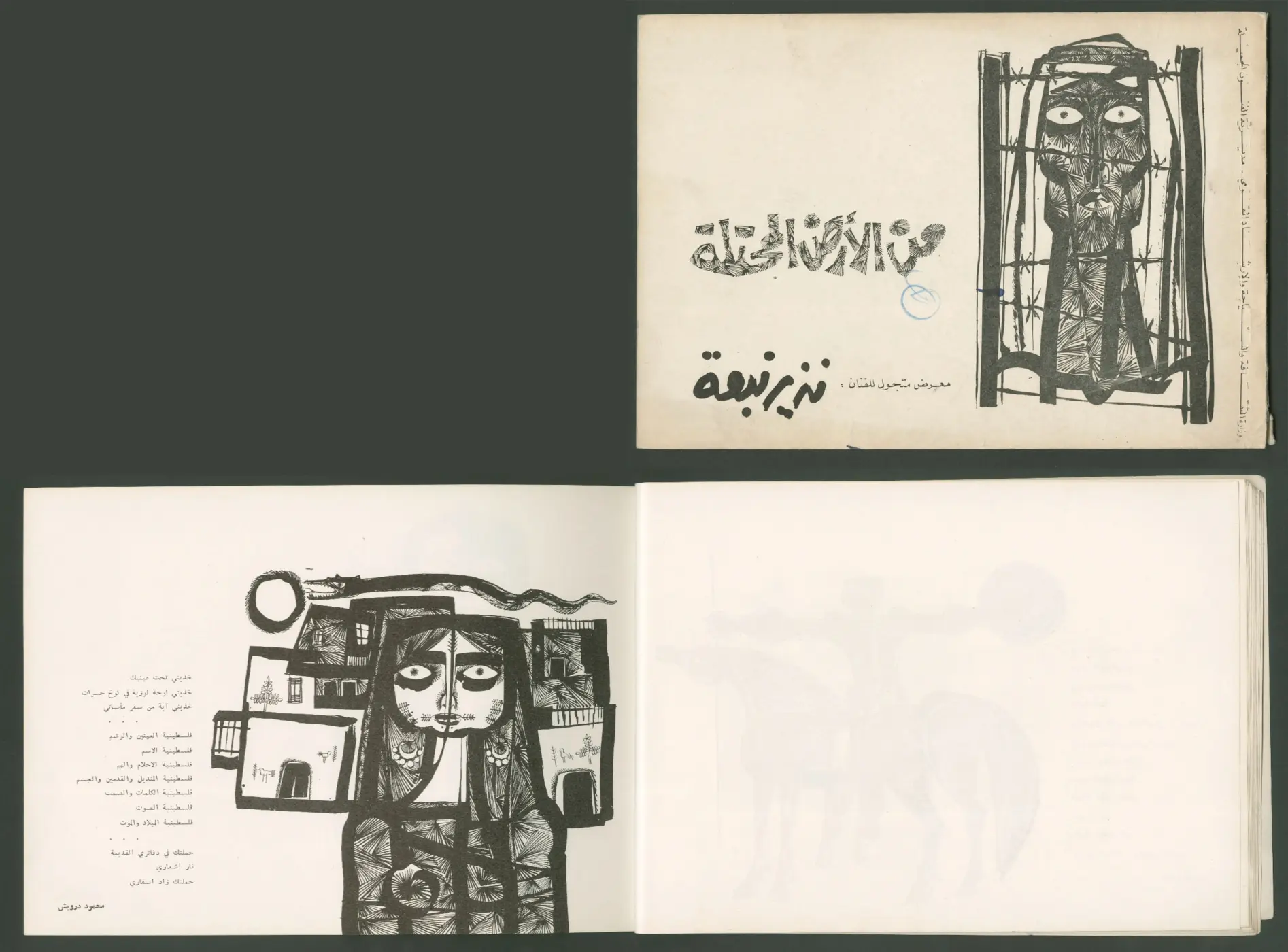
Azzawi, Boullata, Nabaa, and Saudi, among other contemporaries, creatively explored the book as a form through which to bear witness to the violence of their times. In doing so, they blurred the boundaries between art, graphic design, and illustration. This liminality is indicative of the experimental fervour that marked the convergence of aesthetics and politics in this period. Mass-produced and issued by state or independent political publishers, these books were widely available in libraries and sold at very low prices in bookstores. They belong to a radically different order from the artists’ book traditions associated with the French livre d’artiste, with its limited, deluxe editions, as well as from the niche independent art press of the 1960s and 70s.
As artists of this generation strove to revolutionize and democratize art’s place within Arab societies, they expanded the purview of their art to the circulatory power of books. This politicization took place not only at the level of artistic medium, content and form, but also, and no less, in terms of a radical conception of the role of the artist in society. While the above-mentioned artists maintained a hyphenated art and graphic design practice in their early careers, others, such as Helmi el-Touni (1934–2024) and Mohieddine Ellabbad (1940–2010), embraced graphic design as a directly political alternative, working for the Arabic press and radical political publishers between Cairo and Beirut. Their successful careers in book design and illustration contributed to the consolidation of graphic design as a professional practice in the Arab world.
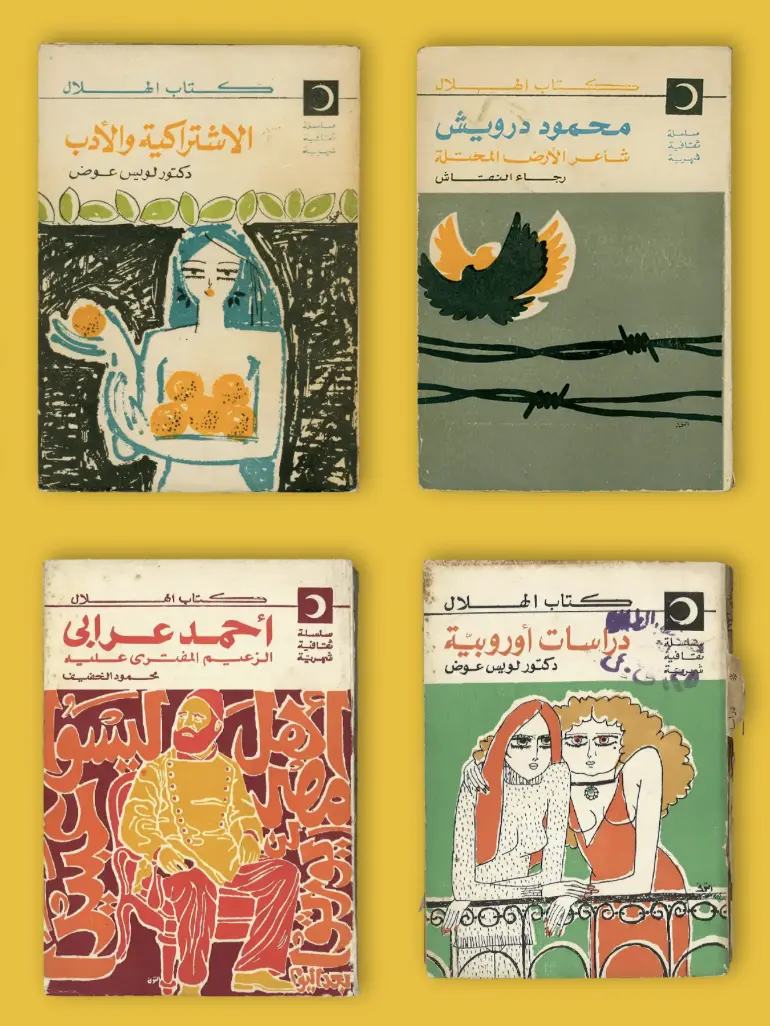
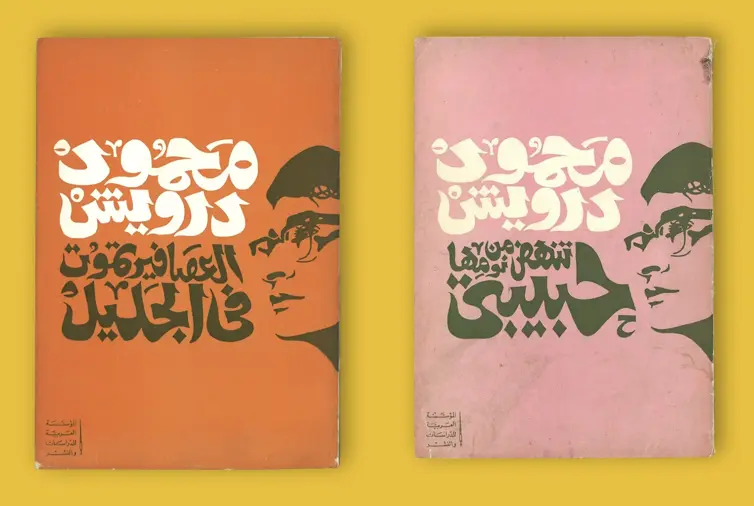
In 1963, early in his career, Touni was appointed as in-house art-director of Dar al-Hilal—Egypt’s most prominent publishing establishment since the late 19th century Nahda, which had been nationalized as part of the postcolonial Arab Socialist policy of President Gamal Abdel Nasser (Figs 7–10). A decade later, Touni and many of his socialist Egyptian contemporaries were not spared the crackdown on the press under the new president Anwar al-Sadat. He relocated to Beirut in 1974 for close to ten years and took on a similar role at the Arab Institute for Publishing, an independent publishing house founded in 1969 by the Palestinian intellectual and political activist Abdul Wahhab Kayyali (Figs 11 and 12).20 Indeed, with increasing authoritarianism in neighbouring Arab states, and with the establishment of the PLO’s various media and publishing institutions in Beirut, the city became ‘the publishing capital of dissident groups’.21 Reflecting on his career choice, Touni noted that ‘We are a generation of mediators, our role is to present an artistic culture through print’.22 ‘Without a public, art is effectively meaningless’ he boldly stated to his interviewer in 1978, while explaining that he prioritized books for their wider public reach and potential to cultivate aesthetic sensibilities.23 He maintained the view that, just as modern poetry and literature have been democratized through the mass production of books, the reproduction of art in print needs to substitute for painting’s bourgeois value as a privately owned original piece. Criticising artists for still upholding dated forms of patronage and private ownership, he astutely asked: ‘Would a writer agree to have his manuscript bought by one person, to be lavishly bound and kept for his sole pleasure, and perhaps that of his guests at dinner?’24
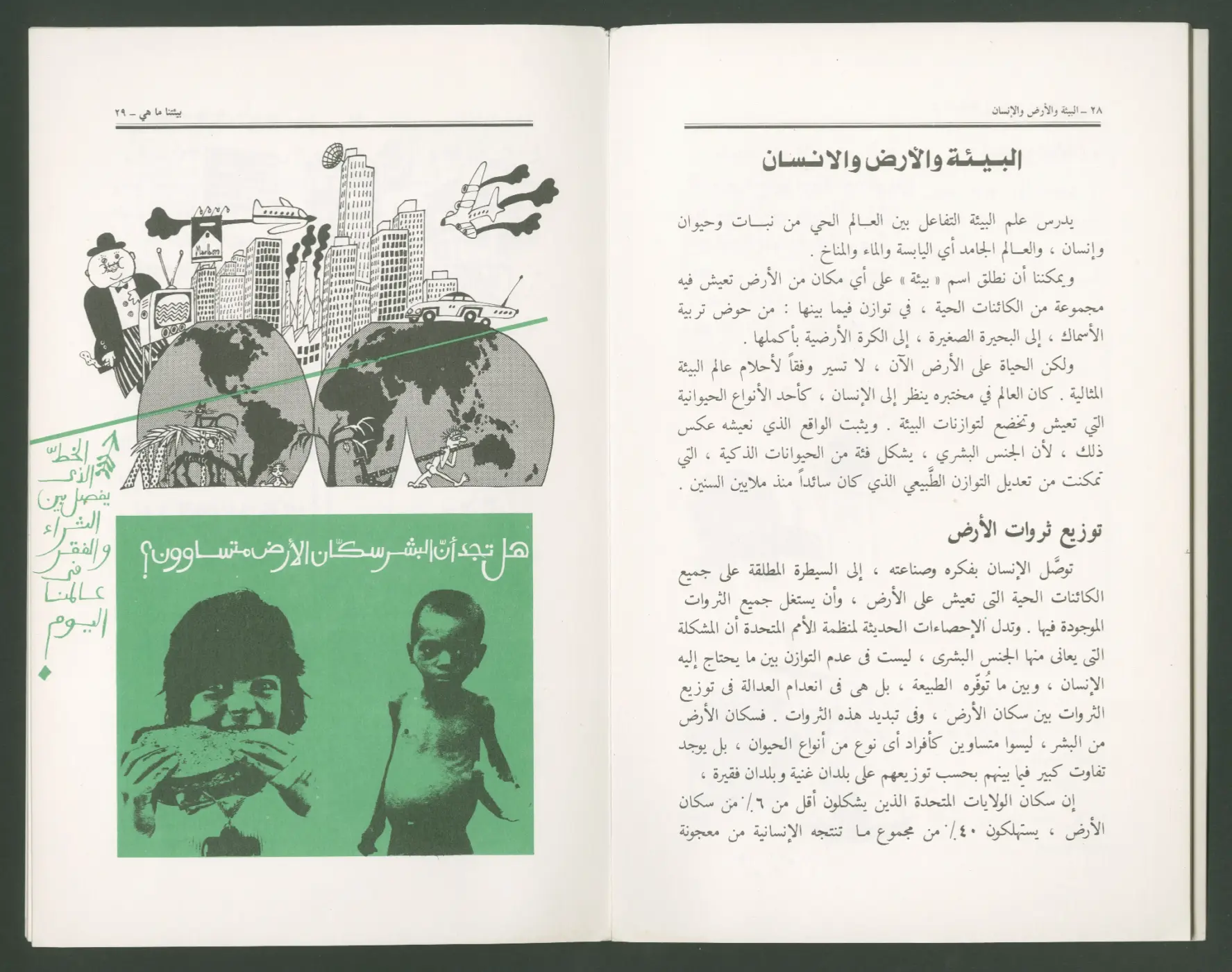
Ellabbad identified himself professionally as a ‘book-maker’, driven by the political conviction that ‘what powerfully marks our conscience and shapes our cultural destiny is not only the ‘great’ artworks, but the whole of everyday visual culture’.25 Building on the work of Kamal Boullata, he became art director of Dar al-Fata al-Arabi in Beirut (1974–1976), where his anticolonial aesthetic practice took shape. He subsequently established a graphic design studio in Cairo, the Arab Graphic Centre, along with an affiliated workshop dedicated to children’s books (al-warsha al-tajribiyya al-‘arabiyya li kutub al-atfal).26 Ellabbad dedicated his career trying to ‘unlearn’ his extensive education in Western art methods and history, re-educating himself in what he asserts ‘should have been taught instead about Egyptian and Arab Art’.27 His numerous publications testify to his search for alternative epistemologies of graphic design and visual culture. Crucially, they also put into practice his pedagogical commitment to sharing his ‘unlearning’ with future generations.
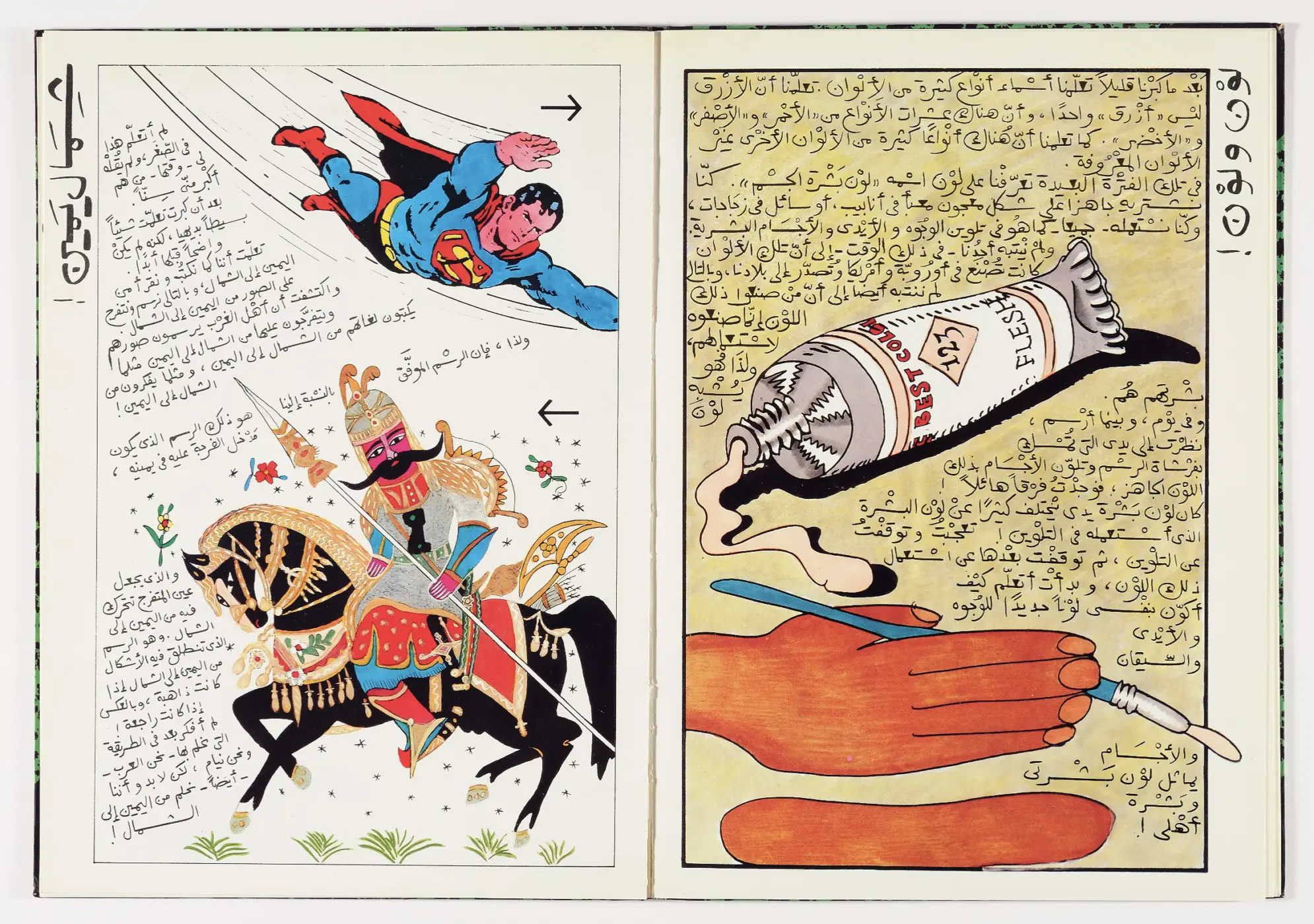
In Kashkul al-Rassam (The Illustrator’s Sketchbook), one of his self-authored illustrated publications, Ellabbad elaborates what this unlearning entailed both in theory and in practice (Fig. 14).28 The autobiographical narrative dwells on his experimentations in forging a visual culture that is grounded in the child’s everyday reality – yet all the while catering to her imaginative desires. Thus he relates how he came to realize that the colour paint tube imported from Europe with the label ‘flesh’, with which he learnt to paint his human figures, did not match the skin colour of his own hands. He likewise reflects on the constitutive differences between reading from left to right (Latin scripts) and right to left in Arabic. ‘We probably also dream from right to left?’ he wonders. He is concerned with how this affects the way the reader’s eye moves on the page, and in consequence how elements on the page should be laid out to express the dynamic action of an illustrated character. For instance, he asks, should that character enter the page from the right or the left to imply swiftness? Here Ellabbad decolonizes for his young readers the universal claims of modernism—the undifferentiated aesthetic theories and principles of visual perception canonized in books, such as Gyorgy Kepes’ Language of Vision (1944) and Rudolph Arnheim’s Art and Visual Perception (1944), which were central to postwar modern art and design pedagogies. He demonstrates how these hegemonic aesthetic principles of visual form, professed to express universal emotions and values, are founded on European particularism. Ellabbad thus questions the Eurocentric foundations of modernist graphic design avant la lettre, before this kind of critique takes its toll in postmodern discourses on design education, especially in US academia in the 1990s.29
In his essay ‘Beautiful Traditions in Arabic Books’, Ellabbad calls for a renewed engagement with the aesthetic traditions of the Arabic book. He advocates recovering the craft of bookmaking through research into its forgotten techniques and abandoned tools, while simultaneously embracing modern technologies capable of carrying these traditions forward in an innovative spirit.30
Ellabbad and Touni, together with the other artists mentioned above, are only illustrative examples—albeit leading figures—of a generation of Arab artist-graphic designers who reshaped the visual culture of the Arabic book. As I have argued elsewhere,31 and as this exhibition demonstrates, their turn to book arts reveals cultural histories of decolonization that deepen our understanding of both its possibilities and its unfinished struggles. In doing so, they open onto an alternative genealogy of graphic design, locating its emergence in the Arab world not in the service of advertising, but at the convergence of anticolonial activism, artistic experimentation, and a flourishing publishing culture.
To borrow Steven Heller’s own words against his argument, ‘it is time for graphic design historians, and designers generally, to remove the elitist prejudices that have perpetuated a biased history’. The prejudice at stake, however, is not the distinction between graphic design and advertising that he identifies, but rather, the Western-centric assumptions and capitalist ideology within which his historical genealogy is situated. The problem, then, is not simply one of correcting the historical record by adding overlooked examples to diversify the canon. The problem is epistemological: historical narratives of emergence constitute the field itself, shaping what counts as graphic design and institutionalizing the discourse through which its practice and education are understood. Attending to alternative points of emergence does not replace one origin story with another; rather, it transforms our understanding of graphic design.
Zeina Maasri (University of Bristol) is researcher and curator of Decolonizing the Page. She is the author of the award-winning Cosmopolitan Radicalism: The Visual Politics of Beirut’s Global Sixties (Cambridge University Press, 2020) and Off the Wall: Political Posters of the Lebanese Civil War (2009), and co-editor of Transnational Solidarity: Anticolonialism in the Global Sixties (2022).
- Steven Heller, ‘Advertising: Mother of Graphic Design’ first published in Eye no. 17 vol. 5, 1995. ↩︎
- This appellation appears in both academic and popular discussions. See, for example, Nada Shabout, ‘A Dialogue with Modernism’, in Dia al-Azzawi: A Retrospective from 1963 until Tomorrow (Doha: Mathaf: Arab Museum of Modern Art; Milan: Silvana Editoriale, 2017), 18–29; and Elisabeth Kendall, Literature, Journalism and the Avant-Garde: Intersection in Egypt (London: Routledge, 2006). ↩︎
- The ‘long sixties’ refers not to a single decade but to an extended period of transnational activism. Beginning with anticolonial liberation movements in the mid-1950s, it culminated in the global uprisings of 1968 and continued along a radical trajectory well into the 1970s. See Zeina Maasri, Cathy Bergin, and Francesca Burke, eds., Transnational Solidarity: Anticolonialism in the Global Sixties (Manchester: Manchester University Press, 2022), 1–27; and Zeina Maasri, Cosmopolitan Radicalism: The Visual Politics of Beirut’s Global Sixties (Cambridge: Cambridge University Press, 2020), 1–18. ↩︎
- Post-independence Arab states had not only failed to fulfil their promise of reclaiming the Palestinian territories lost with the establishment of Israel in 1948, but in the space of just six days, further Arab territories—the Sinai Peninsula in Egypt, the Golan Heights in Syria, and the West Bank in Jordan—fell under Israeli occupation. The war also triggered a new wave of Palestinian displacement, compounding the refugee crisis that had begun in 1948. ↩︎
- Yezid Sayigh, Armed Struggle and the Search for State: The Palestinian National Movement, 1949–1993 (Oxford: Oxford University Press, 1997). ↩︎
- Sorcha Thomson and Pelle Valentin Olsen, eds., Palestine in the World: International Solidarity with the Palestinian Liberation Movement (London: I.B. Tauris, 2023). ↩︎
- See Maasri, Cosmopolitan Radicalism, chap. 5. ↩︎
- Kamal Boullata, ‘Nahwa Fan ʿArabi Thawri’ (‘Towards a Revolutionary Arab Art’), Mawaqif 2, no. 9 (May–June 1970): 26–44, my translation, 41–42. ↩︎
- Mona Saudi, ‘From Dreams to Achievements: A Jordanian Artist in the Era of 1968’, in Anneka Lenssen, Sarah A. Rogers, and Nada M. Shabout, eds., Modern Art in the Arab World: Primary Documents (New York: The Museum of Modern Art in association with Duke University Press, 2018). See also Mona Saudi, video interview by Wafa Roz, Dalloul Art Foundation, 2022, video interview (Dalloul Art Foundation), and Mysa Kafil-Hussain, ‘Biography of Mona Saudi’, Dalloul Art Foundation, accessed December 11, 2024. ↩︎
- The structural violence and dispossession Palestinians have suffered since 1948 has been amply documented. See, for instance, Omar Jabary Salamanca, Mezna Qato, Kareem Rabie, and Sobhi Samour, eds., ‘Past is Present: Settler Colonialism in Palestine’, Settler Colonial Studies 2, no. 1 (2012); Rashid Khalidi, The Hundred Years’ War on Palestine: A History of Settler Colonialism and Resistance, 1917–2017 (New York: Metropolitan Books, 2020); and Ilan Pappé, The Ethnic Cleansing of Palestine (London: Oneworld, 2006). ↩︎
- Vladimir Tamari had been working on his modern Arabic typeface al-Quds, designed to simplify reading and writing Arabic for children, before collaborating with Saudi on her book. He was inspired by children’s handwriting during field research at UNRWA schools for Palestinian refugee children. As the typeface had not yet been produced, Tamari hand-lettered the entire book. See Kamal Boullata, ‘Vladimir Tamari: Beginnings and the Unwavering Pursuit of a Dream’, in There Where You Are Not: Selected Writings of Kamal Boullata, ed. Finbarr Barry Flood (Munich: Hirmer, 2019), 144–50, 145. ↩︎
- Saudi, ‘From Dreams to Achievements’, 322. ↩︎
- For an English translation of this manifesto, see Lenssen, Rogers, and Shabout, eds., Modern Art in the Arab World, 306–09. ↩︎
- For more insight on Azzawi’s graphic design, see Dia al-Azzawi, ‘Personal Reflection: Graphic Design and the Visual Arts in Iraq’, in Modern Art in the Arab World, 370–71; Maasri, Cosmopolitan Radicalism, 198–206; and Lina Hakim, Dia Al-Azzawi: Taking a Stand: Activism through Graphic Design (Amsterdam: Khatt Books, 2017). ↩︎
- Boullata, ‘Children’s Joy and Dying in the Homeland’, in There Where You Are Not, 60–82, 62. ↩︎
- Maasri, Cosmopolitan Radicalism, 235–24. ↩︎
- Boullata, ‘Art in the Time of the Palestinian Revolution’, in There Where You Are Not, 170–75, 172. ↩︎
- Ghazi al-Khalidi, Burhan Karkutli: Fannan al-ghurba wal-hirman (Burhan Karkutli: The Artist of Exile and Deprivation) (Damascus: Ministry of Culture, Syrian Arab Republic, 2004), 194–95. ↩︎
- Johanna Drucker, The Century of Artists’ Books (New York: Granary Books, 1995), 88. ↩︎
- Maasri, Cosmopolitan Radicalism, ch. 4. ↩︎
- George N. Atiyeh, ‘The Book in the Modern Arab World: The Cases of Lebanon and Egypt’, in The Book in the Islamic World: The Written Word and Communication in the Middle East, ed. George N. Atiyeh (Albany: State University of New York Press, 1995), 233–53, 243. ↩︎
- Helmi el-Touni, interviewed by Majida Sabra, ‘al-Juwʿ wa-l-Taʿtir la Yuntijan Fannan’, Al-Shiraʿ, 1 August 1983, 58–61, 60. ↩︎
- Helmi el-Touni, interviewed in al-Hawadith, 31 March 1978, 82. ↩︎
- Ibid. ↩︎
- Mohieddine Ellabbad, ‘Tufulat al-thakira al-bassariyya: Interview’ (The Childhood of Visual Memory), Alif: Journal of Comparative Poetics, no. 27 (2007), 82–104, at 83 (my translation). ↩︎
- For more insight on Ellabbad in English, see Maasri, Cosmopolitan Radicalism, chs. 4 and 6; Moe Elhossieny, ‘Into the Feline’s Den: A Journey Through Mohieddine Ellabbad’s Wondrous World of Animals’ and ‘The Folk Fighter: Fiercely Decolonial’, n.d., Arabic Design Archive (accessed 1 November 2024). ↩︎
- Ellabbad, ‘Tufulat al-thakira al-bassariyya’, 85. ↩︎
- Parts of the following discussion of Kashkul al-Rassam are adapted from my earlier account in Cosmopolitan Radicalism, chap. 6, 231–35. ↩︎
- See for instance, Ellen Lupton and J. Abbott Miller, Design Writing Research: Writing on Graphic Design (New York: Phaidon Press, 1999). ↩︎
- For a longer discussion of this essay, see Zeina Maasri, ‘Book Arts as Archives of Decolonization: The Design and Visuality of Arabic Books (1950s–1980s)’, Journal of Design History 39, no. 1 (2026): 70–88. ↩︎
- Maasri, ‘Book Arts as Archives of Decolonization'. ↩︎