How do we decolonize studies of the Arabic book today?
Foreword by Hala Auji
11.06.2026
Books are often treated as containers of text, as objects to be read primarily through their words. Yet books are also forms that we handle, navigate, and experience through touch, movement, and sight. Their size, weight, layout, binding, and typography shape how meaning is encountered, not just how it is conveyed. Across the fields of art history, design, and visual culture, this broader understanding of the book is now widely acknowledged, with studies increasingly attending to books’ visual and material dimensions, especially within North Atlantic traditions.1 While, in other contexts, manuscript traditions have long foregrounded the relationships between calligraphy, image, and form, mass-produced works and everyday print have only more recently been taken seriously as sites of material and visual inquiry. This exhibition is one key contribution to furthering these aims.2
The question is no longer whether books’ visual and material dimensions are as important as their textual content, but rather how we attend to them, and whose modes of reading and making have been centred in that attention. It is also about what books offer their users, not only as readers, but also as people who engage them beyond standard reading practices. For those who have worked closely with books, whether in classrooms, archives, or collections, it becomes clear that looking alone is not enough. A book is not fully grasped through a two-dimensional reproduction. It unfolds through use. It is held, turned, and navigated. It is encountered over time. Reading is an experience of multiple, mutable facets, many of which cannot be captured through photographs, scans, slides, descriptions, or glass displays—challenges that museums, libraries, and collections have long grappled with.
To “decolonize the page” and, by extension, “the Arabic book” is therefore not simply to recover overlooked histories or to add new examples to an existing canon. It requires a shift in how we engage the book itself. It asks us to reconsider what counts as reading, what counts as design, and how different traditions have understood the relationship between text, image, and form. This shift in perspective is especially important when approaching Arabic books of the mid-twentieth century. Produced in a period often described as “postcolonial” these works emerged within newly independent states that nonetheless inherited the infrastructures, visual conventions, and cultural hierarchies of colonial modernity. The artists and designers represented in this exhibition did not simply adopt modern forms. They actively reworked them, drawing on long-standing practices of calligraphy, manuscript production, and visual composition to reshape what a modern book could be.
Studying the Arabic book today cannot be separated from the conditions under which it is produced and read, amid ongoing violence, displacement, and struggle across the region. In this context, experimental book arts have long challenged the boundaries of the codex, producing works that disrupt format, sequence, material, and legibility.3 To locate innovation only in such departures from “traditional” constructs of the book, however, risks narrowing our understanding of what it means to transform the book. Not all challenges to the page take the form of rupture. In many cases, they unfold within the very structures of the codex itself. Arabic books of the 1950s–1980s, including those produced through commercial presses, offer a different kind of intervention. Through typography, layout, illustration, and the integration of calligraphic traditions, they reconfigure how readers move through and make sense of the page. We must also consider how these logics were shaped through earlier encounters between manuscript traditions and print technologies. The transformations that took place from script to print were not just technical shifts; they also reconfigured how books were produced, circulated, and experienced, all the while carrying forward older practices in ways that are not always immediately visible. To decolonize the book, then, is not only to celebrate works that break its form, but also to attend to those that quietly reshape its visual and material logic from within.
Reading as a Site of Translation from Script to Print
Early studies of the Arabic book have long emphasized the centrality of the manuscript and the role of calligraphy in shaping its form. Yet the introduction of Arabic printing, in Europe in the sixteenth century and in the wider Ottoman and Asian spheres in the eighteenth century, did not simply replace these traditions. From the outset, and well into the late 1800s, printed forms such as broadsheets, pamphlets, newspapers, and postcards coexisted with, and often drew on, earlier practices of writing and image-making. While these later formats were produced through new, machine-based technologies, traces of earlier scribal practices persisted, even if they were no longer visibly tied to the hand of the maker. Unlike manuscripts, where colophons and scribal practices often made visible a chain of authorship and authority, mediated through scribes, workshop directors, and/or overseeing scholars, print introduced a different form of mediation, one in which labour became less visible and authorship more diffuse. This marks a broader shift, from hand to system, that continues to shape how we understand production, authorship, and design today.
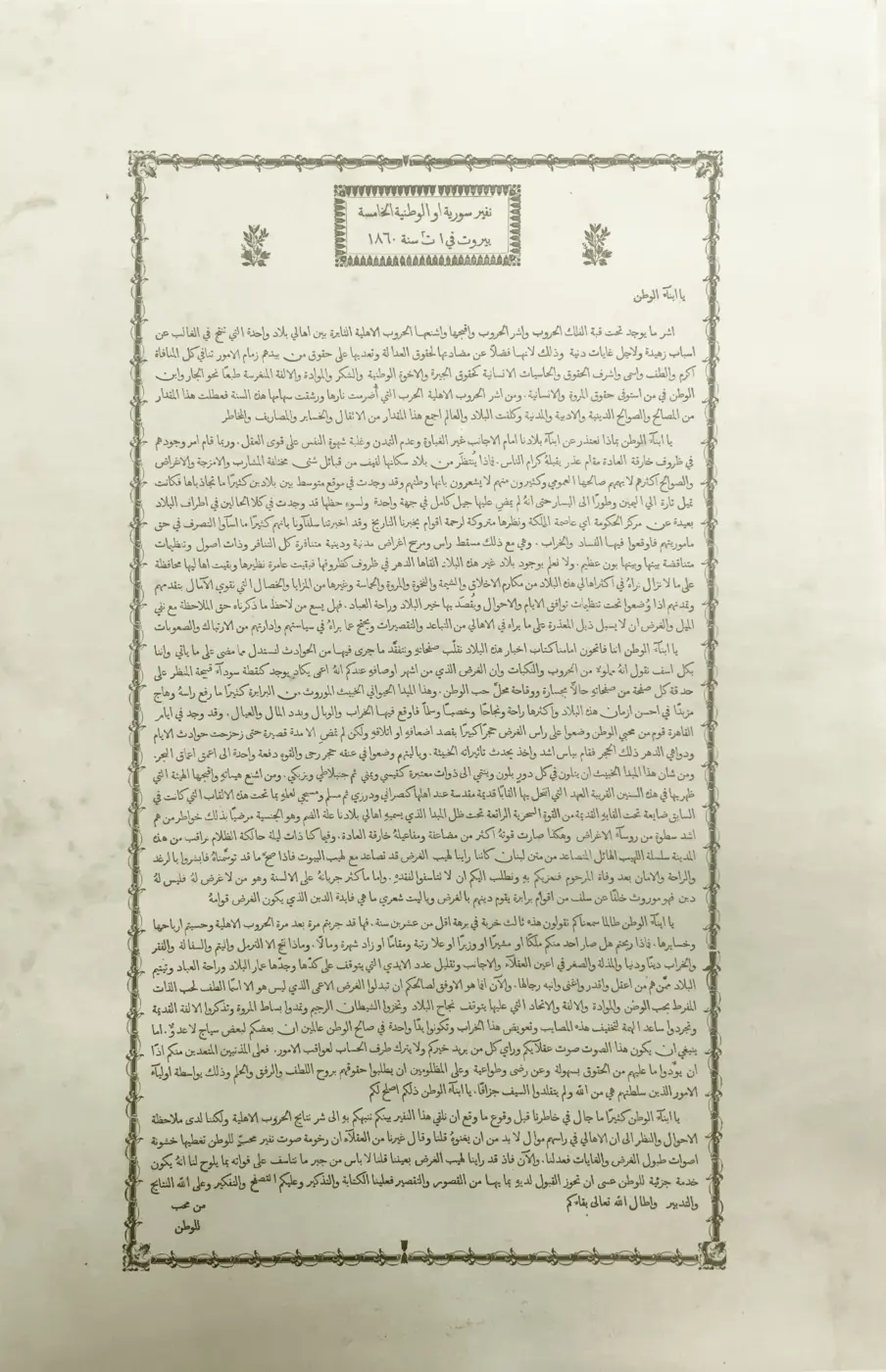
Politics and social situations almost always served as some sort of impetus for the kinds of change we find in printed works, both in their materiality and in their content. For example, the nineteenth-century Syrian intellectual Butrus al-Bustani (1819–1883), writing within the Ottoman imperial context, adopted the broadside, a relatively new and unfamiliar format in Beirut, for his anonymous series of circulars Nafir Suriyya (Clarion of Syria), produced in 1860 (Fig. 1). He had previously used this format for his Arabic translation of the Ottoman Reform Edict of 1856, issued as part of the Ottoman Tanzimat reforms (literally, “reorganizations”, 1839–1876). In Nafir Suriyya, however, the broadside served as a call for Ottoman-Arab patriotism and coexistence in response to intercommunal conflicts in Mount Lebanon in 1860. The use of this format can therefore be understood as an overtly political intervention whose implications may nonetheless have escaped Ottoman censorship at a time when such positions were difficult to articulate within the Ottoman public sphere.4

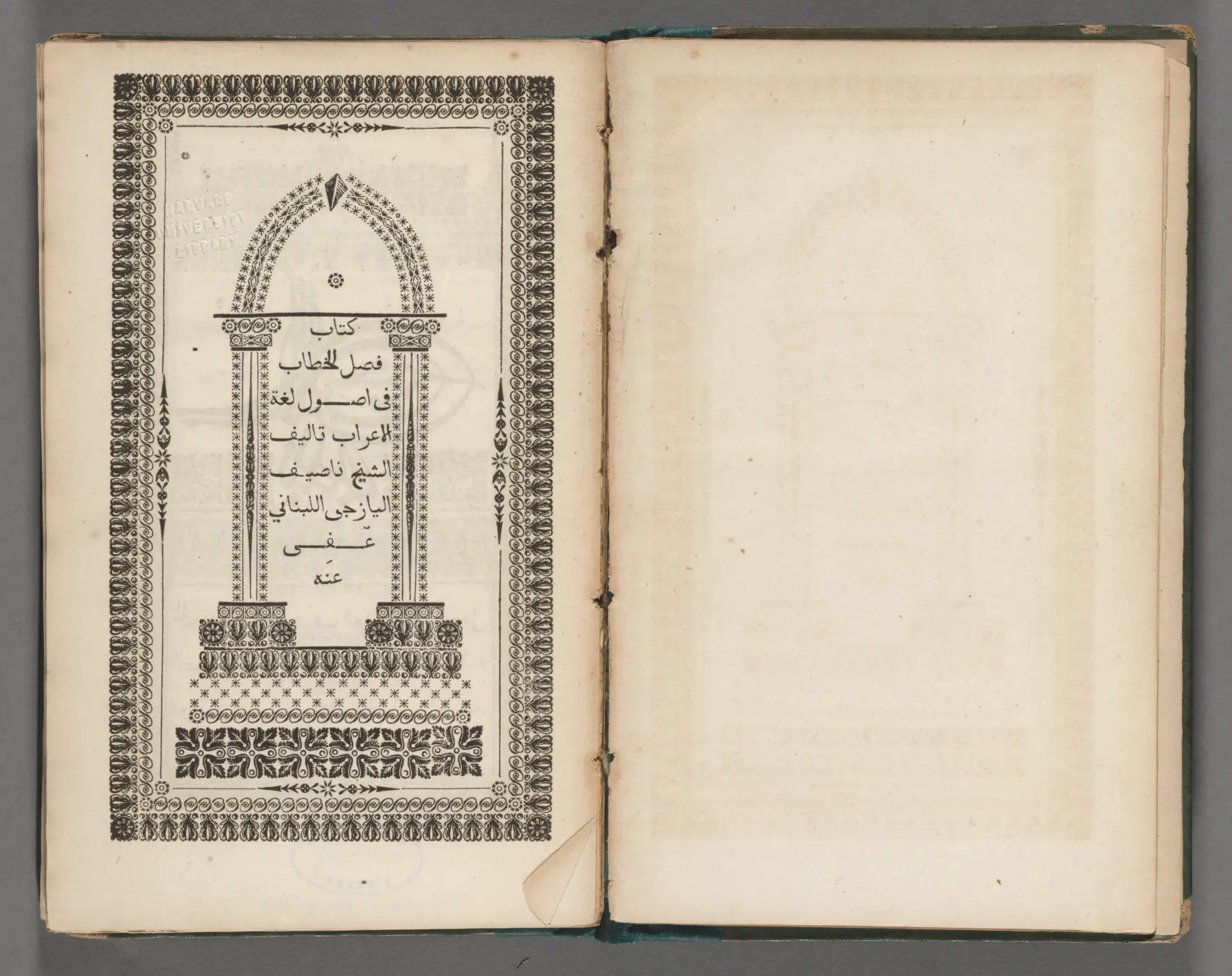
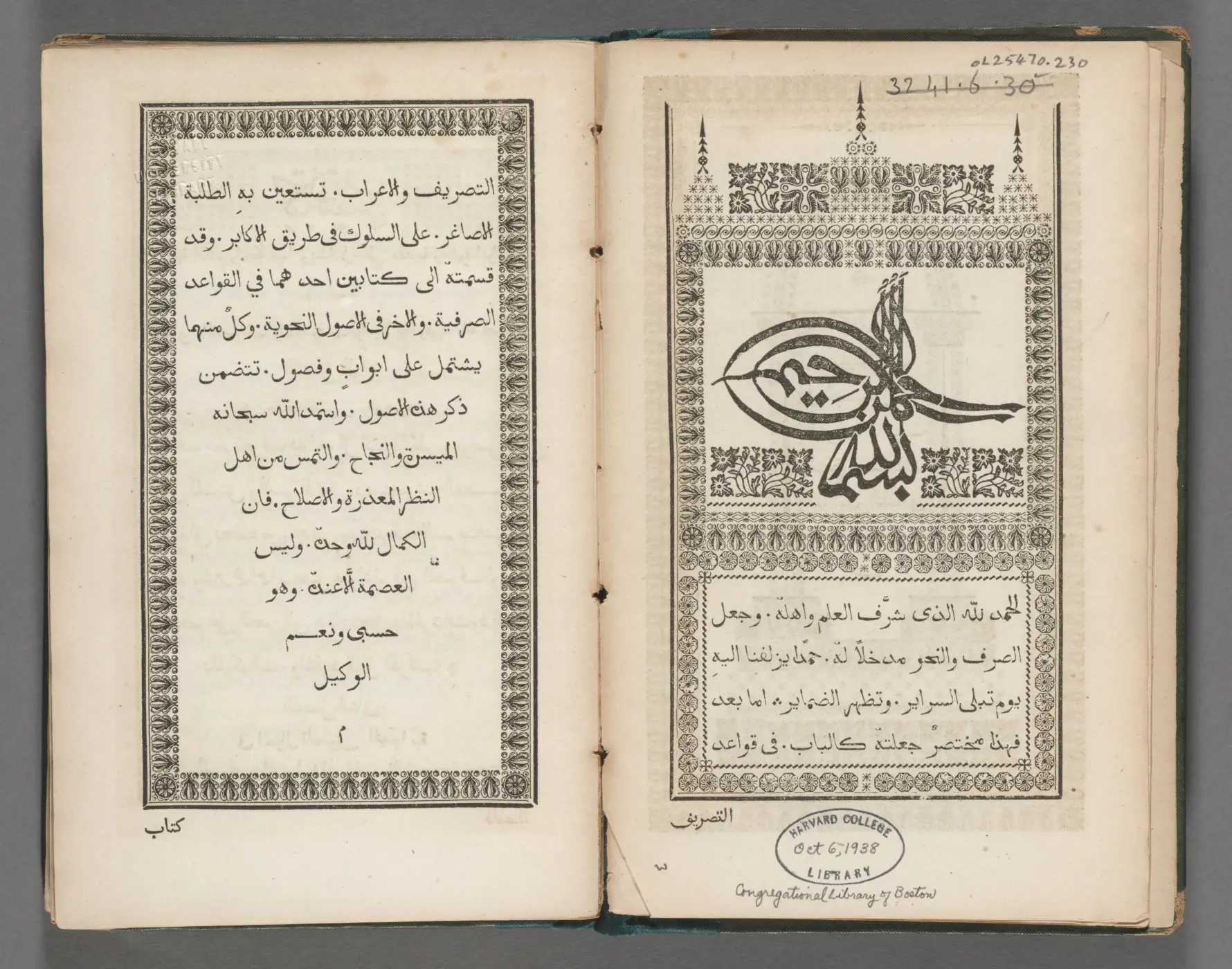
A less overtly political example appears in a seemingly simple and innocuous “Discourse on the Rules of Arabic Grammar” by another Syrian Beiruti scholar Nasif al-Yaziji (1800–1871). This work uses arches, elaborate ornamental opening pages, crownpieces, and even the calligraphic tughra, an official signature form typically associated with the Ottoman sultan and courtly calligraphic practice. These visual devices both assert al-Yaziji’s authorial presence and make visible a broader shift at the time in the conditions of textual production (Figs. 2, 3). Scholars like al-Yaziji, trained within the manuscript tradition, increasingly found themselves working as correctors at newly established commercial presses, translating their philological, linguistic, and scribal expertise into a domain for which they had not originally been trained. This example captures that transition as it unfolded, with typographic and ornamental forms used to evoke the decorative opening pages of illuminated manuscripts.5
Al-Yaziji’s work exemplifies a broader transformation in the practices and circumstances of print production during this period. Early press directors, authors, translators, editors, and related printing specialists, at a time when “designer” was not yet a profession, were not only translating between manuscript conventions and emerging printing technologies, and between calligraphic and typographic systems, but were also participating in the gradual movement of book production from the domain of elite manuscript culture towards wider forms of circulation. Even at this early stage, design was not decoration. It was where epistemic translation was happening, in the sense that decisions about layout, typography, visual hierarchy, cover design, and related aesthetic conventions shaped how texts were segmented, how words were positioned on the page, and how information was arranged hierarchically through variations in type weight and size. All these choices directly impacted how content was read and understood. Book historian Johanna Drucker refers to this kind of visual rhetoric as “diagrammatic writing”6. In this way, knowledge itself was being organized and made legible in new visual and material ways to expanding reading publics.
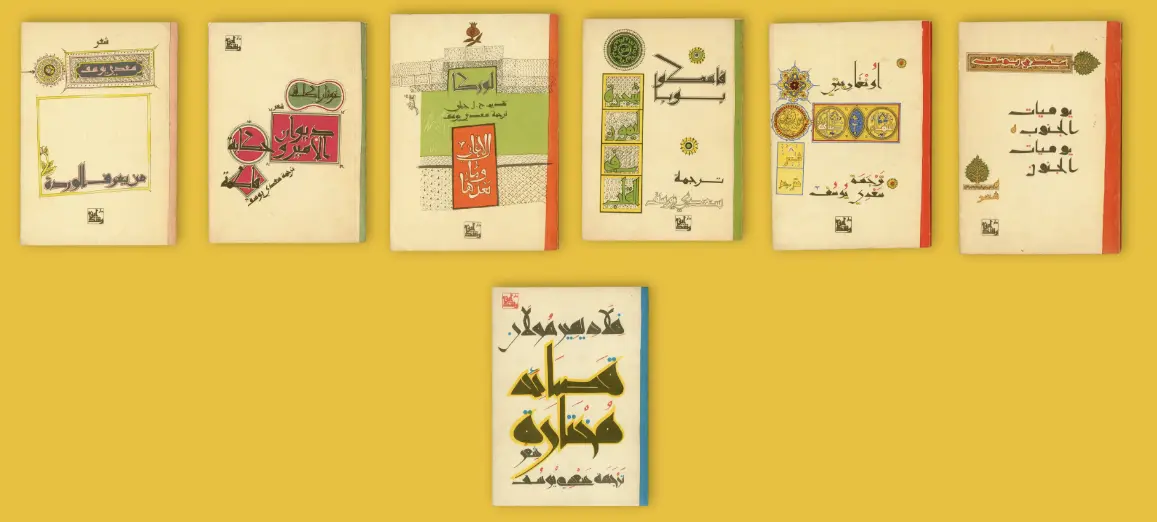
This becomes even more apparent in more recent books, like Mohieddine Ellabbad’s covers for a poetry series published by Beirut’s Dar Ibn Rushd, with works both written or translated into Arabic by Saadi Youssef (Figs 4–11). What is notable across these seven works, published in 1981, is the way each cover design emulates various elements prevalent in Qur’an manuscripts produced between the late tenth and twelfth centuries in Iran and the eastern Islamic regions of Khurasan and Central Asia. Such manuscripts often utilized a distinctive kind of kufi (Kufic) script referred to as “eastern” or “new style” kufi.7 The motifs on these covers single out bits and pieces of these works, at times using cartouche boxes and palmettes for a work’s title or author’s name, and in other instances medallions that had specific meanings in some Qur’ans from this period. On these covers, they become signifiers of an older aesthetic and set of rules that have been dislocated, even stripped of their previous functions. Seen together as a group, the manuscript elements on these covers appear at once familiar to those versed in Qur’an or Arabic manuscript history while simultaneously taking on a completely new set of meanings, particularly when the words being read are non-Arabic names of authors. Thus, here too we see the ways in which scribal conventions are translated into print; yet in these cases they serve new aesthetic purposes by selectively citing and reworking older traditions, imbuing them with new contexts and forms, and disrupting our understanding of scribal continuity and its uses in contemporary settings.
Reading Practices and the Body
In Arabic books, as with other scripts, the act of reading involves a particular orientation of the body and the page. The movement from right to left, the placement of images, and the density of text all shape how attention is directed and sustained. These features make especially visible something that is true more broadly: visual elements do not simply illustrate the text; they interrupt, redirect, and sometimes slow the reader down, producing pauses and shifts in rhythm. When we read, we do so with all our senses and our body, even if we are not always aware of this. Reading a physical book, or even one online, requires multiple senses working in tandem. Where one sense is limited, others come into play. This is especially the case with accessibility features that are becoming more prevalent in classrooms and electronic reading platforms. Hearing, or aurality, plays as important a role as looking. Touching and turning pages, or typing, clicking, and listening to the disembodied voice of an absent narrator, are all part of the experience of reading, yet we rarely stop to consider what that means or how what appears on the page or screen is transformed. Images are encountered differently across media, and in reading we are also trying to make sense of what we are seeing: the text in relation to the image, the margins, the ornaments, and other lines or marks on the page or screen. Pacing is often determined by density and spacing; without necessarily realizing it, these design features inform our rhythm of reading. At this most basic level, we can grasp how reading is a physical, temporal, and affective experience.
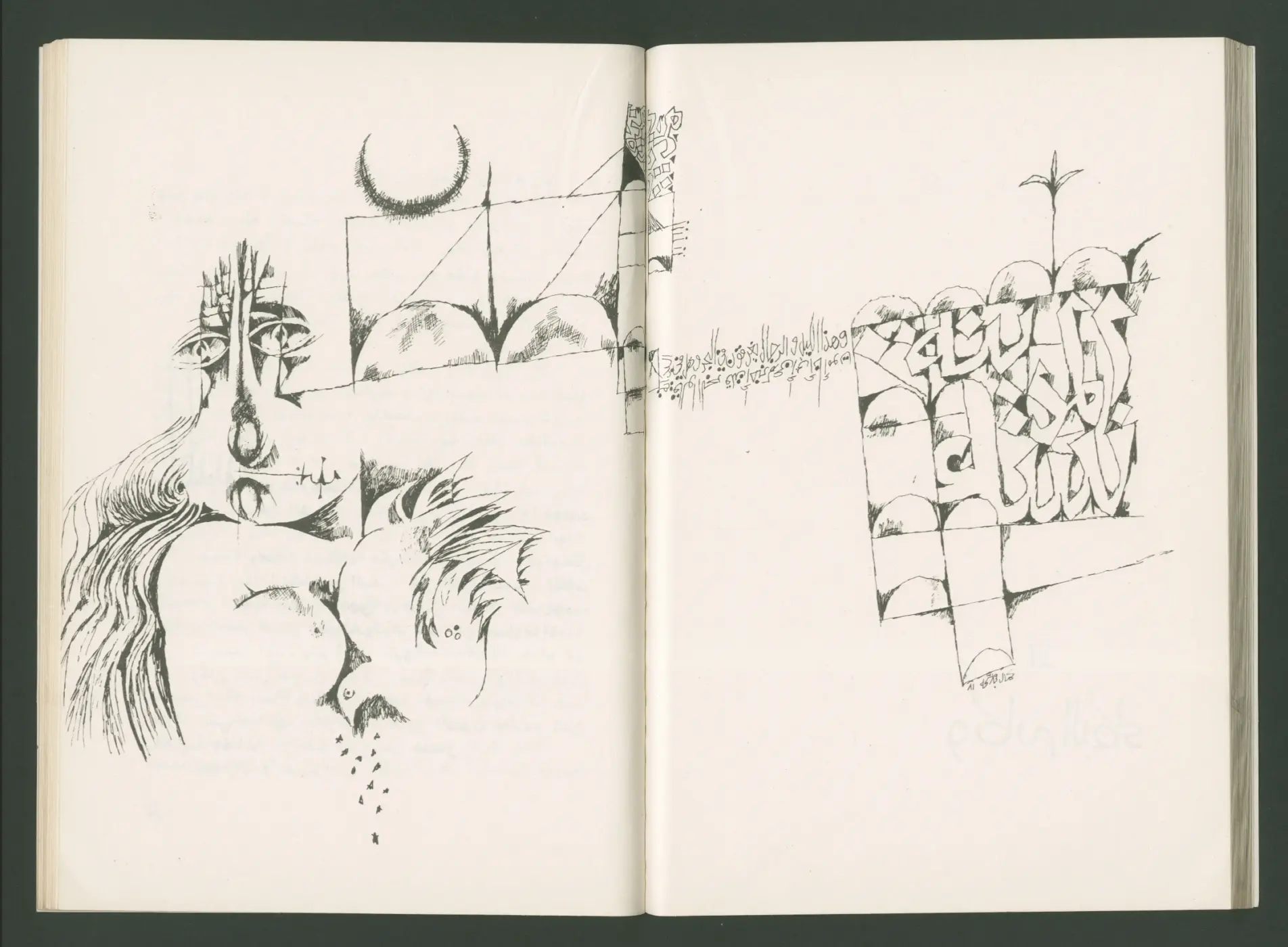
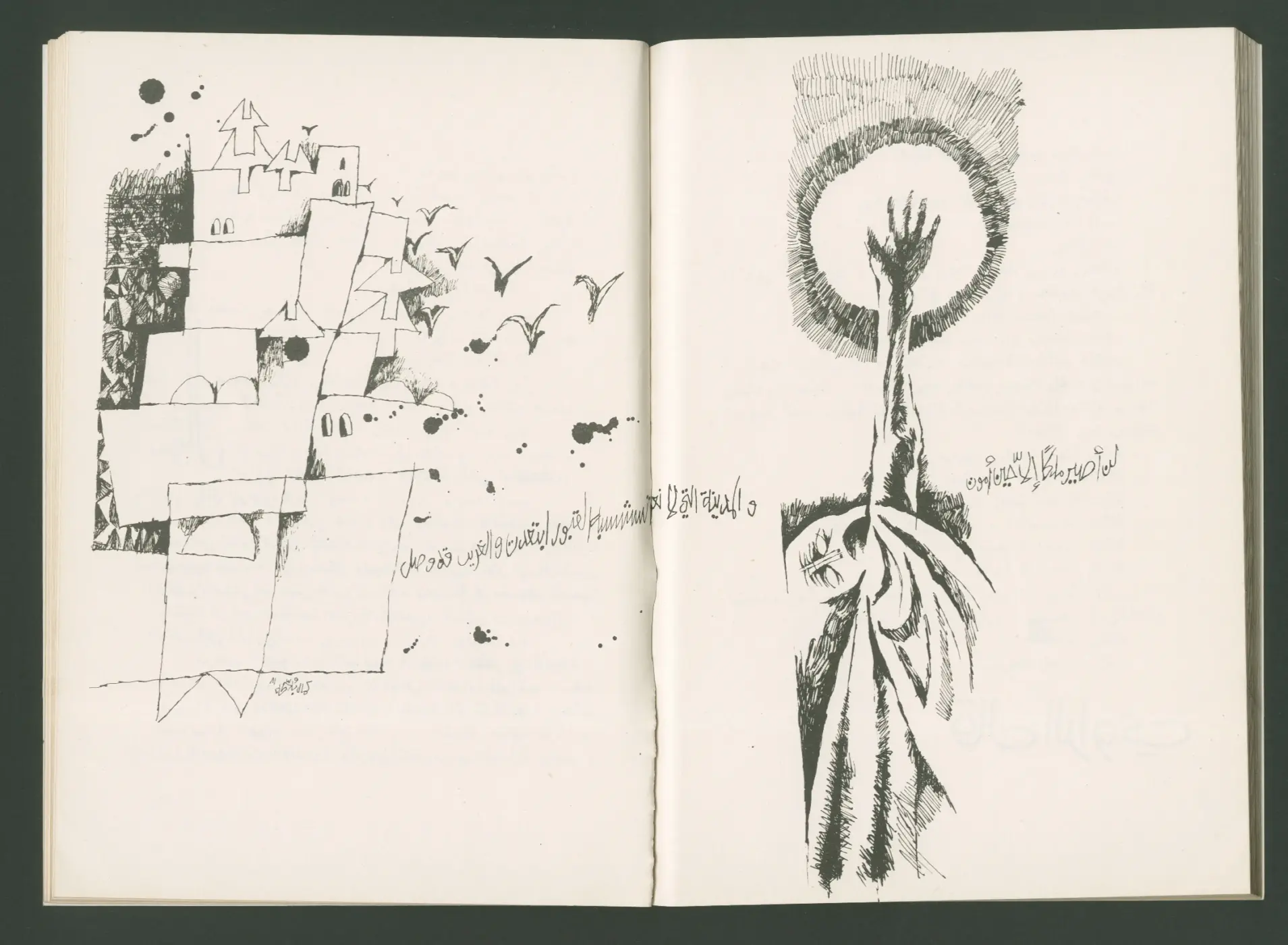
This becomes even more evident when thinking about different book forms and formats, and when considering how little or how much visuals expand on a page: do they disrupt the text, transform the invisible grid, make us look in different directions, pause, or turn the pages around? Kamal Boullata’s illustrations for Elias Khoury’s Abwab al-Madina (1981) visually read like a meandering of shapes, congregating on some pages and stretching into a movable procession across spreads on others; cross-hatched lines take shape, forming the shadows and contours of Arabic letters and scripts in some places, and the lines of dysmorphic female body parts in others (Figs 12, 13). The bodily experience here is both literal and figurative, asking the reader to straddle the boundaries of the mental void and disconnection between these different elements, which at times resemble architectural forms and at others appear to disintegrate into misshapen emblems of doves, olive branches, and human figures. Where the text ends and where the illustrations take over is a connection that needs to be grasped in the process of moving concurrently through the visual, the spatial, and the literal. Spatiality here, through the architectural shapes and forms, also evokes cityscapes and the movement of the body through these urban fabrics. In doing so, we can almost hear the letters and forms traced in black lines across these pages, asking us to alternate between visual and aural experience.
Reading as it is often understood today—outside religious settings—tends to be a silent practice, but that was not always the case and is in fact a relatively modern construction. It has long been a deeply aural and oral practice, often with elements of performance, as continues to be the case in Quranic recitations. However, in the past, this was also more broadly practised across scriptoria, libraries, schools, seminaries, mosques, and other sites of learning. It was always a communal practice, not just of orators and audiences, but also between readers, authors (in their present absence), and specialists. The process itself was at once a mode of authentication, transmission, recitation, and performance. In Islamic and Arab contexts, silent reading became normalized during the long nineteenth century, with the growing emphasis on printed works and pocket-book-sized literary texts.
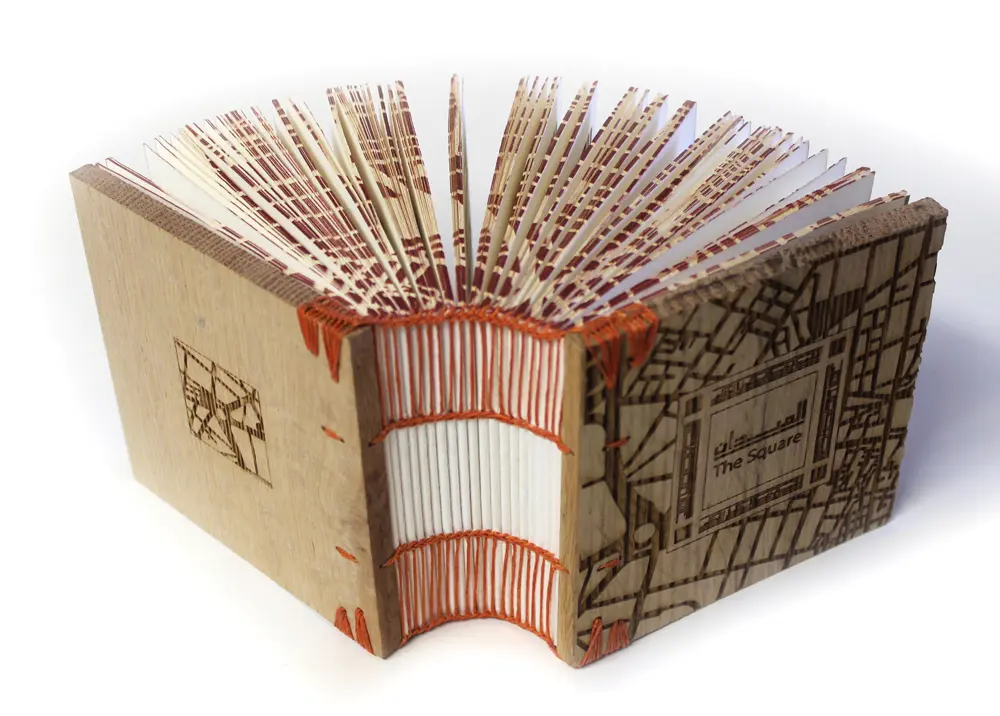
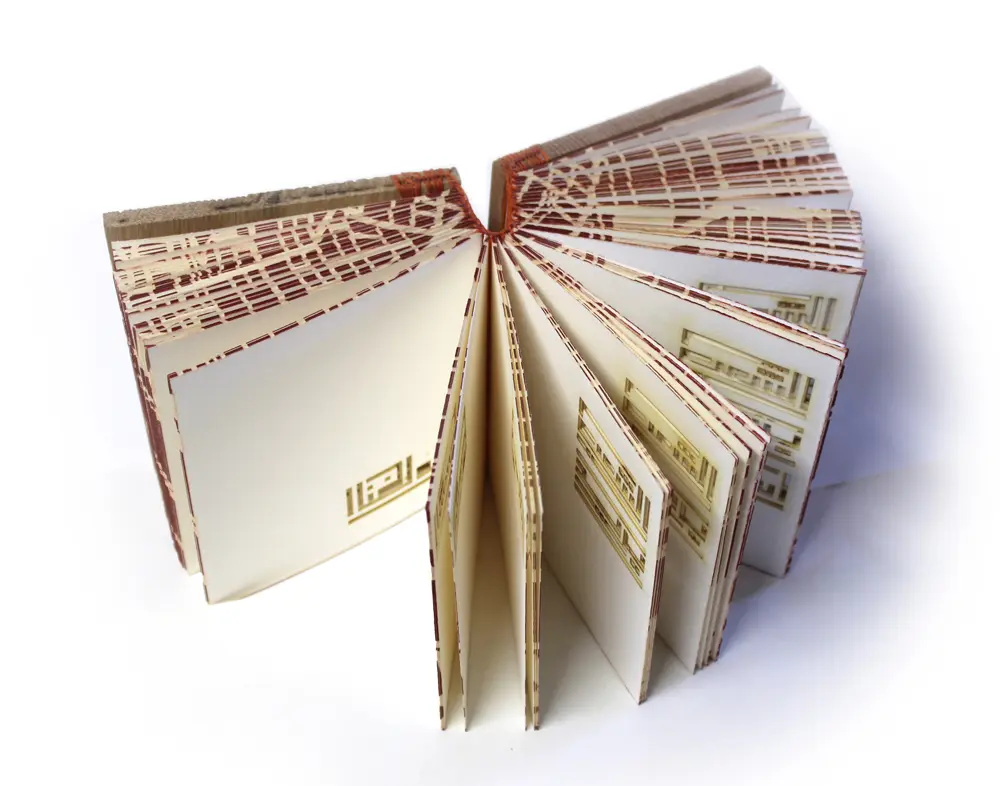
Nonetheless, books continue to offer opportunities for engaging the aural; in some cases, like artist books, they do so in ways that may not be typical. Artists such as Islam Aly, working in the context of the Egyptian revolution (2011–12), have mobilized the book as a site of fragmentation, immediacy, and political urgency. These practices are often recognized as radical precisely because they visibly depart from the conventions of the printed book. Aly’s The Square, Al Maydan (2014), for example, is made up of pages that include stencil die-cuts of chants from the street protests in Cairo in 2011, specifically the slogan “al-sha‘b yurid isqat al-nizam” (“The people want the fall of the regime”) (Figs 14, 15). This phrase, as well as other iterations, is laser engraved onto consecutive pages of the cubic, almost tower-like book. The outlines of these words vary from page to page, as do their traces, the extent to which they have been burnt into the surface of the pages, and the ways in which they gradually disappear. This recalls how street chants echo and reverberate across marching masses, with words and phrases replacing others and creating an aural rhythm that replicates across crowds. This experience of aurality is captured in Aly’s work, and for those who may have encountered these kinds of gatherings, irrespective of language, the pages can recall similar sound effects. What we see here is how books bring together material trace and sonic repetition.
Circulation and the Afterlives of Form
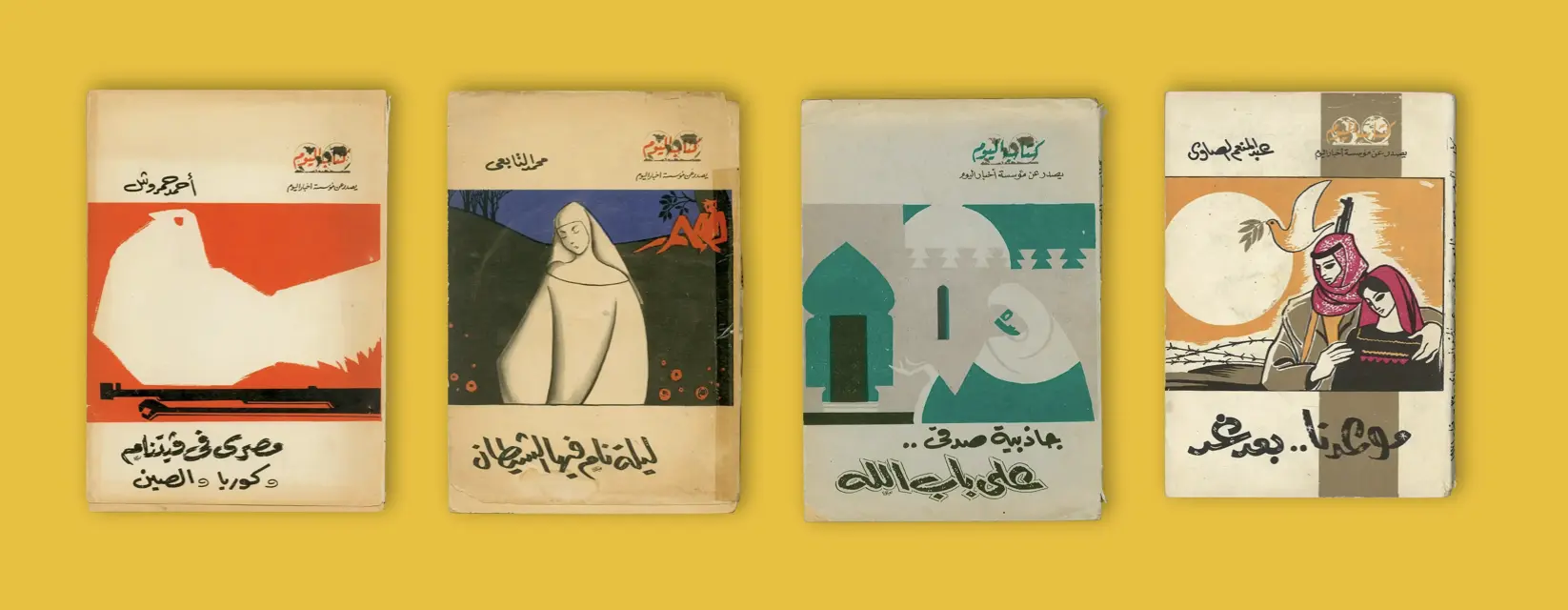
Circulation is what activates design, materiality, and reading through movement across readers and contexts. This is not simply about the spatial transfer of books themselves, but also about their reiterations through reproduction. Relatedly, circulation is not merely about the democratic potential of works as reproductions, but about how reproduction strengthens experience, rather than diluting it or reducing it to an empty shell. For many of the books produced by artists on display in this exhibition, dissemination and reproducibility were built into their conception. This is evident in the seriality of these works, like the previously discussed poetry series by Dar Ibn Rushd, and in the ways that publishers structured and framed specific collections of texts, such as Mu’assasat Akhbar al-Yawm’s “Kitab al-Yaum” series (Figs 16–19). In these, and similar examples, reproduction is baked into the process, not only in the sense of multiple press runs, but also in the conception of these works as inherently serial, even in cases where the original texts were not written with serialization in mind. The design decisions that unify such series, while attending to each individual work or iteration, are also conceived as reproducible units, allowing for variation while maintaining recognizable continuities for readers. These decisions are not simply about “packaging” a work or operating at the level of surface. They alter the nature of the text and its significance by situating it within a serial framework. In this way, seriality does not merely reproduce canonical works, but reframes them, placing them in relation to other texts and contexts they would not otherwise inhabit, thereby reshaping how they are read, understood, and carried forward.
Returning to the Dar Ibn Rushd series, whose covers emulate elements from Qur’an manuscripts produced in the eastern Islamic lands between the late tenth and twelfth centuries, visual elements do not operate only retrospectively. They also move forward, producing the very situations through which that past becomes legible to modern audiences. For many readers, these covers may serve as their first point of encounter with the visual language of so-called “eastern” kufi and associated manuscript traditions of eleventh-century Iran and Iraq. In this sense, these designs do not simply cite or displace earlier Qur’anic forms, but participate in their afterlives, transforming them into recognizable exemplars of a historical “style”. What appears as fragmentation or dislocation thus functions as mediation, rendering these earlier conventions visible even as it detaches them from their original contexts and meanings. The covers thus help constitute how past manuscripts are seen, known, and categorized in the present.
What such examples show is how books—and art more generally—are not encountered in isolation, but always through mediation, whether through reproductions, photographs, social media posts, snippets, assemblages, and the like. This challenges the typical emphasis in art history on singular works and their presumed uniqueness, since this tends to obscure how books are encountered and produced in practice. While this singularity may sometimes be the case for artist books, in most forms of publishing, printing, and bookmaking, we deal with multiplicities, such as editions, copies, and reproductions. To decolonize our understanding of books and print culture, then, is also to undo the assumption that copies and reproductions are secondary or less “authentic” than singular works. In fact, rather than diminishing the original work (of art), mass production makes possible the conditions through which works subsist and reach audiences. This position runs counter to a familiar framework in which reproducibility is understood as loss, most notably in Walter Benjamin’s account of mechanical reproduction, which hinges on the erosion of the work’s “aura”, a quality tied to its singular presence in time and space.8 As Islamic art historian Finbarr Barry Flood has recently argued in his discussion of mass-produced tracings of the Prophet Muhammad’s sandal (ni‘al), reproduction can instead amplify ritual and affective value, suggesting not a rupture with tradition but its continuation and fulfilment.9 Even while Benjamin recognizes the transformative potential of reproduction, his argument retains the original as its point of reference, measuring what is diminished in its absence. The works discussed in this essay suggest a different orientation. Reproducibility does not mark a decline from an original state but is the very condition through which these works come into being, circulate, and remain legible over time. Most importantly, throughout this “afterlife” of reproduced works, what is sustained is not an “aura” as singular presence, but the capacity of the work to be re/activated across contexts, readers, and forms.
More broadly, circulation is not simply about the modes through which copies are made. It is also spatial and temporal, unfolding through readers, institutions, and the circumstances under which books are collected, preserved, accessed, and encountered. These conditions are historically specific, and the works we can view today, whether in archives, exhibitions, or digital repositories such as this, are already shaped by them. What appears as a coherent collection is itself the result of a series of selections, mediations, and uneven access. Thinking not only about a book’s production or intention, but also how it multiplies, transforms, and moves through time and space, helps shift our focus from the book as a static object to one formed through an ongoing series of active, unfolding encounters.
Hala Auji is the Hamad bin Khalifa Endowed Chair for Islamic Art at Virginia Commonwealth University. Her research examines Arabic print culture, publishing history, and image circulation in nineteenth-century eastern Mediterranean. She is the author of Printing Arab Modernity: Book Culture and the American Press in Nineteenth-Century Beirut (Brill, 2016), and co-editor of The Arab Nahda as Popular Entertainment (Bloomsbury, 2023) and Islamic Art History and the Global Turn (Yale University Press, 2026).
- For a sustained commitment to these approaches in connection to North Atlantic contexts, see the work by Johanna Drucker, including Graphesis: Visual Forms of Knowledge Production (Harvard University Press, 2014); and The Visible Word: Experimental Typography and Modern Art, 1909-1923 (Chicago University Press, 1994). See also: Dana Janeta Bădulescu and Cristina Gavriluță, “Notes on the Materiality and Spirituality of Books and Their Being in the World”, Linguaculture (Iași) 11, no. 2 (2020): 163–74; and Anna Sigrídur Arnar, The Book as Instrument: Stéphane Mallarmé, The Artist’s Book, and the Transformation of Print Culture (University of Chicago Press, 2011). ↩︎
- Some scholarship includes Zeina Maasri, “Book Arts as Archives of Decolonization: The Design and Visuality of Arabic Books (1950s–1980s)”, Journal of Design History (2026), epag002, https://doi.org/10.1093/jdh/epag002; Cosmopolitan Radicalism: The Visual Politics of Beirut’s Global Sixties (Cambridge University Press, 2020); J.R. Osborn, Letters of Light: Arabic Script in Calligraphy, Print, and Digital Design (Harvard University Press, 2017); Hala Auji, Printing Arab Modernity: Book Culture and the American Press in Nineteenth-Century Beirut (Brill, 2016); and Kathryn Schwartz, “Meaningful Mediums: A Material and Intellectual History of Manuscript and Print Production in Nineteenth Century Ottoman Cairo”, PhD Dissertation, Harvard University, 2015. ↩︎
- Select scholarship on artist books from Southwest Asia and North Africa includes Sonja Mejcher-Atassi and May Muzaffar, eds., Rafa Nasiri: Artist Books (Skira, 2016); Sonja Mejcher-Atassi, “Contemporary Book Art in the Middle East: The Book as Document in Iraq”, Art History 35, no. 4 (2012): 817–39; and Venetia Porter, Artists Making Books: Poetry to Politics (The British Museum, 2023). For artist books more broadly see Johanna Drucker, The Century of Artists’ Books (Granary Books, 2004). ↩︎
- Hala Auji, Printing Arab Modernity: Book Culture and the American Press in Nineteenth-Century Beirut (Brill, 2016). ↩︎
- Hala Auji, Printing Arab Modernity: Book Culture and the American Press in Nineteenth-Century Beirut (Leiden: Brill, 2016). ↩︎
- Johanna Drucker, Diagrammatic Writing, Visual Writing: Documents in Concrete and Visual Poetry (Visual Writing/ubu editions, 2013). Later editions of this text were also published by Set Margins and designed by Drucker, Diagrammatic Writing, Set Margins #2 (Set Margins’ Press, 2023; 2025). ↩︎
- See, for example, the corpus discussed in Alya Karame, The Forgotten Qur’ans of the Eastern Islamic World: Manuscripts of the Ghaznavid and Ghurid Dynasties, 11th-12th centuries CE (Edinburgh University Press, 2026). ↩︎
- Walter Benjamin, “The Work of Art in the Age of Mechanical Reproduction (1935)”, in Illuminations, ed. Hannah Arendt, trans. Harry Zohn (New York: Schocken Books, 1969), 1–26. ↩︎
- Finbarr Barry Flood, “Relics and Resistance: Toward a Global Microhistory of a Devotional Print”, in Islamic Art History and the Global Turn: Theory, Method, Practice, ed. Hala Auji and Radha Dalal (London: Yale University Press, 2026), 43. ↩︎