Arabizing science for liberation: Dar al-Fata al-Arabi’s Simplified Sciences Series
Hana Sleiman
17.08.2026
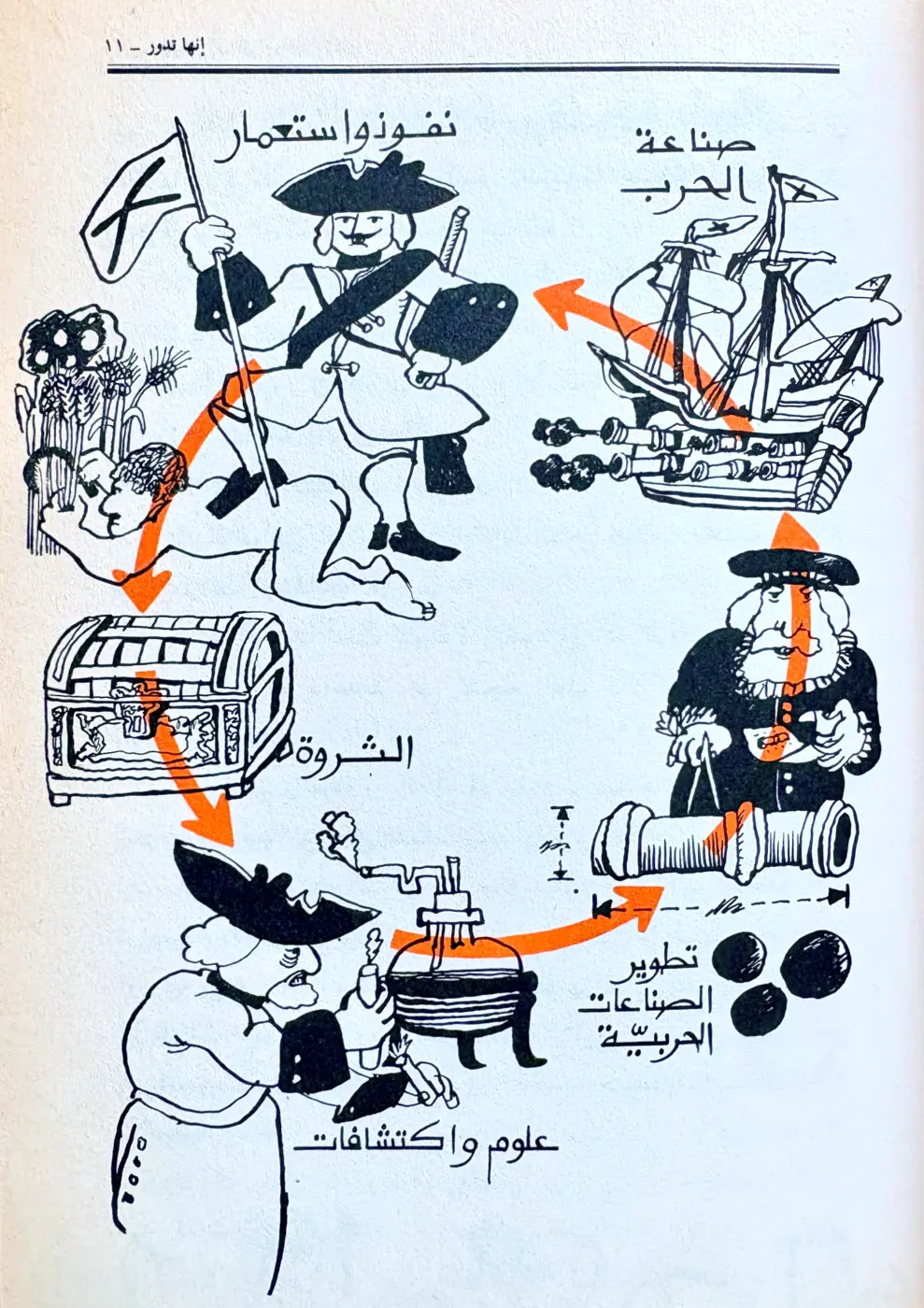
In 1980 Dar al-Fata al-Arabi, a children’s publishing house that operated in Cairo and Beirut (1974-1994), published Innaha Tadur (It Rotates: The Story of the European Renaissance).1 A full-page illustration featured a cycle (fig. 1, read anticlockwise starting at the upper right corner): war expanded Europe’s power and colonial reach. The labour and resources extracted from the colonies increased Europe’s wealth, which in turn bolstered science. New scientific discoveries enhanced the war industry, which fuelled wars, and the cycle continued. Image and text told a story not of a seamless transition of knowledge and power from East to West but of an historical process rooted in violence and exploitation. The ‘it’ that rotates was not only the earth around the sun and its central axis or a wheel propelled by the power of an engine. It was also the cycle of Europe’s colonialism and progress.
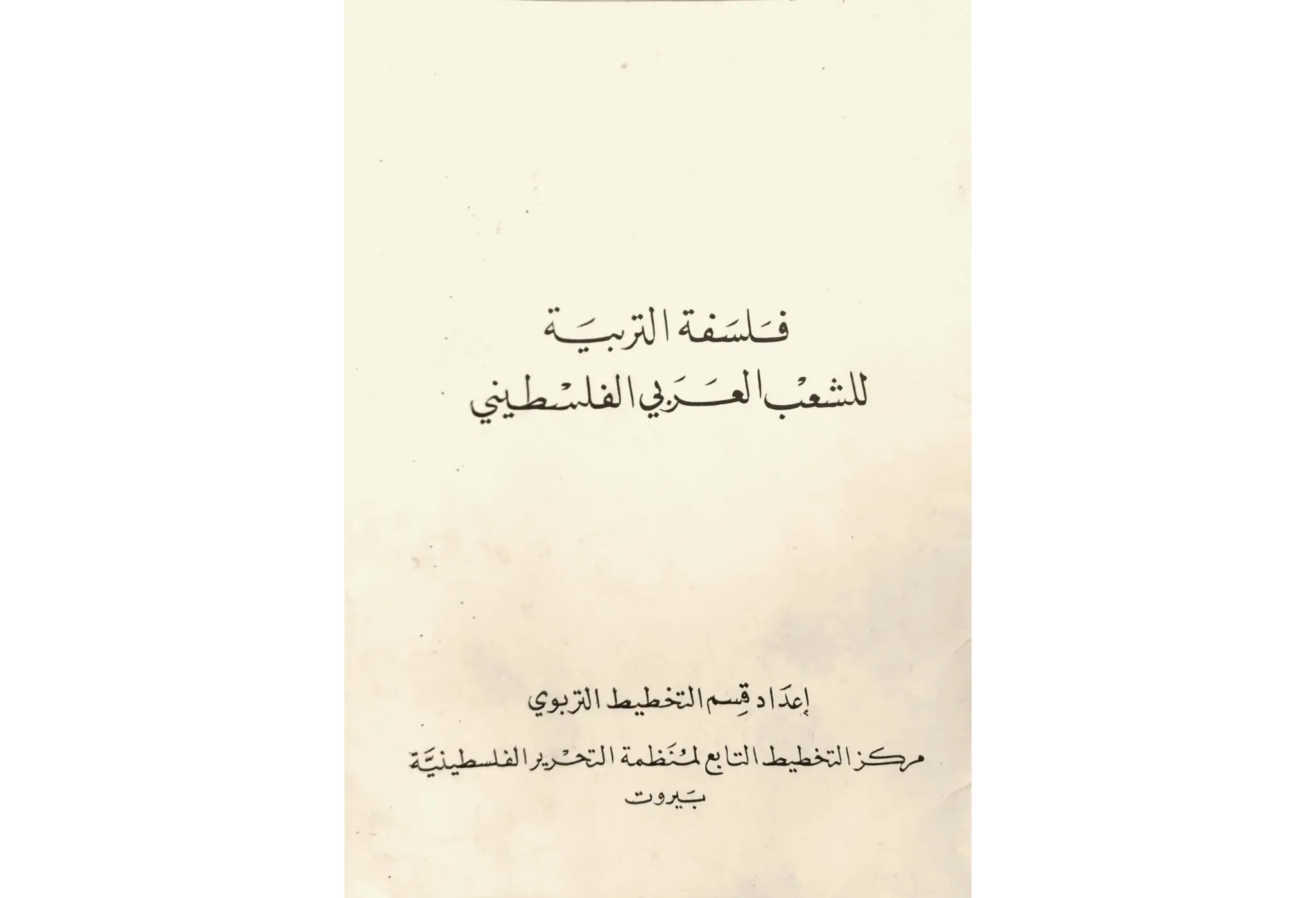
In 1972, the PLO Planning Centre issued a report, ‘The Philosophy of Education for the Palestinian Arab People’ (fig. 2).2 Its first clause emphasized that the world is an objective reality in constant flux, and that humans can know the world and change it. Drawing on this vision, ‘the philosophy of education rejects all notions that doubt the ability of man and masses to know the world and change it and rejects submission and surrender to a status quo.’ In other words, the philosophy emphasized that a people could resist colonialism, revolt against injustice, attain freedom, and struggle for social justice.3 The Education Department at the Planning Centre then worked to translate ‘The Philosophy’ into action, and it is out of this moment that a project for children’s literature was first envisioned.

In 1974, Dar al-Fata al-Arabi saw the light of day. Although formally established as an independent commercial institution, its genesis is inseparable from the cultural and material infrastructure of the Palestinian revolution.4 Dar al-Fata drew its artistic and editorial policies (and some of its founders) from the Planning’s Centre and its Philosophy of Education. The Dar served as the most vivid manifestation of ‘The Philosophy’. Its books have long inspired children and adults across the Arab world. It produced over 200 stunning books, commissioned, written, illustrated, designed, printed, and distributed by some of the Arab world’s brightest intellectuals, artists, writers, and organizers. They were read by wide-eyed, awe-struck children and adults, and their dazzling effect continues to enchant readers to this day. The publishing house addressed ‘al-Fata al-Arabi’ (the Arab child) of the seventies, eighties and nineties—the (middle-aged) adults of today. The books cultivated an imaginative, inquisitive, and whimsical curiosity among its readers, while advancing sharp critiques of self and other (a selection can be viewed in Decolonizing the Page, Room 4 “Postcolonial Futurity”).
One can write volumes about Dar al-Fata and the many men and women who made it over the course of two decades: Mahjoub Omar, Nabil Shaat, and Hasna Reda-Mikdashi sustained the Dar through thick and thin; Ihsan Abbas and Abdelfattah al-Jamal gave it editorial, literary and intellectual direction; while Kamal Bullata and Mohieddine Ellabbad gave it artistic vision and guided the translation of this vision into material publications that were at once sublime and affordable. Perhaps the most compelling aspect of the Dar is its pan-Arab reach, involving luminary artists and writers who wished to remain engaged in the anti-colonial struggle and saw in the Palestinian revolution a way out of the defeat and surrender of Arab regimes after 1967. As Zeina Maasri has shown, Dar al‑Fata functioned as a radical node of solidarity that decolonized children’s literature to educate Palestinian and Arab youth into a revolutionary, liberationist subjectivity.5
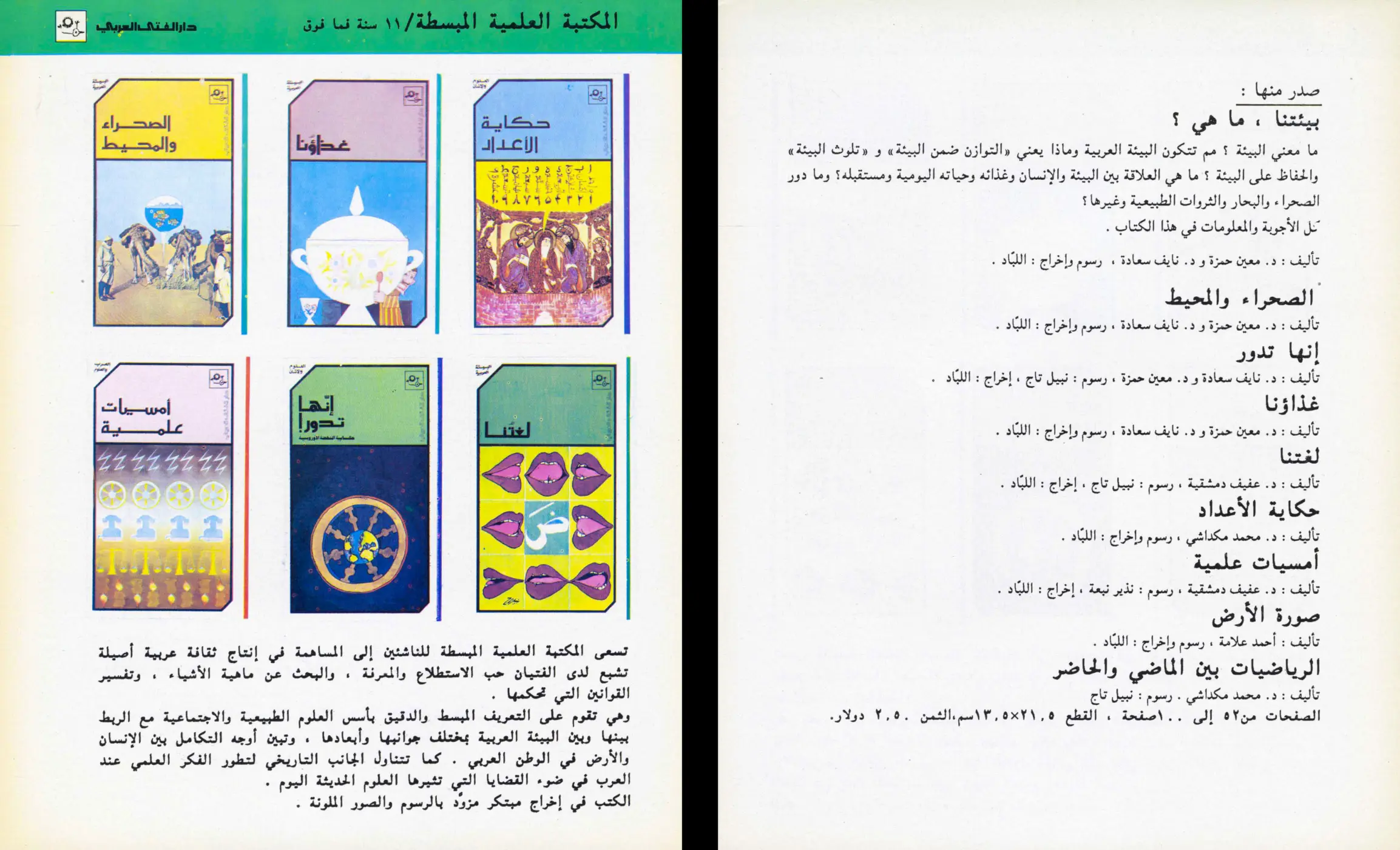
These histories are documented in the paper archive6 and the oral history archive of the Dar,7 which constitute a treasure trove for the history of the period: its art history, print culture, social and political history, and the history of thought and education. This piece offers an introductory overview of one aspect of the Dar: its effort at Arabizing and simplifying science (fig. 3).
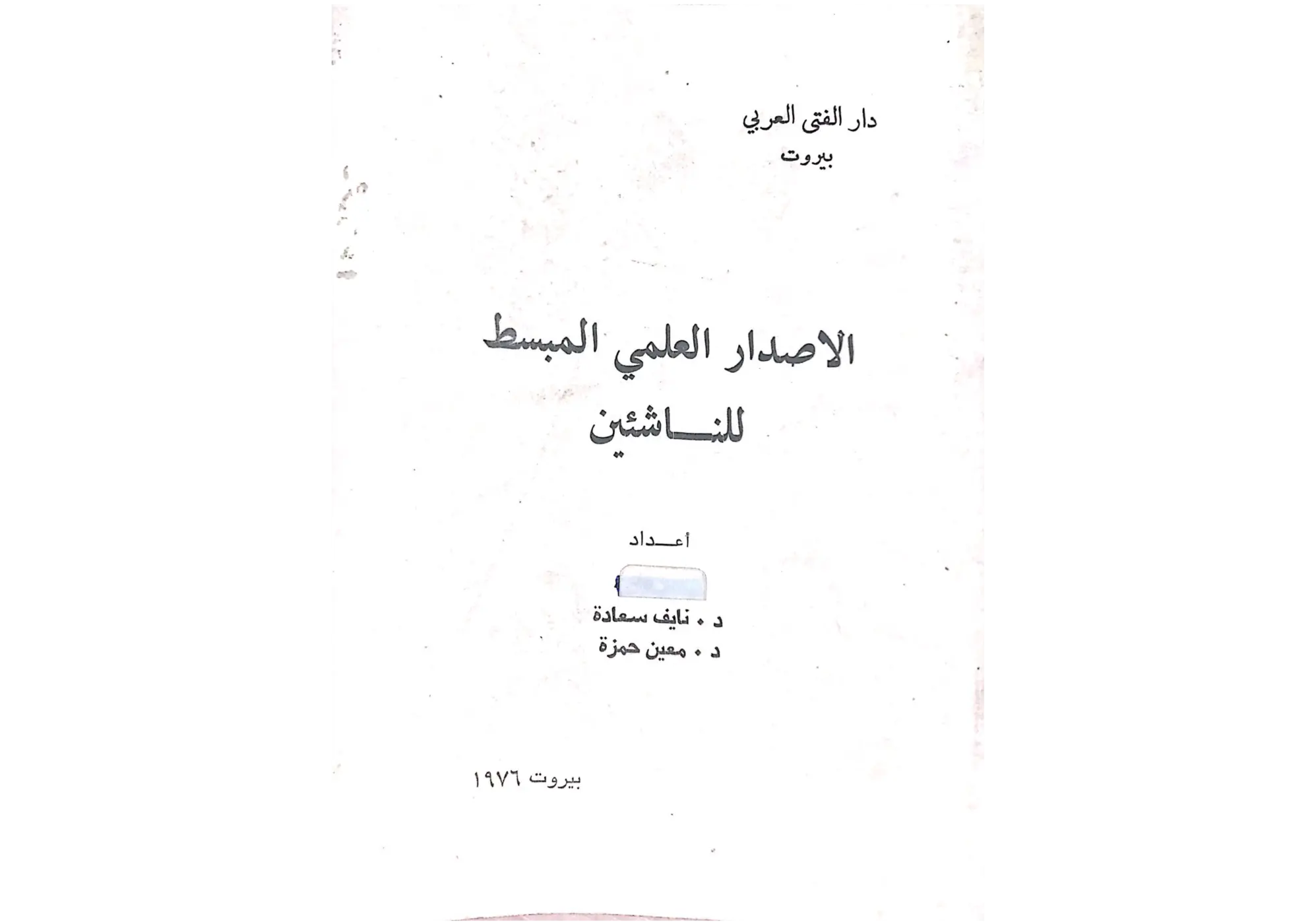
In the 1970s, psychologist Nizar el-Zein, a professor at the Lebanese University, embarked on a project of producing Arabic science books for curricula at different levels. Hailing from Saida, he served on the board of al-Maqasid Philanthropic Islamic Association, which operated schools in Saida, Beirut, and other cities. El-Zein worked with physicist Hasan al-Sharif, who was the headmaster of the school in Saida, to produce school curricula for sciences in Arabic. They worked with physician Nayef Saadeh, agricultural scientist Mouin Hamza, mathematician Mohammad Mikdashi, and others. Almost all scientists were at the time engaged in one form or another with the political and cultural work for the liberation of Palestine, and many were members of the Scientific Committee of the Planning Centre. Saadeh and Hamza, the co-editors of the Sciences series, acted as liaison with Dar al-Fata. Their first order of business was to develop an editorial policy for the Dar’s scientific series, and in 1976 they published ‘al-‘Isdar al-‘Ilmi li-l-Nashi’in’, a booklet on the pedagogical and editorial policy of simplifying and Arabizing science for Arab young readers (fig. 4).8
The intellectual history of Arabizing science is steeped in nineteenth-century anxieties over modernity and modernization as articulated in the nahda, or the Arab renaissance—a broad project of political and cultural modernity in the nineteenth and early twentieth centuries.9 Marwa al-Shakry has explained how nineteenth-century intellectuals employed conceptual syncretism to translate new sciences through older systems of knowledge. This crystallized in the field of history of science after the First World War, which gave way to a linear understanding of science as Western, universal and modern.10 In my own work on historian and intellectual Constantine Zurayq, I explore how the history of science, and the history of civilizations at large, became a key epistemological concern for intellectuals at mid-century who endeavoured to develop reasoned and scientific answers to the crises that have altered their worlds: the nakba of 1948, and the take-over of post-colonial states by military leaders adamant on reform and modernization.11
The scientists and intellectuals who were concerned with Arabizing science in the second half of the twentieth century, including those who created the Simplified Sciences series, were formed by this moment and its intellectual-political manifestations. As the opening anecdote of this piece shows, the generation active in the 1970s was acutely aware of colonialism as modernity’s insidious underside. They were aware that Europe’s scientific revolution, or indeed its modernity at large, were premised on the extraction of resources and labour from the colonial world. They operated on the premise that the cycle of colonialism and science was the wheel that carried European empire forward. They grappled with the contradiction: how do Arabs reap the benefit of humanity’s scientific tradition (of which they were part) while not adopting wholesale the (colonial) outlook on which Western science was premised?
This intellectual genealogy forms the blueprint of the Sciences Series, detailed over the forty pages of the 1976 booklet ‘al-‘Isdar al-‘Ilmi li-l-Nashi’in’.12 In it the authors write, ‘our aim is not to Arabize science in the sense of automatically translating it into Arabic, but to contribute to the production of an authentic Arab scientific culture’ (thaqafa ‘ilmiyya ‘arabiyya asila). They go on to describe what they mean by authenticity (another key theme in Arab intellectual history), not as a seclusion from and a rejection of the scientific fruit of human civilisation, but an absorption of these cultures and systems of knowledge, and their use as an intellectual aid for comprehending Arabs’ contemporary reality and developing it.13 This humanist vision of science permeates the series’ books, as the authors journey through time and space to explore different sciences from the dawn of civilisation and onto their contemporary moment, with emphasis on the contributions of the Arabo-Islamic civilisation broadly construed.
The booklet outlines four foundational principles or aims for the series: 1) to tackle scientific subjects from an Arab perspective while emphasizing their humanist nature; 2) to cast a wide Arab net in terms of authorship and distribution, striking a balance between quality and cost; 3) to use an economical two-colour unified format rich with graphics and maps; and 4) to continue reassessing and adapting the books in light of a broader pedagogical-scientific vision that responds to a developing reality. The series addressed Arab youth across various ages and national curricula by simplifying sciences across fields, which in turn would aid young Arab readers to understand and develop their environment. The books were meant to follow children’s cognitive and biological development beginning from sensory-motor development through to direct observation and inquisition and onto abstraction and general laws.14
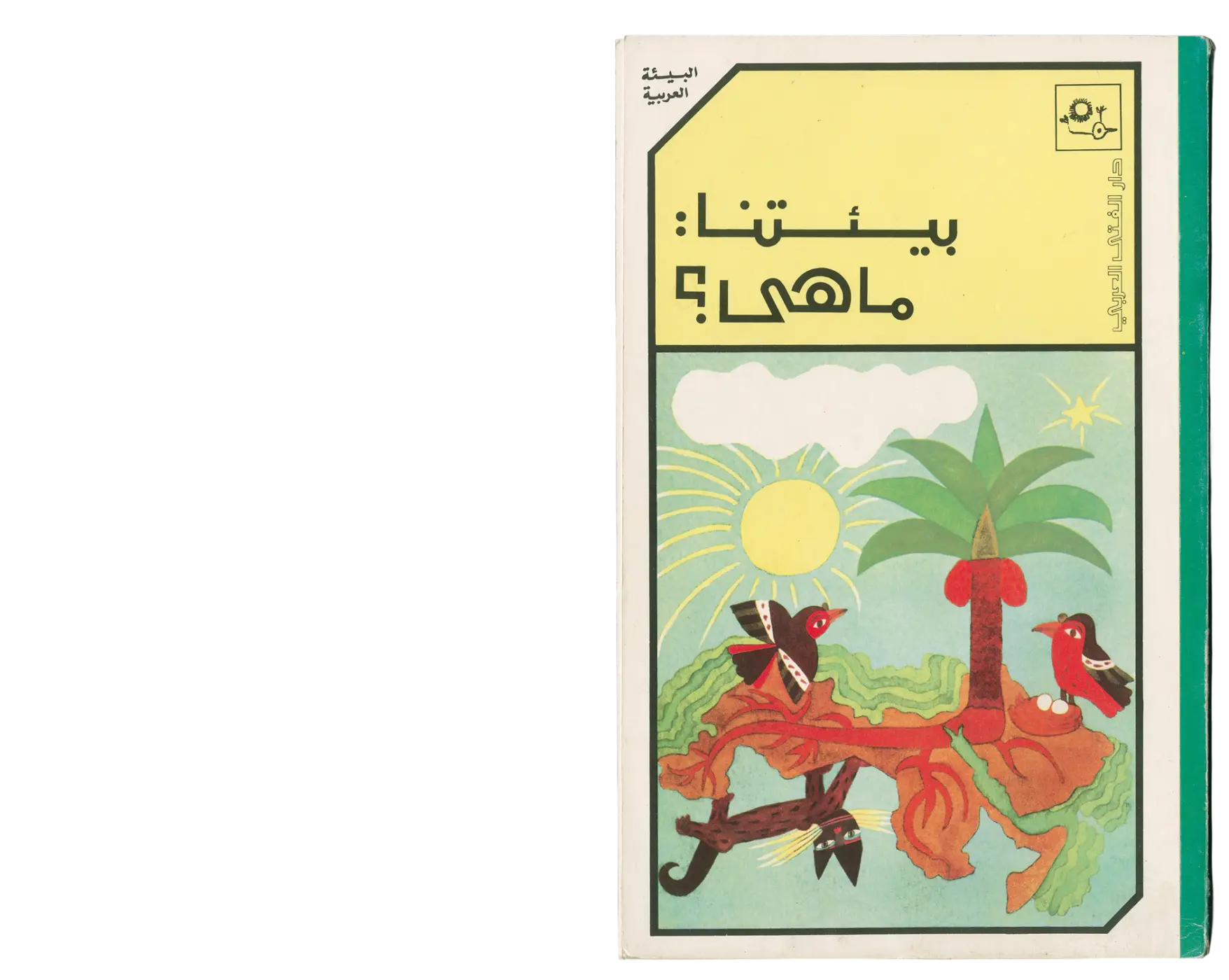
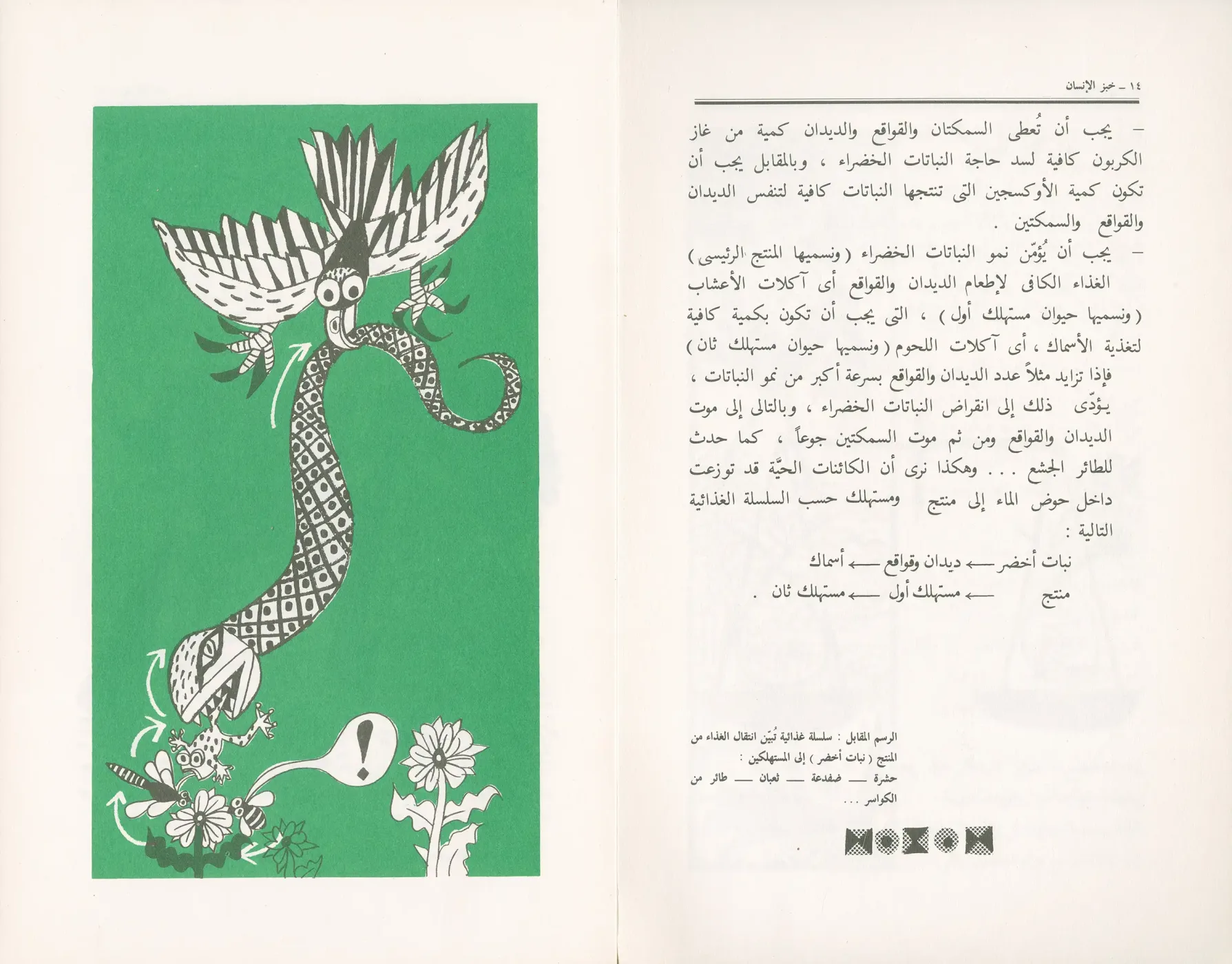
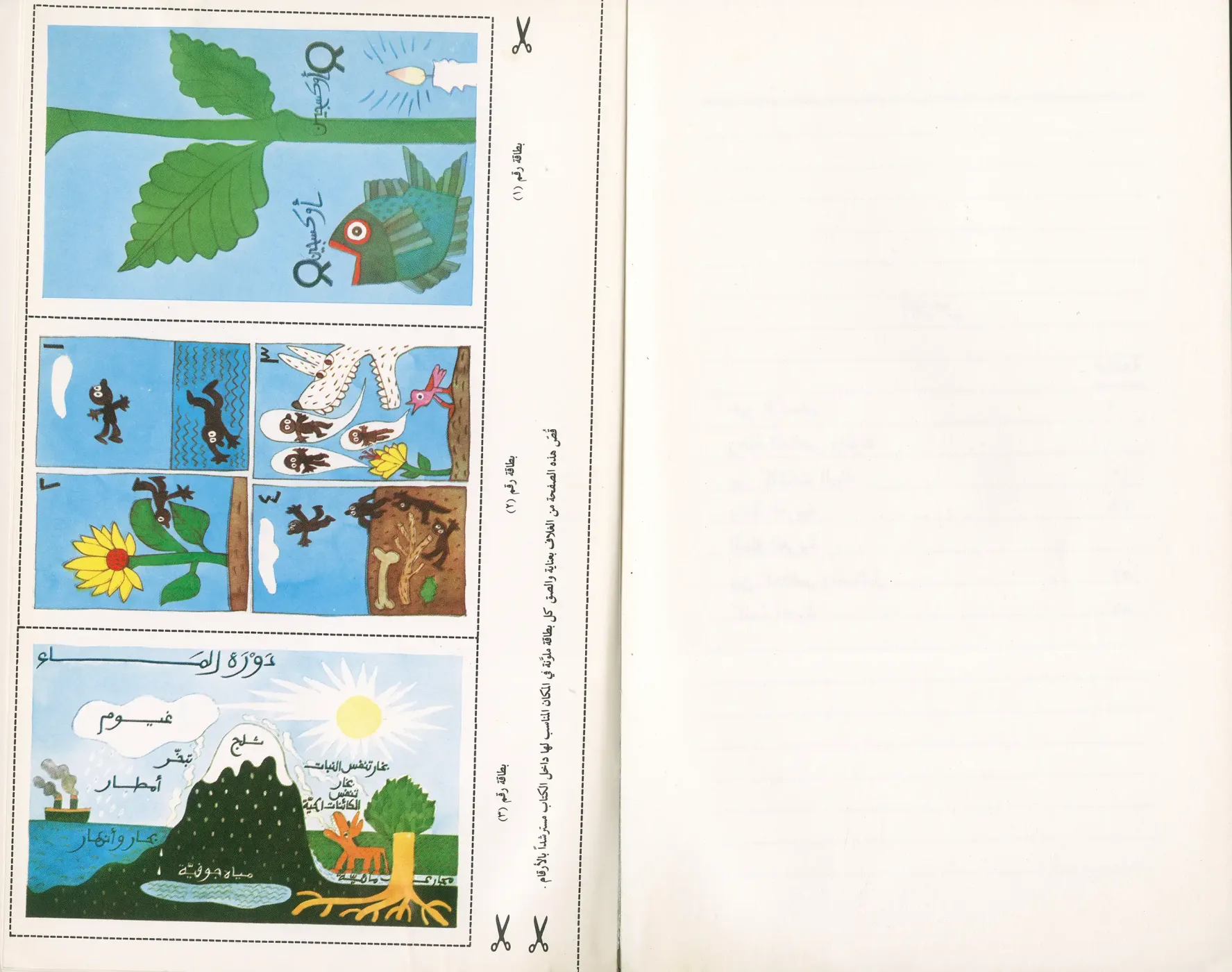
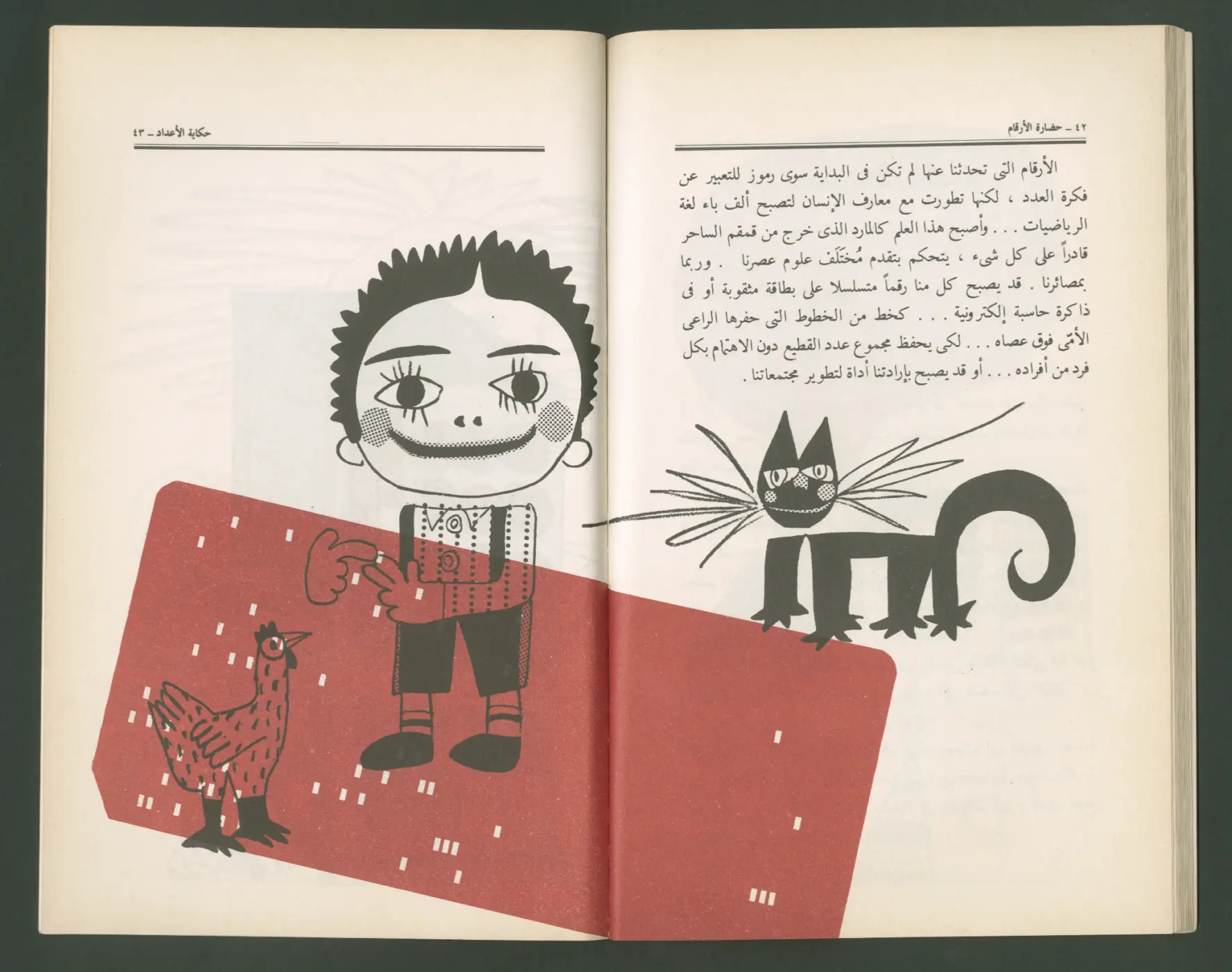
The first eight books addressed the age group 11 to 15 and were organized into four sub-series: Arabs and Science, Science and Man, the Arab Environment, and the Story of Mathematics (figs 5–10). The description of each series contains a conceptual overview of its key terms—how the authors conceived of notions such as science or the environment—followed by directions on style and pedagogical approach. This vision, in addition to the books themselves, constitute rich sources for intellectual history and the history of science. Simplifying science for children and young adults entails breaking down of complex ideas and processes in a very clear and succinct language, bringing to the surface the assumptions and blind spots of their time. These sources are thus methodologically significant, as they shine light on the concerns and priorities that occupied intellectuals as they sought to address and mould a new Arab generation.
One example of the rich potential of these books as sources is how they inform the prevailing intellectual discourse on the role Islamic civilisation played in humanity’s march towards progress: the Arabo-Islamic tradition serves as a key link in the chain of civilisational history, connecting the Greco-Roman tradition to Enlightenment Europe. In enshrining the Arabo-Islamic tradition as a key link in the chain of human progress, intellectuals at mid-twentieth-century first claimed a place for themselves in history, then used this claim to issue a call to the Arab nation-in-formation to re-grasp the tools of science and reason that their ancestors developed, and to put it at the service of building their future.15
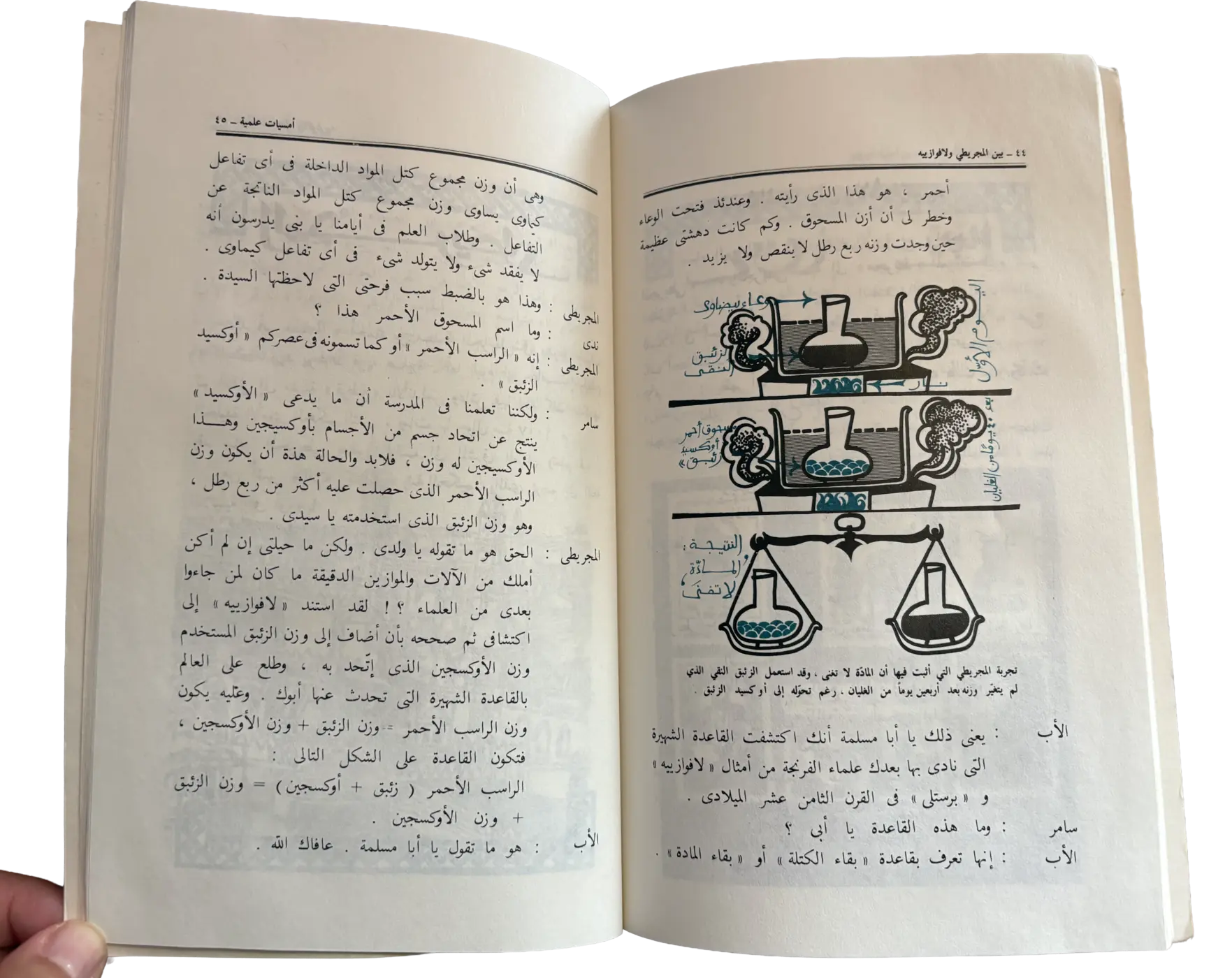
In the book Umsiyat ‘Ilmiyyah (Scientific Evenings), author Afif Demashqiyah takes his young readers through an imaginary time-space journey through Arab(ic) science, where a family of four visit scientists in their laboratories, from Jabir Bin Hayyan through to al-Jahez, al-Razi, al-Biruni, al-Majriti, Ibn al-Haytham and Ib al-Souri (fig. 9). There is much to unpack about classifying these scientists under the rubric of al-‘Ilm al-Arabi (Arab/ic science)—how it informs categories of self and other, nationalism, and secularism—but that is a discussion for another time. In a chapter titled ‘Between al-Majriti and Lavoisier’, the family are visiting with Maslama al-Majriti in 10th century Cordoba. They catch him in a state of frenzy, having just arrived at the greatest discovery of his scientific life. He explained to his twentieth-century visitors how he observed that the weight of pure mercury, when transformed through heat to mercuric oxide, remains the same. He thus concluded that in a chemical reaction, matter is neither destroyed nor created. The father was quick to point out that al-Majriti had arrived at a variation on the law that 18th century French chemist Antoine Lavoisier articulated as ‘Rien ne se perd, rien ne se crée, tout se transforme (nothing is lost, nothing is created, everything is transformed)’. Like many examples in the series, readers are reminded of Europe’s indebtedness to the Arabs’ pioneering role in science.
The book ends with a chapter titled Shajarat al-Tarikh (the tree of history), which employs a narrative structure similar to the other books in the series: an emphasis on the humanist nature of science, the place of Arabs in it, and the need for upcoming generations to learn, internalize, and enact this knowledge. In the conclusion to Bi‘atuna Ma Hiya (figs 6–8) titled ‘The Arab Environment Between the Present and the Future’, Saadah and Hamzeh explicitly diagnose the Arab state of takhalluf (underdevelopment, backwardness) and attribute it to colonialism, the absence of strategic planning, and the lack of investment in human capital. Surat al-Ard ends with the chapter ‘A Map of the Future’, and Innaha Tadur ends with the fable of the jinn in the magic flask. The flask in the story is the human mind, the jinn is reason, and ‘Europe’ is the fisherman who released the jinn. The book ends with a warning that the jinn will consign to oblivion any nation that fails to enlist it in the march for progress.
Not unlike the nahdawi periodicals of the nineteenth century, the problem of progress / backwardness and the Arabs’ relationship to Europe was re-negotiated on these pages. Unlike their nineteenth-century forebearers, the intellectuals writing these books were operating in the aftermath of the breakup of the Ottoman Empire, the vicissitudes of colonial rule in the Levant, the creation of military post-colonial states, the institutionalisation of the Zionist settler-colonial project, and the ethnic cleansing and destitution of Palestinians. These intellectuals renegotiated the liberal tradition they inherited in the context of an explicitly anti-colonial liberatory movement. In simplifying complex historical, scientific, mathematical, cartographic, and environmental knowledge, the authors of the series revealed their epistemological world view, one that is in conversation with earlier nahdawi thought as well as contemporary ideologies for future building. As this exhibition demonstrates, the books serve as an archive of a radical pedagogy employed in building a ‘postcolonial futurity’. The Sciences series in particular lays bare the intellectual assumptions and contradictions of the time.
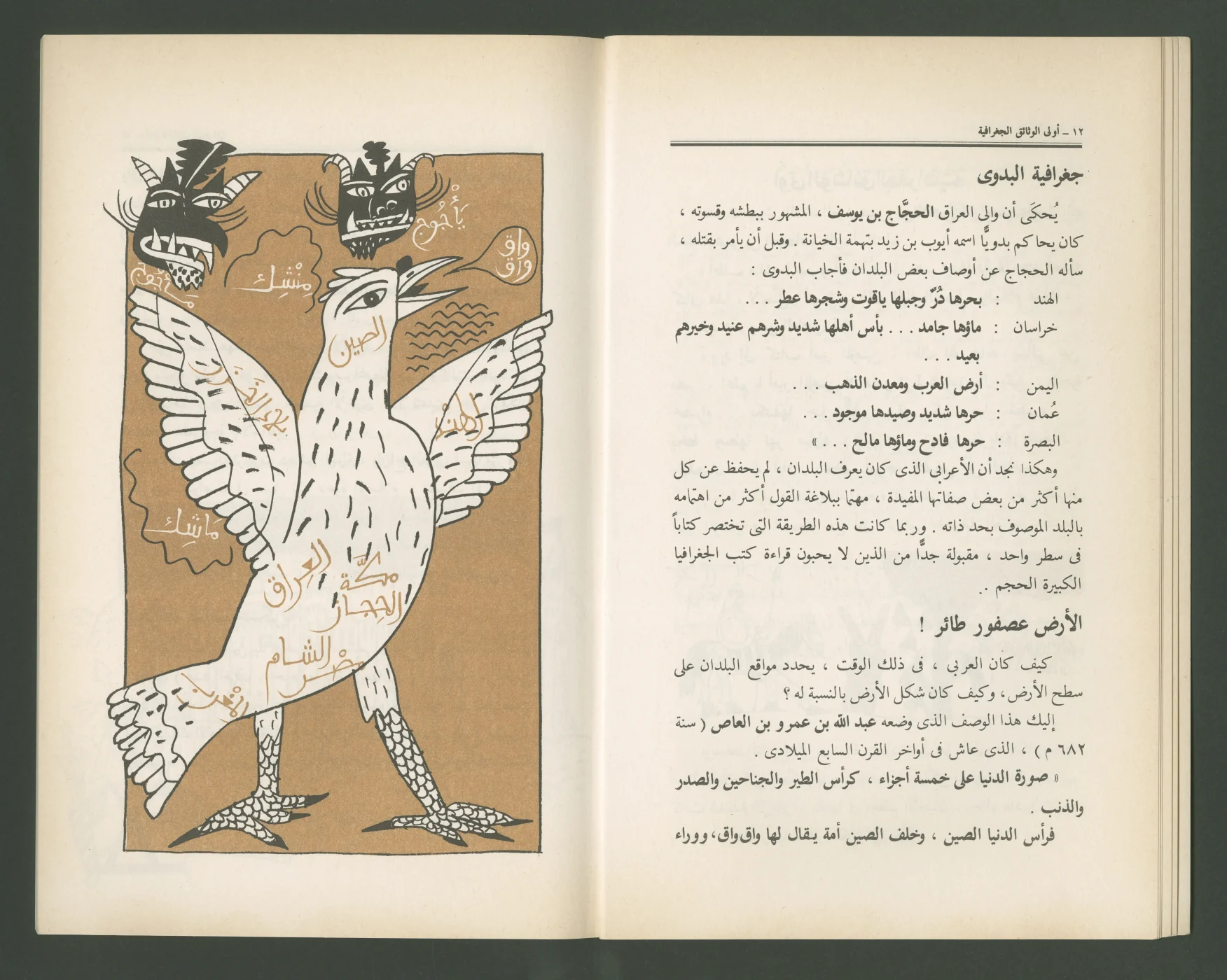
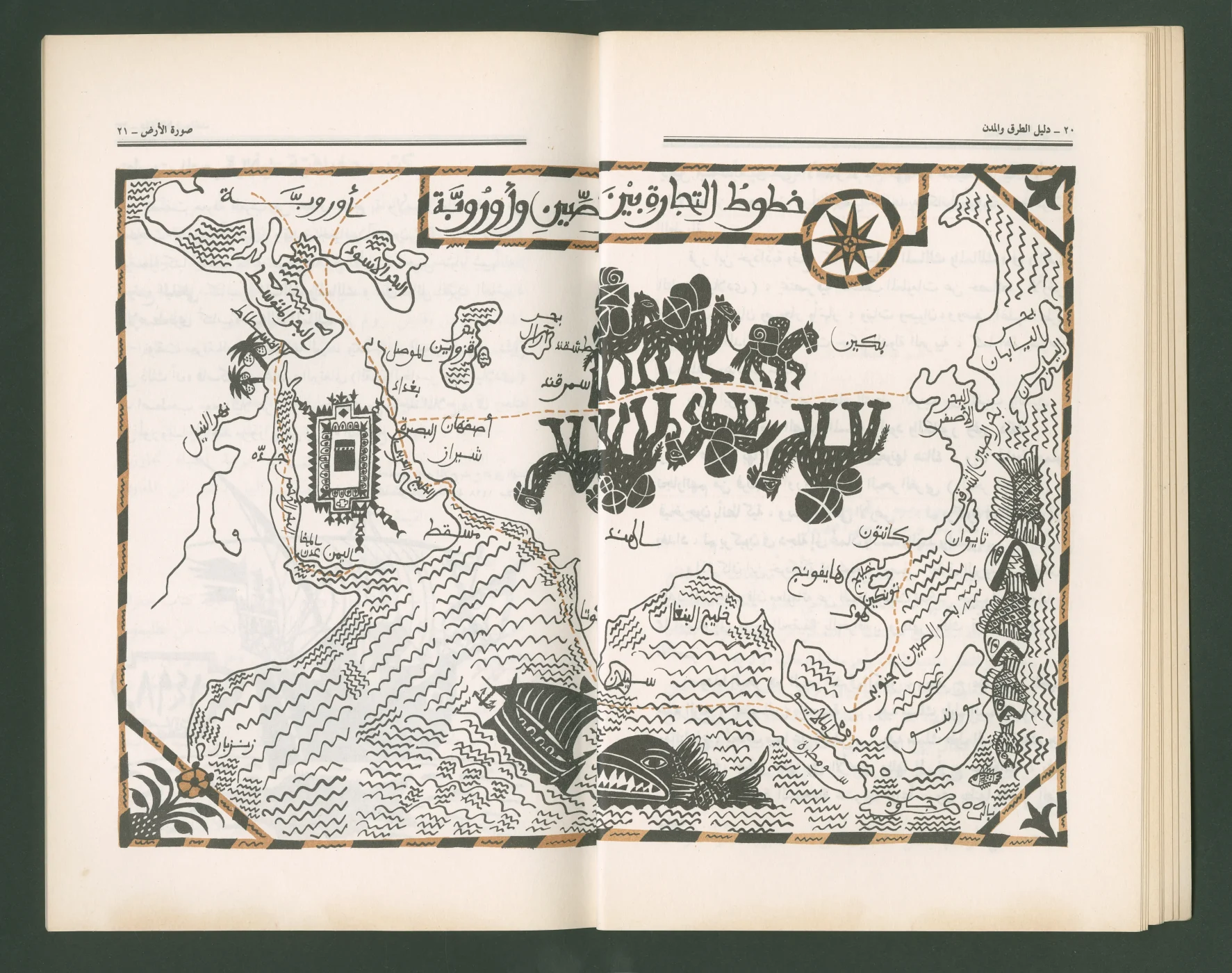
Simplifying science operated at the level of image as well as text. In Surat al-‘Ard (The Image of Earth, figs 10 and 11), on the history of geography, Mohieddine Ellabbad offers a visual reinterpretation of the seventh-century description by Ibn ‘Amr Ibn al-‘As (682) of earth in the form of a bird: with the head being China, the tail Morocco, and the Islamic world at the centre. This is in fact a map of Asia and North Africa with East, not North, at the top. It is a visualization of Arab geographic imagination in the early Islamic civilisation. The illustration occupies a full page, while the accompanying text occupied half a page. Ellabbad drives home the author Ahmad Allama’s argument: how the Islamic tradition conceived of an East-up map that precedes (and could supersede) the eurocentrism of modern maps. It is the image, here, that inhabits the intellectual centre.
In other instances, images told what the text implied. Innaha Tadur, with which this piece opened, does not contain a narration of the relationship between science and colonialism. The narration is the image, and the book’s metanarrative is articulated through Ellabbad’s design. The process of co-production across text and image, and across the editorial and the artistic visions, was indeed a defining feature of Dar al-Fata. In her recent article, Maasri has shown how the visual culture of books was integral to decolonisation struggles at the middle of the twentieth century, and how the visual pedagogy of Dar al-Fata served as a manifestation of this ‘postcolonial futurity’.16
Mohieddine Ellabbad played a pivotal role in the production of this series. All books were published in collaboration with his Experimental Workshop for Children’s Books, and he served as book designer, illustrator, or both. Significantly, Ellabbad did not simply illustrate the text handed over to him by the editorial committee. Rather, he designed visual content that captured the intellectual spirit of the text and then produced it in visual form. He did so along the lines that Maasri describes on this platform: he strove to unlearn Western epistemologies and educate himself and his readers on a vernacular form of thought and artistic practice.17 In his interview, Nayef Saadah describes him as a key intellectual partner in this project; the editorial and art committee collaborated to co-produce the project, with Ellabbad insisting on this process of co-production.18
It is also remarkable to think about the transnational collaboration and geography across which the book production process took place. In 1977 the Dar escaped the Lebanese civil war and moved a significant portion of its operations to Cairo, while Beirut remained the core locus for printing and distribution. This meant that the editorial team often met in Cairo and commissioned writers in Baghdad, Amman or other cities across the region. They collaborated with the art director (in Cairo since 1977), who would then commission and correspond with an artist in another Arab city, before the final mock-ups and artwork were sent for print in Beirut. The printers would then correspond with the Cairo team, sharing proofs and mock-ups, making edits, and finally printing the books. These would then travel from Beirut to the Arabic-reading world, to be enjoyed by young and old readers alike. This process took place over two tumultuous decades of our region’s life.
This makes Dar al-Fata’s archive—the books, the administrative archive, and the oral history archive—a key resource for writing our material, intellectual, and political history. There has been great interest in reviving the experience of Dar al-Fata al-Arabi and in re-printing some of its books. I humbly suggest that the desire to recreate the books during an especially bleak moment of our history is animated by our desire to recreate the lifeworld of Dar al-Fata: a world of intellectual rigor, artistic sublimation, experimentation in print culture, and a locally embedded pedagogy—all at the service of liberation and justice. The evergreen afterlife of Dar al-Fata is a testament to the power these books have had on an entire generation, as we continue to return to them for inspiration and awe.
Hana Sleiman is a historian whose work explores processes of archive making and history writing in the context of the Palestinian liberation movement in Lebanon and the diaspora. Her work is rooted in collaborative archival and oral history production. She is a Lecturer in Modern Middle Eastern History at the University of Edinburgh.
- Nayef Sʿadah and Mouin Hamza, Innaha Tadur! Hikayat al-Nahda al-Urubiyya (Beirut, Cairo: Dar al-Fata al-Arabi, 1980). ↩︎
- Planning Centre, Falsafat Al-Taribya l-Il-Sha’b al-’Arabi al-Filastini / The Philosophy of Education for the Palestinian Arab People(Palestinian Liberation Organisation, 1972). The Dar al-Fata al-Arabi collection at the Gender Oral History Archive contains various interviews with Planning Centre Employees, which discuss the development and aims of the philosophy. See in particular interviews with Munir Shafiq, Hasna Mikdashi, Najla Nuseir, Bassem Serhan, Qassem Ayna, and Jaber Suleiman. ↩︎
- As often articulated by Hasna Mikdashi in her conversational description of Dar al-Fata. This work is deeply indebted to her relentless effort to safeguard the memory of Dar al-Fata. ↩︎
- Nabil Shaath was the director of the Planning Centre and the founder of Dar al-Fata al-Arabi. When operationalizing the recommendations of the Philosophy and the Education Department, he sought support and funding from Palestinian and Lebanese businessmen to establish the Dar as a private institution. The initial investors in 1974 included Hasib al-Sabbagh, Umar al-Aqqad, Zuheir al-Alami, Abdelmohsen Qattan, Qassem al-Khatib, Nabil Shaath, Khalil Nubani, Usamma el-Khouri, Suhayl Moussa Khouri, Youssef Khouri, Rifa’t el-Nimer, Ihsan Abbas, and Ali Uthman. In later years it expanded to include Najiba Usayran, Mohammad Umran Bamyah, Subeih al-Masri, Bashir el-Alami, Mohammad Kamal, Issam Noubani, Abdel Majid Shouman, Munib al-Masri, and Mohammad Mikdashi. There is much to unpack on the link between Palestinian capital and Dar al-Fata, as it offers an entry point to exploring the long and complex relationship between capital, the struggle for liberation, and the arts in the context of Palestine. The list of the 1974 investors, as well as additional documents on the financial and administrative status of Dar al-Fata could be found in: Dar al-Fata al-Arabi Collection, 070, Series I – Administrative Papers., Boxes 1-3., American University of Beirut Library, Archives and Special Collections. ↩︎
- Zeina Maasri, Cosmopolitan Radicalism: The Visual Politics of Beirut’s Global Sixties, The Global Middle East (Cambridge: Cambridge University Press, 2020), chap. 6. ↩︎
- Dar al-Fata’s paper archive is currently housed at the American University of Beirut’s Archives and Special Collections. For more information see Yasmin Younes and Hasna Mikdashi, ‘Dar Al-Fata al-Arabi Collection, 1974-1994, Finding Aid’, American University of Beirut Library, 2024, Call no. 070, Archives and Special Collections. ↩︎
- The oral history archive of Dar al-Fata was collected as part of the Gender Oral History Archive, funded by the Mellon foundations and lead by Kaoukab Chebaro and Nadia el-Cheikh. The interviews were collected by Hasna Mikdashi, Hana Sleiman, and Kaoukab Chebaro between 2019 and 2022, and are publicly available online as part of AUB’s digital collections: ‘Gender Oral History Archive’, American University of Beirut Library, Digital Collections, accessed 8 August 2026. For more on the making of the archive and its significance for knowledge production see Kaoukab Chebaro, Hana Sleiman, and Hasna Mikdashi, ‘An Oral History of Dar Al-Fata al-Arabi: A Philosophy and Aesthetics of Resistance (Timestamp: 1:25-2:13)’, Gender Oral History Archive (GOHA) International Conference 2025 - Day 1, 14 November 2025. ↩︎
- This story was compiled from interviews with Hasan al-Sharif, Nayef Saadah, and Mohammad Mikdashi, with additions from Hasna Mikdashi. Hasan Sharif, ‘Interview with Hasan Sharif’, interview by Hasna Mikdashi, Gender Oral History Archive, American University of Beirut Library, Digital Collections, 13 February 2020, Oral History Interview. Nayef Saade, ‘Interview with Nayef Saade’, interview by Hana Sleiman, Gender Oral History Archive, American University of Beirut Library, Digital Collections, 7 September 2021, Oral History Interview. Muhammad Mikdashi, ‘Interview with Muhammad Mikdashi’, interview by Hana Sleiman, Gender Oral History Archive, American University of Beirut Library, Digital Collections, 3 March 2020, Oral History Interview. ↩︎
- Tarek El-Ariss, ed., The Arab Renaissance: A Bilingual Anthology of the Nahda, Texts and Translations (New York: The Modern Language Association of America, 2018). He adds that the nahda also institutionalized, “Arab models of nationalism and secularism as well as Islamic revival are attributed to Nahda thought and institutions such as linguistic reform and the practice of translation; the emergence of new literary genres such as the novel; the periodical press, journalism, and a new publishing industry; professional associations and salons; a new education system; and, overall, an Enlightenment ideal of knowledge”. ↩︎
- Marwa Elshakry, ‘When Science Became Western: Historiographical Reflections’, Isis 101, no. 1 (March 2010): 100–104. ↩︎
- Hana Sleiman, History Writing and History Making in Twentieth Century Beirut (PhD Diss), 2021. ↩︎
- Nayef Saade and Mouin Hamza, Al-‘Isdar al-‘Ilmi Li-l-Nashi’in / Youth Scientific Series (Beirut: Dar al-Fata al-Arabi, 1976). ↩︎
- Saade and Hamza, Al-‘Isdar al-‘Ilmi Li-l-Nashi’in / Youth Scientific Series, 4. ↩︎
- Saade and Hamza, Al-‘Isdar al-‘Ilmi Li-l-Nashi’in / Youth Scientific Series, 5–6. ↩︎
- Sleiman, History Writing and History Making in Twentieth Century Beirut (PhD Diss). ↩︎
- Zeina Maasri, ‘Book Arts as Archives of Decolonization: The Design and Visuality of Arabic Books (1950s–1980s)’, Journal of Design History 39, no. 1 (March 2026): 70–88. ↩︎
- Zeina Maasri, ‘Activism and the History of Graphic Design: The 1960s Generation of Arab Artist-Designers’, Decolonizing the Page, 29 June 2026. ↩︎
- Saade, ‘Interview with Nayef Saade’. ↩︎