Pictorial nation: a Palestinian photobook after 1967
Nadi Abusaada
08.09.2026
The orange cover appeared almost luminous amid the hundreds of books crowding al-Furat bookshop, which occupies a vast basement just off Bliss Street in Ras Beirut. Serving as much as an archive as a bookshop, al-Furat continues to preserve posters, pamphlets, catalogues, and other traces of the city’s modern cultural and political life, gathered over the years through Abboudi Bou Jawde’s discerning eye.1 I visit often, and nearly every visit yields an unexpected finding. This time, I was looking for an orange book.
Once I held it in my hands, I could see the cover more clearly. A set of black-and-white photographs was arranged against the vivid orange background: a policeman in British uniform; an armed man standing before the sea; and the portrait of a woman I immediately recognized as the Palestinian artist Jumana al-Husseini. The book suddenly felt both proximate and strangely at home: directly above the bookshop, in the same building, are the offices of Inaash, the Palestinian organization that al-Husseini’s older sister, Serene al-Husseini, helped establish.2 Jumana herself would have spent time there, working alongside embroiderers from Palestinian refugee camps across Lebanon.
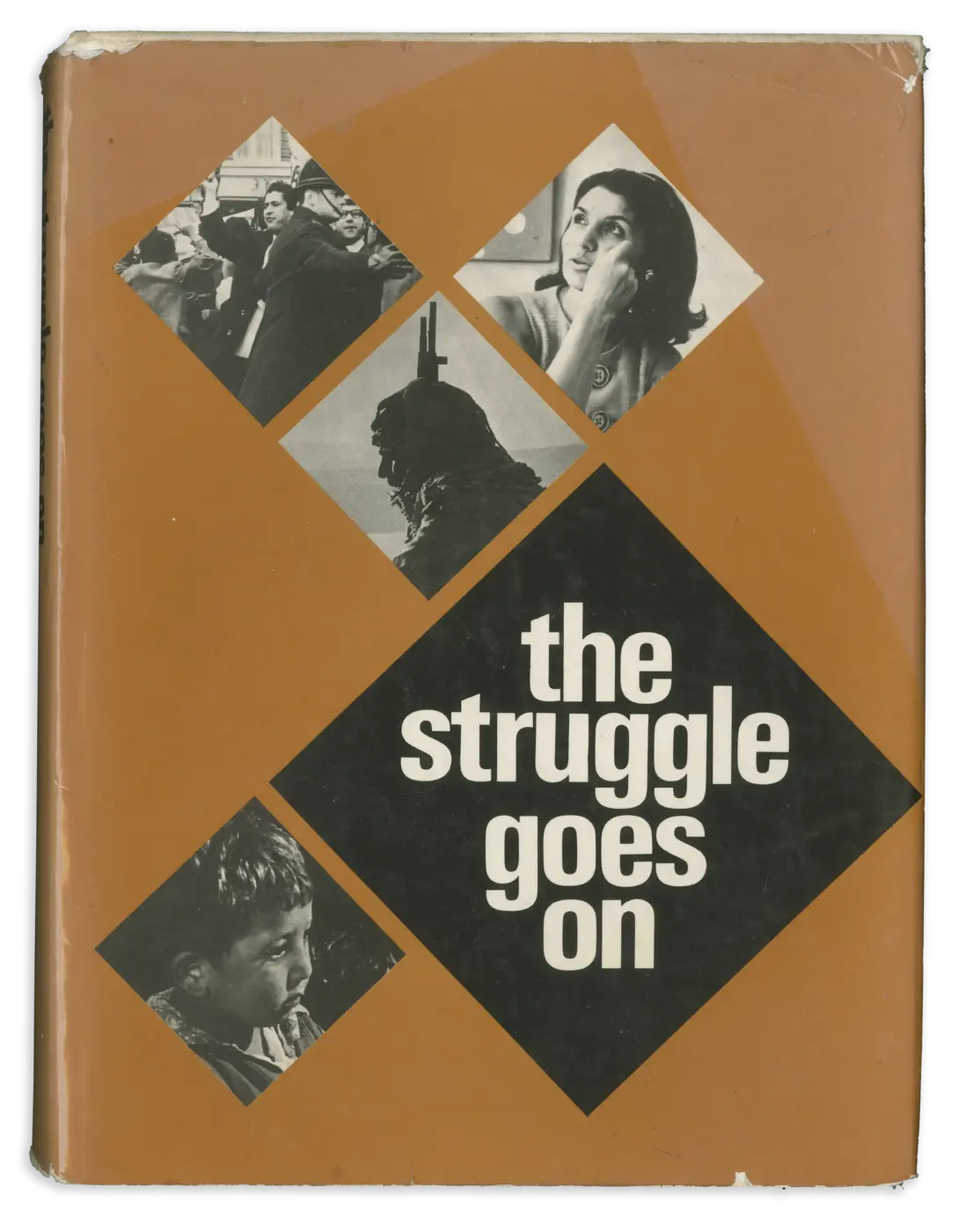

The book’s bold English title appears directly beneath the photographs: The Struggle Goes On. Below it, the face of a child looks outward with an expression that seems at once troubled and accusatory. Whatever ambiguity the cover retained was dispelled by the statement printed on the book jacket’s front flap:
‘This book is the first to make use of the dynamic process of the art of photography to give form to the identity of the Palestinians and to explain the facts of their case. The account begins with the everydayness of their life today, in exile or under occupation, and recalls their past and the events which led up to the full occupation of their country and the complete collapse of its structure. Like the pieces in a kaleidoscope, the facts begin to fall into a recognizable pattern and the Palestinian nationalist movement of today emerges as an outgrowth of the vital movements which have dominated this area since the turn of the twentieth century. Many countries which had for a long time sought self-determination have in the last two decades achieved it. But for the Palestinians, the struggle goes on…’3
The language felt uncannily contemporary. Were it not for the historical references embedded in the passage, the book might easily have been published in recent years. The Palestinian condition it describes persists in many ways. What struck me most, however, was its understanding of photography: not merely as a tool of documentation, illustration, or proof, but as part of a dynamic artistic process capable of giving form to the experience of a people whose history had been defined by fragmentation and dispossession.
The circumstances of the book’s production gradually became clearer as I turned its pages. Edited by Aida Karaoglan, The Struggle Goes On was among the many publications produced by the Palestine Liberation Organization’s Research Center in Beirut, then headed by Palestinian intellectual Anis Sayigh.4 It was published in 1969, only two years after the 1967 Arab-Israeli War and four years after the Center’s establishment. It belonged, in other words, to a formative moment in which the Palestinian national movement was not only being politically reorganized but also searching for new intellectual and visual forms through which to narrate itself. The book’s urgency lay precisely there: in its attempt to turn photography into a field of historical argument and to transform the scattered evidence of Palestinian life into the image of a persistent, ongoing struggle.
To better understand The Struggle Goes On, it is useful to situate it within a broader transformation in the political use of photography during the mid-twentieth century. Across the 1960s and 1970s, a period marked by decolonization, anti-imperialist struggle, and civil rights mobilization, the photobook emerged as an especially powerful vehicle for political argument. What might be called the militant photobook was not defined by a single aesthetic or political programme. Its practitioners nevertheless shared a conviction that photographs acquired political force through their selection, arrangement, captioning, and circulation.
Such books did more than collate images taken in the midst of political struggle. Dirk Alvermann’s Algerien (1960), produced in solidarity with the Algerian struggle against French colonial rule, combined photographs with political documents, military statements, pamphlets, and press extracts. Alvermann initially conceived it in a small, inexpensive format that could pass from hand to hand like a political manifesto. In the United States, The Movement: Documentary of a Struggle for Equality (1964) brought photographs by Danny Lyon and others into dialogue with texts by Lorraine Hansberry, turning the activities of the civil rights movement into a visual and narrative account. Three years later, the South African photographer Ernest Cole’s House of Bondage (1967) organized images of work, education, transport, policing, and domestic life into an indictment of the structures of apartheid; the book was soon banned in South Africa.5
A few years after The Struggle Goes On was released, Philip Jones Griffiths’s Vietnam Inc. (1971) would similarly bring photographs and extended commentary together to challenge the official American representation of the war in Vietnam. Moving between the destruction of war and the textures of Vietnamese rural life, it demonstrated how the photobook could sustain a political argument more complex than any single image or magazine spread.6
These publications differed considerably in authorship, audience, and political context. Yet each treated the book as more than a neutral receptacle for photographs. Through montage, sequence, repetition, collage and the interplay of text and image, the photobook could reorganize the visual evidence of political events into a portable historical argument. Usually reproducible, inexpensive, and easily transported, it could move between organizations, conferences, universities, libraries, bookshops, and private homes. Through the photobook, pictures produced in the immediacy of struggle were thereby detached from the fleeting temporality of newspapers and magazines and assembled into narratives intended to endure.
The militancy of such books, including The Struggle Goes On, did not necessarily reside in images of armed struggle alone. It could also lie in the act of making visible the structures that produced violence: the train journey under apartheid, the organization of a demonstration, the routines of village life during war, or the persistence of ordinary life under occupation. Their political force emerged from the relationship constructed between images. A photograph that might appear isolated or ambiguous on its own could, when placed within a carefully composed sequence, become part of a larger account of oppression, collective identity, and historical transformation.
The Struggle Goes On also belonged to a longer history of Palestinians using photography to document and disseminate the quests of their national movement. One of the clearest earlier examples emerged from the political upheavals of the early 1930s, when Palestine was under British colonial rule. In 1933, Palestinian demonstrations were met with extensive violence by the British police, in events that anticipated the broader mobilization of the Great Palestinian Revolt three years later. In response, Theodore Sarrouf, a Palestinian publisher based in Jaffa, assembled a photographic volume documenting the repression of unarmed demonstrators.7
Interestingly, Sarrouf described the publication as a ‘pictorial souvenir’.8 Whether or not the phrase was deliberately ironic, it carried a striking charge. In Palestine, souvenirs had long belonged to the commercial visual culture of the Holy Land. Since the late nineteenth century, photographic albums produced for foreign travelers assembled biblical landscapes, ancient monuments, local costumes, and supposedly timeless ways of life into compact, transportable objects. They promised a form of visual possession: the Holy Land could be encountered through a sequence of picturesque scenes, purchased, and carried away.
Sarrouf appropriated this familiar format only to reverse its visual and political logic. In place of an idealized biblical landscape, he presented evidence of contemporary colonial repression. The picturesque panorama gave way to the injured Palestinian body; the timeless Holy Land to a society caught within an unfolding political struggle. His ‘souvenir’ did not allow the viewer to remain a detached traveller. It carried the evidence of violence beyond the place of its occurrence and asked its readers to become witnesses to it. It was, in that sense, a souvenir of a different kind: a souvenir of colonial atrocities.
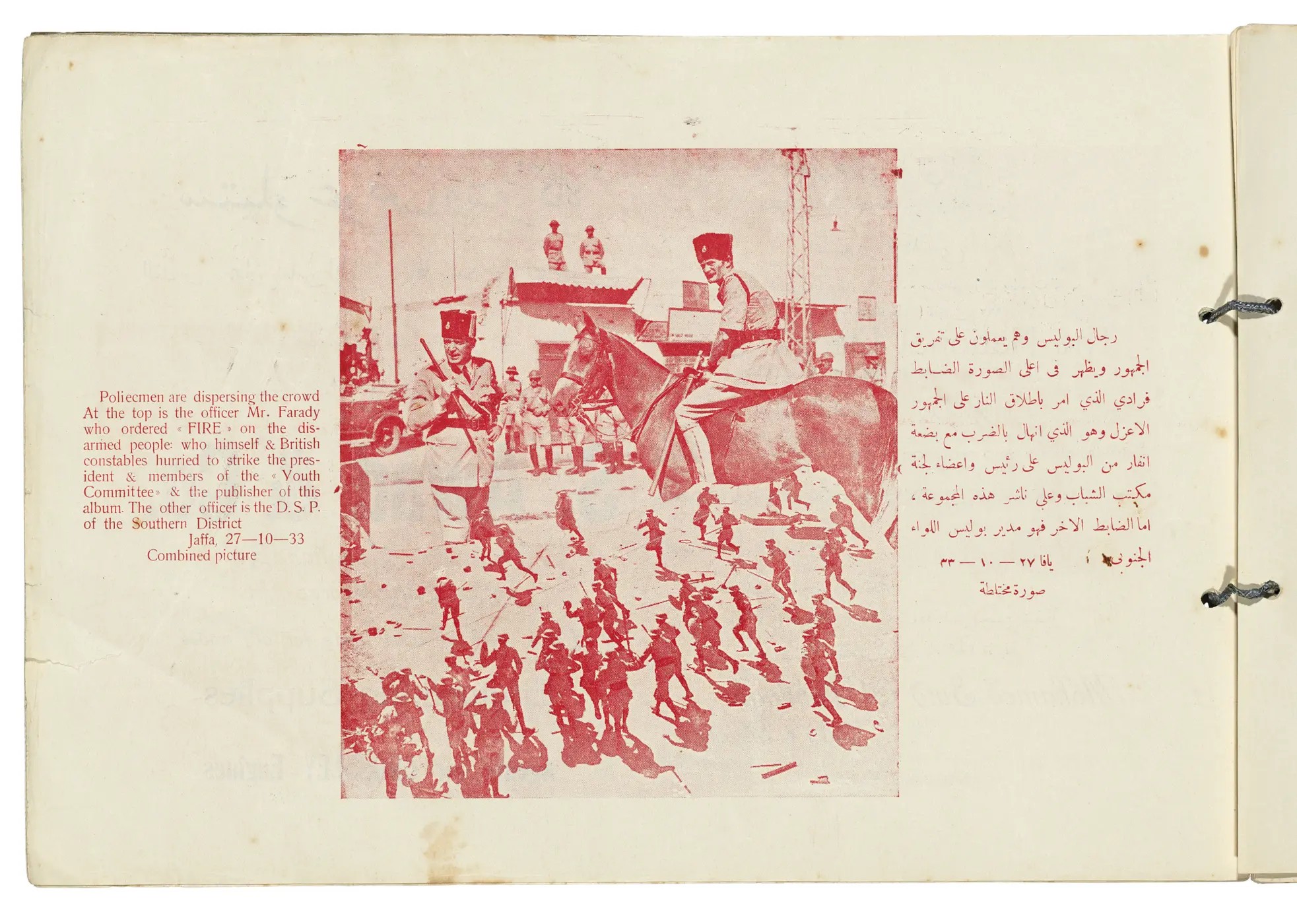
Like Sarrouf’s ‘pictorial souvenir’, The Struggle Goes On was intended to carry a Palestinian visual argument beyond the immediate site of struggle, and its use of English was therefore integral to its political function. Within the PLO Research Center’s publishing programme, overwhelmingly dominated by Arabic-language scholarship, it was among the relatively few publications directed towards foreign residents in Lebanon and readers in Europe and the United States.9
Yet, published in a markedly different revolutionary moment, the book expanded the argument Sarrouf’s album had begun to make. Although it reproduced some of the same visual evidence of colonial violence, such violence constituted only one part of a broader political history encompassing displacement, exile, resistance, and the persistence of a people whose political existence had repeatedly been denied.
The difference could perhaps be understood as a difference in the work demanded of Palestinian photography itself. Sarrouf’s book sought to expose a colonial crime. The Struggle Goes On sought to present an entire people as a historical and political subject. It did not merely ask its readers to recognize what had been done to the Palestinians. It asked them to recognize who the Palestinians had become, what they were struggling for, and why that struggle goes on.
The political power of photography was not unfamiliar to the PLO when The Struggle Goes On appeared in 1969. Throughout the 1960s, Palestinian photographers, artists, and eventually filmmakers increasingly turned to visual media to document the struggle and construct the image of its revolutionary subject.10 Central to this vocabulary was the armed, mobile, politically conscious fida’i. The guerrilla embodied the transformation of Palestinians, in Rosemary Sayigh’s formulation, ‘from peasants to revolutionaries’.11 In this same period, artist-photographers such as Ismail Shammout, among others, helped recast the Palestinian not simply as a dispossessed refugee, but as an agent of liberation.12
Shammout’s Mujaz tarikh Filastin al-musawwar (Palestine: Illustrated Political History), published in 1972 with a preface by Shafiq al-Hout, was perhaps the clearest embodiment of this ethos. Combining illustration and photography, the book mobilized images to narrate the Palestinian cause through a sweeping political history. Beginning with prehistoric Palestine and moving through the Canaanites, Hebrews, Islamic conquest, and Crusades, it then leaps forward to Zionist immigration, the Balfour Declaration, the 1936 Palestinian Revolt, and the 1967 Arab-Israeli war. The result is a compressed, and heavily didactic, account in which a long history of Palestine culminates in the modern Palestinian struggle for a democratic Palestinian state.
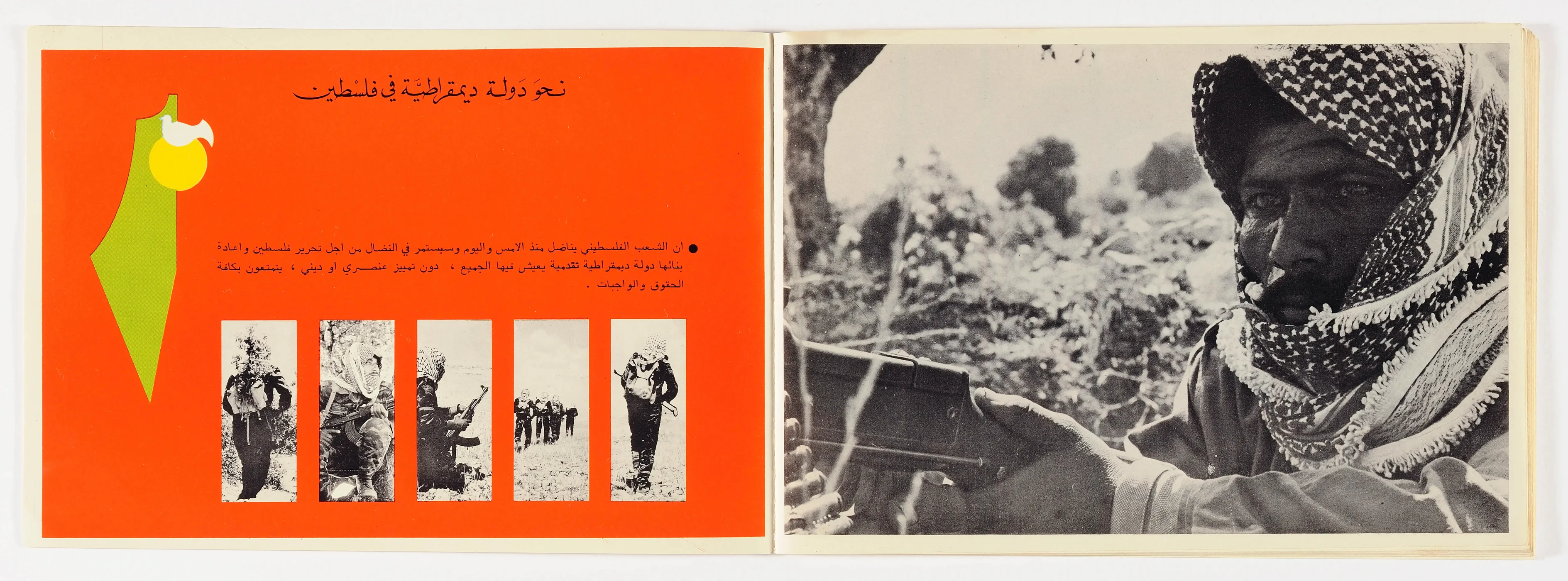
The Struggle Goes On belongs to this visual and political tradition, but it also exceeds it. The book neither restricts the Palestinian struggle to armed resistance nor makes the militant its exclusive subject. Instead, it places the revolutionary image within an account of endurance, intellectual achievement, cultural continuity, and everyday life. The fighter is one figure within its visual world, but so too are the scientist, artist, farmer, student, and artisan. Together, they embody a determination both to resist dispossession and to remake Palestinian life.
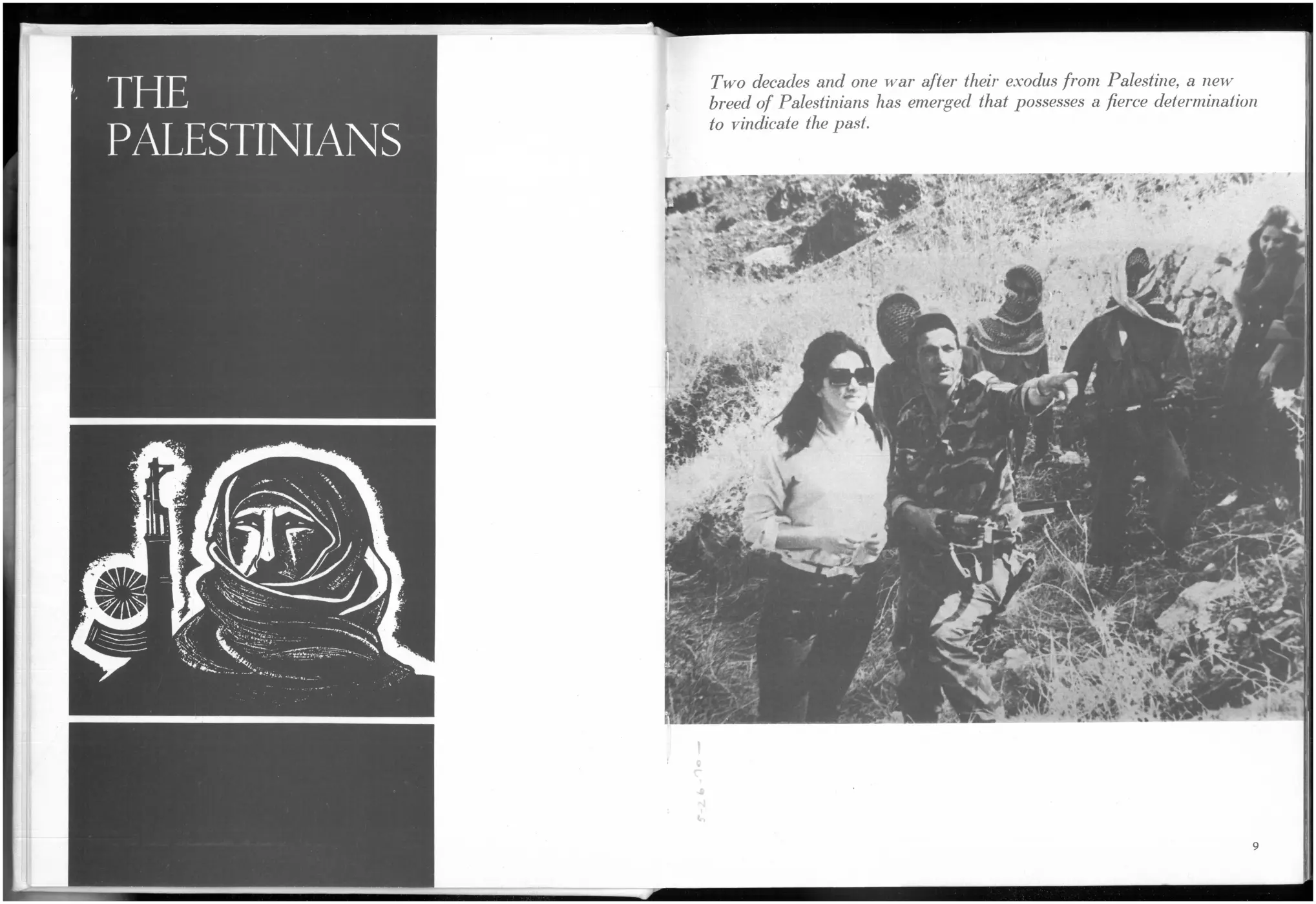
The book’s opening pages establish the conditions from which the revolutionary subject emerged. In ‘The Palestinians’, an etching by Mustafa al-Hallaj showing a man raising his arms appears opposite a photograph of the author among militants. The accompanying text announces that, ‘two decades and one war after their exodus from Palestine, a new breed of Palestinians has emerged that possesses a fierce determination to vindicate the past’.13 Characteristic of the post-1967 moment, military defeat is answered here by a political subject no longer willing to entrust the Palestinian future to others.
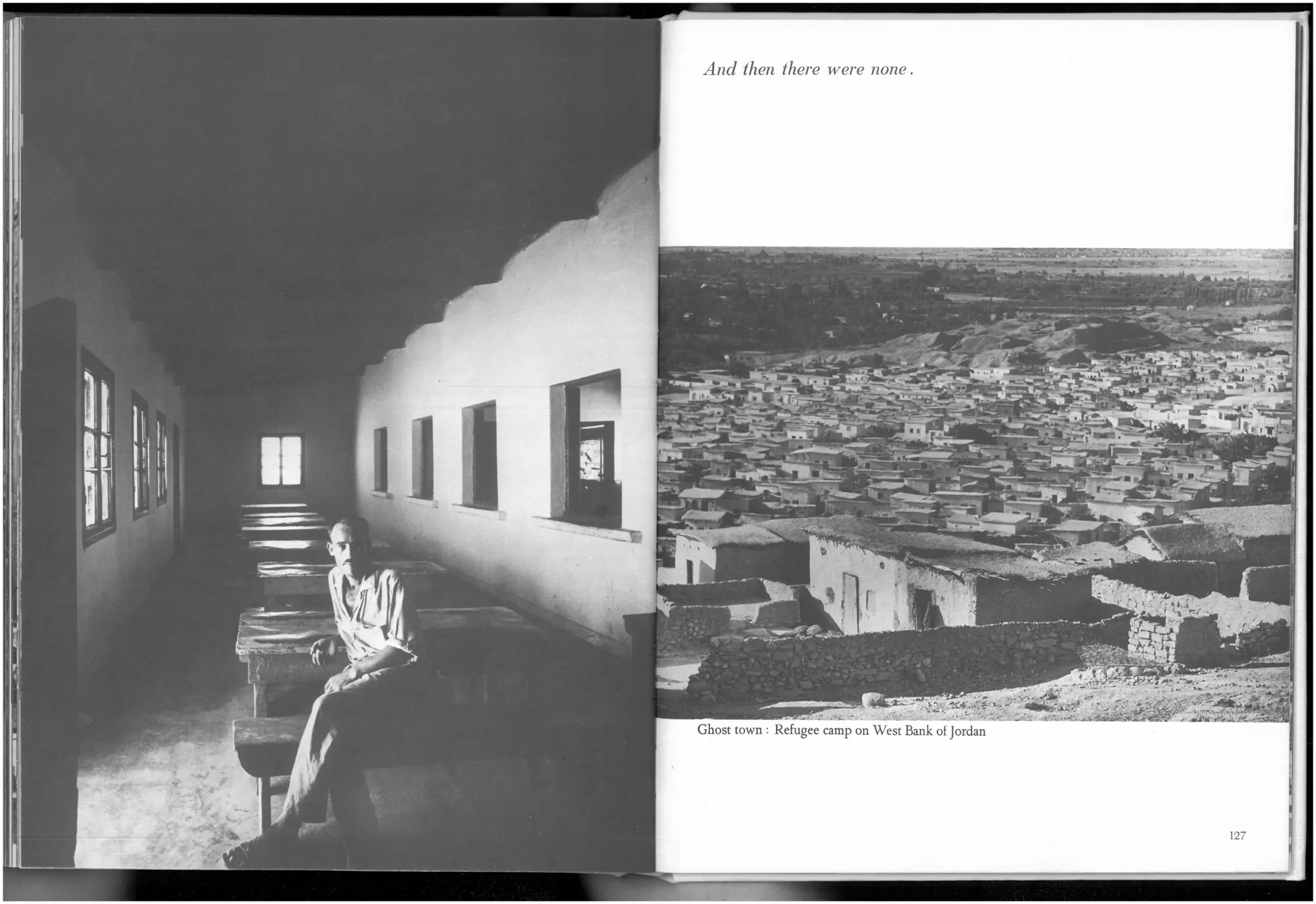
Yet militancy is never detached from the fractured world that produced it. The book describes Palestinian life, in exile and under occupation, as consumed by ‘the sheer effort of preserving an individual existence and collective identity’.14 Photographs show storm-soaked camps, young men seated before barbed wire under Israeli guard, families crossing the Jordan River bridges, and crowded conditions across Palestine and neighbouring Arab countries.
A later section, ‘The Invasion of Palestine’, gives this condition a longer history. Beginning with Theodor Herzl and a ship carrying Jewish immigrants towards Palestine, it moves through Zionist settlement, British colonial rule, the suppression of the 1930s revolt, and the violence of 1948. Photographs of arrests, destroyed towns, Arab fighters, and the failures of the United Nations assemble a genealogy of dispossession. Militancy thus appears as the consequence of prolonged colonial violence and political abandonment.15
The book’s most distinctive intervention, however, lies in what it places beside this history. It does not merely oppose the colonizer with the heroic image of the colonized, nor does it allow Palestinian identity to become synonymous with victimhood or militancy alone. Images of destruction and displacement are interwoven with photographs of education, artistic production, scientific research, religious ceremony, agriculture, and craft.
‘About fifty thousand Palestinian Arabs have graduated from college since 1948’, the book states beside photographs of scientists working in laboratories at the American University of Beirut.16 A larger image shows the artist Jumana al-Husseini alongside Dr Adel Afifi operating an electron microscopy unit. Elsewhere are scenes of religious celebrations, a portrait of a history professor, and even a university beauty queen.17
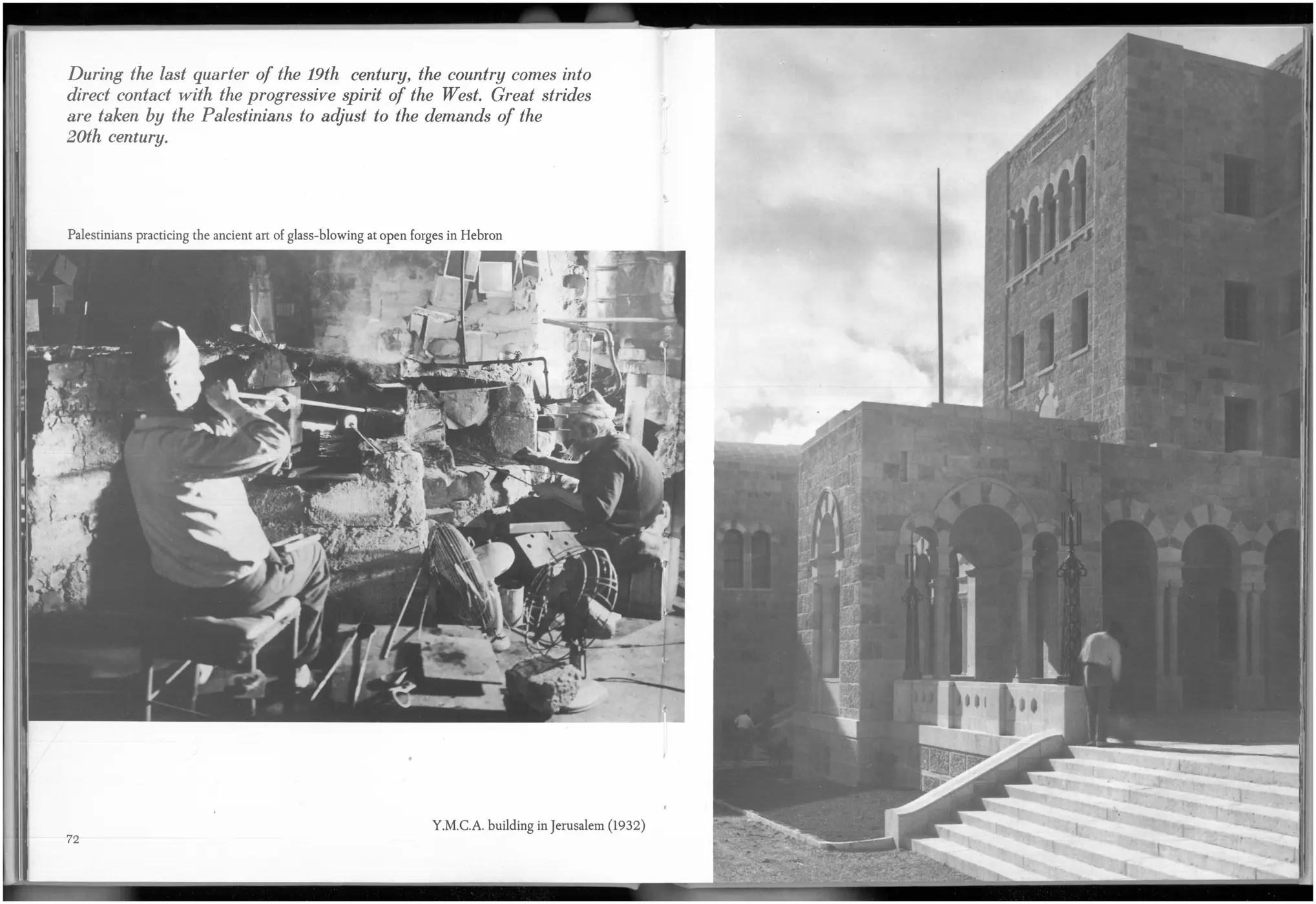
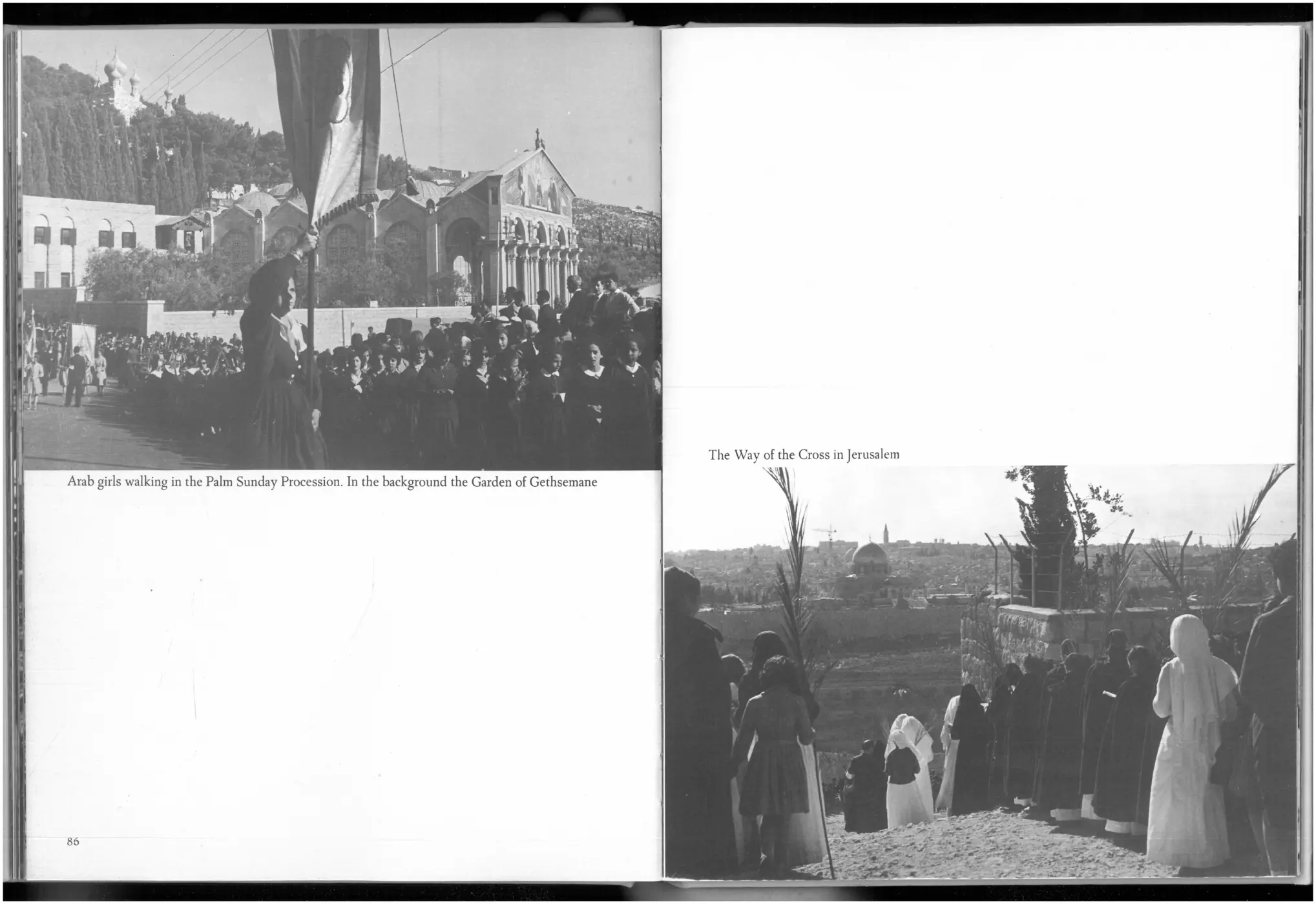
These images carry a particular historical weight. Elsewhere in the region, the educated and urban classes are often disproportionately present in the photographic archive: they possessed cameras, commissioned portraits, inhabited institutions, and produced records of their own lives. In the Palestinian case, this expected archival privilege was fractured by displacement and the dispersal or destruction of collections, while the dominant revolutionary iconography of the 1960s and 1970s elevated other figures—namely, the refugee, the fellah, and the fida’i—as the principal embodiments of the national struggle. One consequence is a peculiar inversion: the professionals, artists, scientists, and urban social worlds ordinarily most visible in modern archives can be surprisingly difficult to see in the visual memory of this period. Their recovery would become more pronounced only in later archival and historiographical work.
Their appearance in The Struggle Goes On is therefore not incidental, nor does it merely offer moments of respite from images of violence. These photographs are themselves political evidence. Education resists the reduction of the Palestinian to the dependent refugee; artistic and scientific achievement asserts a people fully engaged in modern intellectual and cultural life; agriculture affirms an enduring relation to land; and craft gives material form to continuities that displacement had failed to sever. The book’s argument is not simply that Palestinians endured, but that a complex social world endured with them. The quotidian is not outside the struggle; it is among the things the struggle seeks to preserve.
The book therefore advances two inseparable narratives. The first is a story of Zionist colonization and Palestinian resistance: dispossession and fragmentation, but also the decision to take up arms and reclaim political agency, especially after 1967. The second is a story of a tenacious will to life: the capacity to study, work, cultivate, create, worship, and celebrate under conditions intended to make such continuities impossible. One concerns the defense of life; the other, the lives being defended.
This duality also broadens the meaning of iltizam, or political commitment, which had been a key topic of discussion for Arab writers, artists, musicians, and intellectuals during the 1960s.18 For this milieu, commitment was a question not only of subject matter, but of form: what should committed cultural production depict, and how should it make politics visible? The Struggle Goes On offers one answer through photography. Commitment need not consist solely in representing the militant or battlefield. It may also reside in revealing the ordinary forms of life that make resistance meaningful.
This understanding returned to me as I left al-Furat. From the bookshop, it is only a short walk to Sadat Street, where the PLO Research Center once stood before it was bombed by Israeli forces in 1983.19 The building still stands as a ghost of its former self: a phantom presence. The orange book had emerged from the shelves of an archive-like bookshop only minutes from the former site of the institution that produced it. Few places condense history as powerfully as Beirut.
As I walked, I recalled two photographic envelopes from Anis Sayigh’s collection that I had consulted at the American University of Beirut.20 One contained photographs documenting the Israeli attacks on the Research Center during the 1970s and 1980s and the destruction inflicted upon it. Many similar photographs would later circulate in international media reporting on the events.21 The other envelope preserved a very different, and seldom seen, photographic record: the Center during its active years, the people who worked and gathered there, and scenes from Sayigh’s personal and family life.
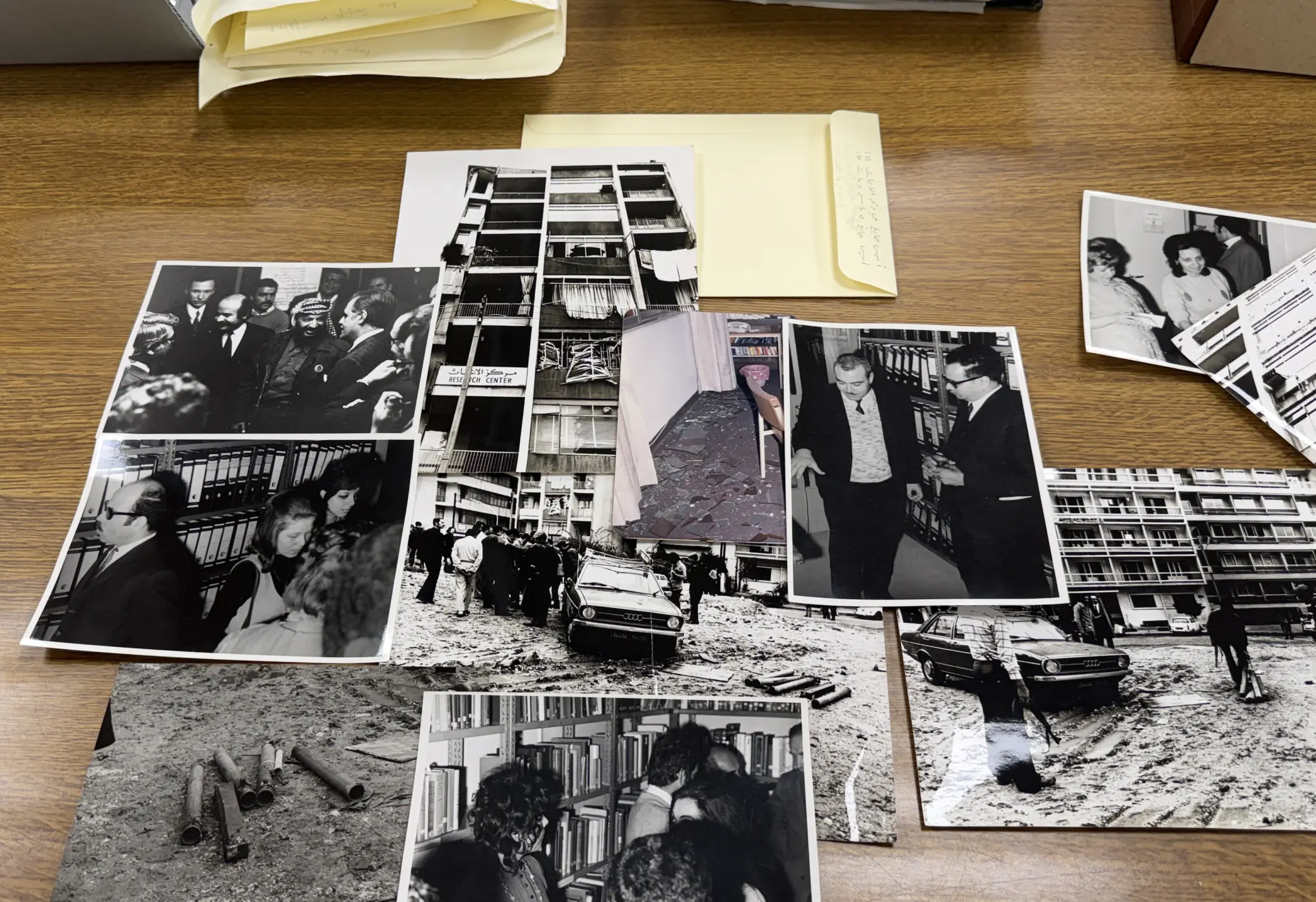
I opened the two files on the archive table. Seen together, the photographs conveyed more than either file could on its own. The images of destruction revealed what had been attacked; those of work, friendship, and family revealed what had been at stake. Their juxtaposition echoed the central duality of The Struggle Goes On: photography as evidence both of the violence directed against Palestinian life and of that life’s refusal to disappear. The struggle goes on because life goes on. Through photographs, books, and archives, Palestinians preserve not only the traces of destruction, but the life that destruction sought to erase.
Nadi Abusaada is an Assistant Professor of History and Theory of Art and Architecture in the Islamic World at the American University of Beirut. He is also the Head Curator of The Palestinian Museum. He is the co-editor of the two books Arab Modern: Architecture and the Project of Independence (gta Verlag, 2015) and Resurgent Nahda: The Arab Exhibitions in Mandate Jerusalem (Kaph Books, 2014). Abusaada holds a PhD in architecture from the University of Cambridge and has held several prestigious fellowships including the Aga Khan Postdoctoral Fellowship in Islamic Art and Architecture at the Massachusetts Institute of Technology (MIT) and the ETH Zürich Postdoctoral Fellowship. He is also an incoming 2026 Jameel Fellow at the Victoria and Albert Museum in London.
- The online exhibition and resource, Decolonizing the Page: A Forgotten Golden Age of Arabic Book Arts (1950s–80s), where this essay sits, includes numerous additional works sourced from the Abboudi Bou Jawde (Al-Furat Bookshop) collection. ↩︎
- Serene Husseini Shahid, Jerusalem Memories, introduction by Edward W. Said (Beirut: Naufal, 1999); ‘Stitch by Stitch’, Bespoke Magazine, accessed August 7, 2026, https://bespoke-magazine.com/235/Article/Stitch-by-Stitch/. ↩︎
- Aida Karaoglan, ed., The Struggle Goes On (Beirut: Research Center, Palestine Liberation Organization, 1969), opening leaf, n.p. ↩︎
- For a history of the Center, see Hana Sleiman, ‘The Paper Trail of a Liberation Movement’, Arab Studies Journal 24, no. 1 (Spring 2016): 42–67; Jonathan Marc Gribetz, Reading Herzl in Beirut: The PLO Effort to Know the Enemy (Princeton, NJ: Princeton University Press, 2024), 9–42. ↩︎
- Dirk Alvermann, Algerien (Berlin: Rütten & Loening, 1960); Steidl, ‘Dirk Alvermann: Algeria’, accessed August 7, 2026, https://steidl.de/Books/Algeria-0409255459.html; Lorraine Hansberry, The Movement: Documentary of a Struggle for Equality, photographs by Danny Lyon and others (New York: Simon and Schuster, 1964); Ernest Cole, House of Bondage (New York: Random House, 1967). On the book’s banning in South Africa, see Museum of Modern Art, ‘Ernest Cole’s House of Bondage: A Look at Apartheid in South Africa’, accessed August 7, 2026, https://www.moma.org/magazine/articles/888. ↩︎
- Philip Jones Griffiths, Vietnam Inc. (New York: Collier Books, 1971). ↩︎
- Theodore Sarrouf, Photographs of the Demonstrations Which Took Place in Palestine 1933 (Jaffa: Press and Publication Office, 1934); For an analysis of the album in the context of Mandate-era Palestinian photography, see Nadi Abusaada, ‘Urban Encounters: Imaging the City in Mandate Palestine’, in Imaging and Imagining Palestine: Photography, Modernity and the Biblical Lens, 1918–1948, ed. Karène Sanchez Summerer and Sary Zananiri (Leiden: Brill, 2021), 359–89, esp. 380–82. ↩︎
- Ibid. ↩︎
- Gribetz, Reading Herzl in Beirut, 26–42. ↩︎
- On the politics of Palestinian visual art in the 1960s, see Zeina Maasri, Cosmopolitan Radicalism: The Visual Politics of Beirut’s Global Sixties (Cambridge: Cambridge University Press, 2020). ‘Revolutionary Palestinian filmmaking took off when the Fatah movement set up the Palestine Film Unit, which took shape thanks to the efforts of a group of filmmakers including Hani Jawhariyyeh, Salafa Mersal, and Mustafa Abu Ali. This unit helped to establish the Palestinian Film Group, which joined the PLO Research Center, which produced a single film in 1973, Mashahid min al-ihtilal fi Ghazza (Scenes from the Occupation in Gaza) by Palestinian director Mustafa Abu Ali, a 13-minute documentary on the harsh reality in the towns, villages, and camps in the Gaza Strip’. Quoted from: https://www.palquest.org/en/highlight/32840/palestinian-cinema. ↩︎
- Rosemary Sayigh, Palestinians: From Peasants to Revolutionaries: A People’s History (London: Zed Press, 1979). ↩︎
- For a close study of the visual culture of the fida’i, including Shammout’s work, see Cosmopolitan Radicalism, 181-190. ↩︎
- Karaoglan, The Struggle Goes On, ‘The Palestinians’, 9-10. ↩︎
- Karaoglan, The Struggle Goes On, 12. ↩︎
- Karaoglan, The Struggle Goes On, ‘The Invasion of Palestine’, 94. ↩︎
- Karaoglan, The Struggle Goes On, 30-31. ↩︎
- Karaoglan, The Struggle Goes On, 32-33. ↩︎
- On debates regarding iltizam in 1960s Beirut, see Yoav Di-Capua, No Exit: Arab Existentialism, Jean-Paul Sartre, and Decolonization (Chicago: University of Chicago Press, 2018), 77–107. On the manifestations of this debate in the artistic sphere, see Cosmopolitan Radicalism. Also see Nadi Abusaada, ‘The Many Worlds of Palestinian Art: Disrupted Journeys and Awakened Pasts’, The Avery Review, no. 69 (November 2024), https://www.averyreview.com/issues/69/the-many-worlds-of-palestinian-art. ↩︎
- On the 1982 Israeli raid and looting of the PLO Research Center and the subsequent 1983 bombing of the Center, see Sleiman, ‘Paper Trail of a Liberation Movement’, 42–67; Gribetz, Reading Herzl in Beirut, esp. 26–42. ↩︎
- American University of Beirut, Archives and Special Collections Department, Anis Sayigh Collection, 1949–2010: A Finding Aid to the Collection at the University Libraries, AUB, prepared by Dalya Nouh (Beirut, 2021), Series VI, Box 9, envelopes 2 and 10. ↩︎
- Thomas L. Friedman, ‘18 Die in Bombing at P.L.O.’s Center in Western Beirut’, New York Times, February 6, 1983. ↩︎