How do children witness war? Seta Manoukian’s ‘Lebanese children and the war’
Gregory Buchakjian
03.08.2026
In the wake of the fifth Israeli invasion of Lebanon in March 2026, the Buddhist nun Ani Pema Tsultrim Drolma, also known as Seta Manoukian (b. 1945), the Lebanese-Armenian painter who is my father’s cousin, called from Los Angeles to ask whether we were safe. As we spoke, I wondered whether to tell her that I had been invited to write about Lebanese Children and the War, a project she had initiated half a century earlier. Faced with the brutality of the present war, it did not seem the right moment.

At the time of writing, at least 247 children had been killed and 992 injured during the ongoing Israeli assault on Lebanon. According to the UN News agency, this amounts to an average of 12 children being killed or maimed every day since hostilities escalated.1 Tens of thousands of children from South Lebanon, Beirut’s Southern Suburbs and other regions of the country have lost their homes and may never see them again. A day or so before Manoukian’s call, the world witnessed the massacre of 150 schoolgirls in Minab, Iran, amid the surge of violence that began in Iran and spilled over into Lebanon. Meanwhile, thousands, perhaps hundreds of thousands, of children in Palestine had been killed, while many more were severely injured, amputated, orphaned, and left physically and psychologically devastated. One recent UN report reveals how the systematic targeting of Palestinian children has fundamentally undermined the conditions of childhood itself.2 Nor was Palestine an isolated case. From Yemen and Sudan to Afghanistan and elsewhere, successive conflicts continued to inflict comparable devastation on civilian populations, particularly children.
‘We are the children of war’
What does it mean to be a child of war? What does it feel like to hear and see bombings, to move from one place to another, and to witness atrocities? Since the beginning of the twentieth century, scholarship in the fields of psychology and psychoanalysis has formulated how ‘disasters can destroy the routine and daily functioning of any age group. Children are especially reliant on routines […]. Disasters can also affect children’s beliefs regarding their own vulnerability, their parents’ ability to protect them, and the safety of the world in general’.3 In the aftermath of the Lebanese Civil War (1975–90), one study concluded that ‘on average, a Lebanese child experienced six different types of war traumas, and some were experienced several times’.4
Aged four in 1975, I belong to this generation. My childhood was marked by endless days and nights of shelling, spent hidden in the bathroom, or in a makeshift shelter, by forced displacement, and by scenes of urban warfare. Because I was not physically harmed, I belong to the category of ‘indirect victims’:
‘In countries at war, children become both direct victims of violence, as in the much-publicised case of the child burn victim in Iraq, or indirect victims, in the sense of witnessing combat and conflict related atrocities. Children’s lives are often further disrupted by family instability and the breakdown of health and educational structures’.5
As a child, did I express what I was going through? Not especially. The only instance I recall occurred in 1987, during an international pacifist youth camp in the United States, when two classmates and I gave a presentation about Lebanon. It opened with a slide of the cover of Time, 16 August 1982, bearing the headline ‘Destroying Beirut’ above a view of a seaside cityscape in flames. Looking at the image, I said: ‘This is a slide of my house’. Many of the camp participants came from places marked by conflict and dispossession, including Palestinians from Jerusalem and the West Bank. Together, we took part in a collective performance centred on a song that declared: ‘We are the children of war’.6 Did my classmates and I draw or paint the war? I have no recollection of having done so. It was only much later that I became aware of children’s representations of violence and their significance. As they are ‘unaware of art’s “rules”, [children] don’t imitate; they go straight to the point of what is in their heads’.7 Furthermore, drawing has long been used in psychiatric and therapeutic contexts as a means of diagnosing and addressing trauma. It also provides a powerful medium through which individuals and communities can articulate experiences of violence, displacement, and collective oppression.8
Encountering Lebanese Children and the War
Seta Manoukian’s work remained largely absent from art-historical scholarship for decades and has only recently become the subject of the first monograph devoted to her practice, Seta Manoukian. Painting in Levitation. I contributed to this book with an essay largely based on the visions of the war-torn city she constructed during the 1970s and 1980s. One of the earliest paintings in this sequence, After the Bombing (fig. 3), depicts an unidentified girl whose blurred face allows her to stand in for any child, running from danger and out of a frame ‘displaying a space like a movie set’.9
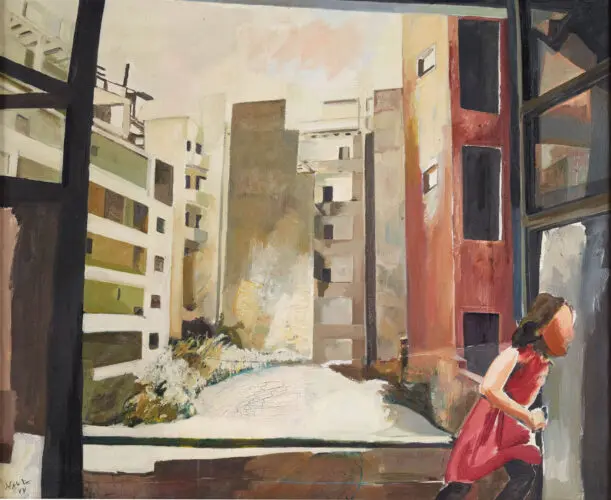
A note in the artist’s biographical chronology briefly mentions that, in 1976, Manoukian began teaching painting to children in disadvantaged areas of Beirut, leading to the publication of Lebanese Children and the War by Dar al-Farabi. This project was developed at roughly the same time as After the Bombing, suggesting a close temporal relationship between her engagement with children affected by the war and her own artistic response to the conflict. Following the Israeli invasion of Lebanon in 1982, she continued this work with displaced children, whose artwork was subsequently collected in Traces rouges et bleues, published by the League for Lebanese Women’s Rights.10 In a conversation with researcher and curator Kristine Khouri, published in the same monograph, Manoukian elaborates on the project:
‘I wanted to do something for the children who were living through the violence. My natural inclination was to teach children painting, so I went somewhere between the two sides of divided Beirut, where there was an empty school, perhaps bombed, but where children were playing outside. When I set up an area to draw, children joined enthusiastically. I still recall a small child, aged about ten, who stood amid the rubble, but was dressed up, with neatly cut hair. He had so much self-respect. He painted flowers, and I remember him writing that he didn’t have to prove to me that he was an artist. He wished me a good day, thanked me, and left. There was an Armenian club in Beirut where Kurdish, Armenian and Palestinian children would go, and I also taught there, as well as in the school yard of the Ahlieh school where Palestinians and immigrants from South Lebanon were living in classrooms. One day, the English journalist Robert Fisk wanted to sit in one of my art class, but when we arrived, the school was empty since it had been hit by a bomb the night before. I have another memory of Palestinian children drawing a boat that would take them from Lebanon, and they painted the boat idealistically. They were so excited, talking about taking the boat to sea. Working with the children reminded me how they rarely see the negative side of the world, but of course, when they do, it becomes a huge trauma that they carry with them’.11
At the time, I paid little attention to this aspect of her work. My encounter with Lebanese Children and the War coincided with the fiftieth anniversary of the outbreak of the Lebanese civil war. In the spring of 2025, Zeina Maasri introduced me to Decolonizing the Page and showed me a copy of the book. As the object lay on the table, not yet open, an intense emotion traversed me. Beyond my affection for Seta Manoukian, and my own chronological and geographical proximity to the children whose drawings it contains, the object itself seemed to radiate a special energy, an aura.
Largely forgotten by the general public and overlooked by art historians, including myself, Lebanese Children and the War was revisited in 2022 by the historian Nova Robinson in an edited volume entitled Women’s War Stories.12 Robinson’s analysis draws primarily on Manoukian’s testimony about the project and its therapeutic dimension. Yet the work also merits sustained attention as both an artistic object and a significant cultural artefact of the Lebanese Civil War.
A singular object
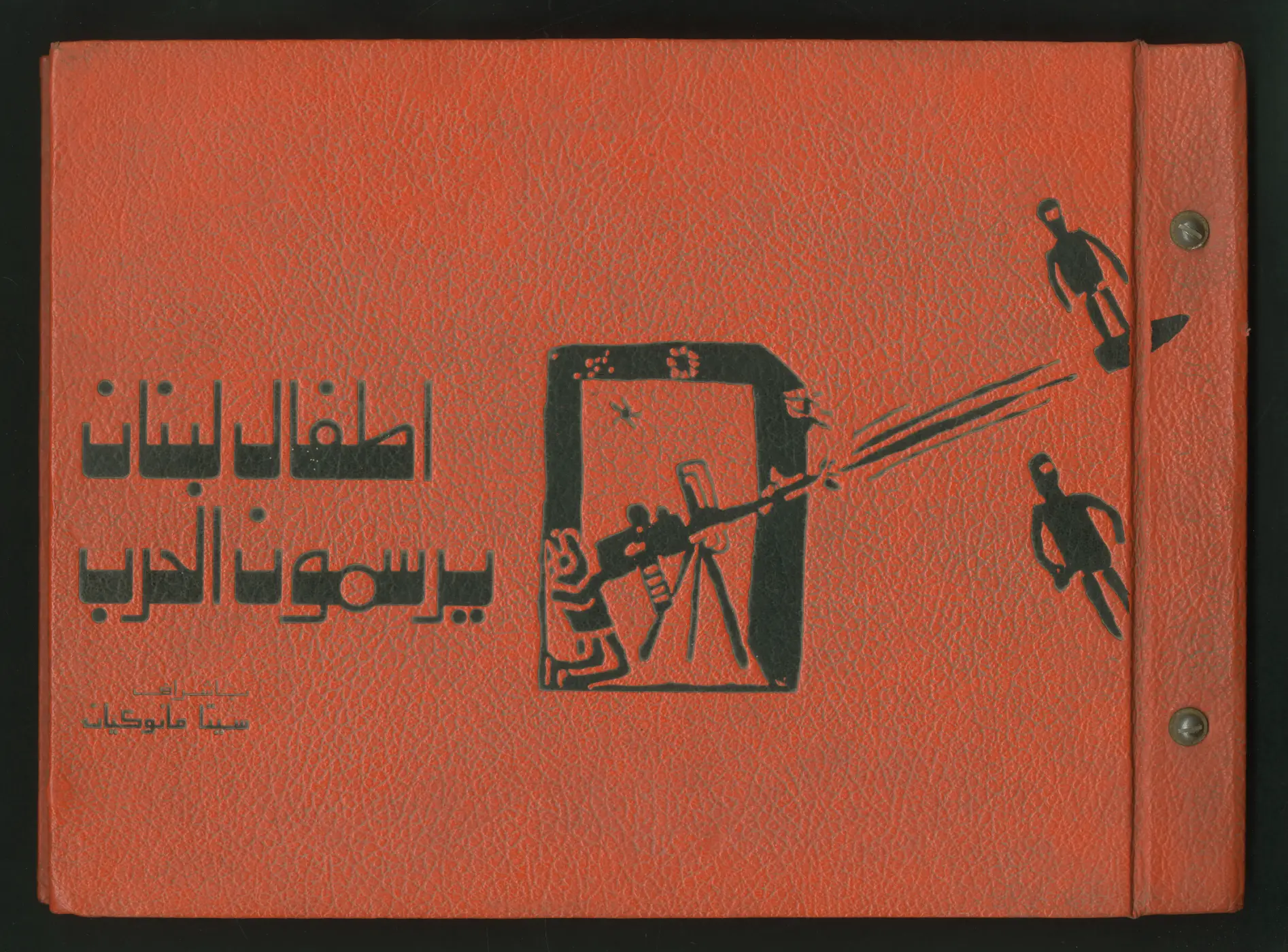
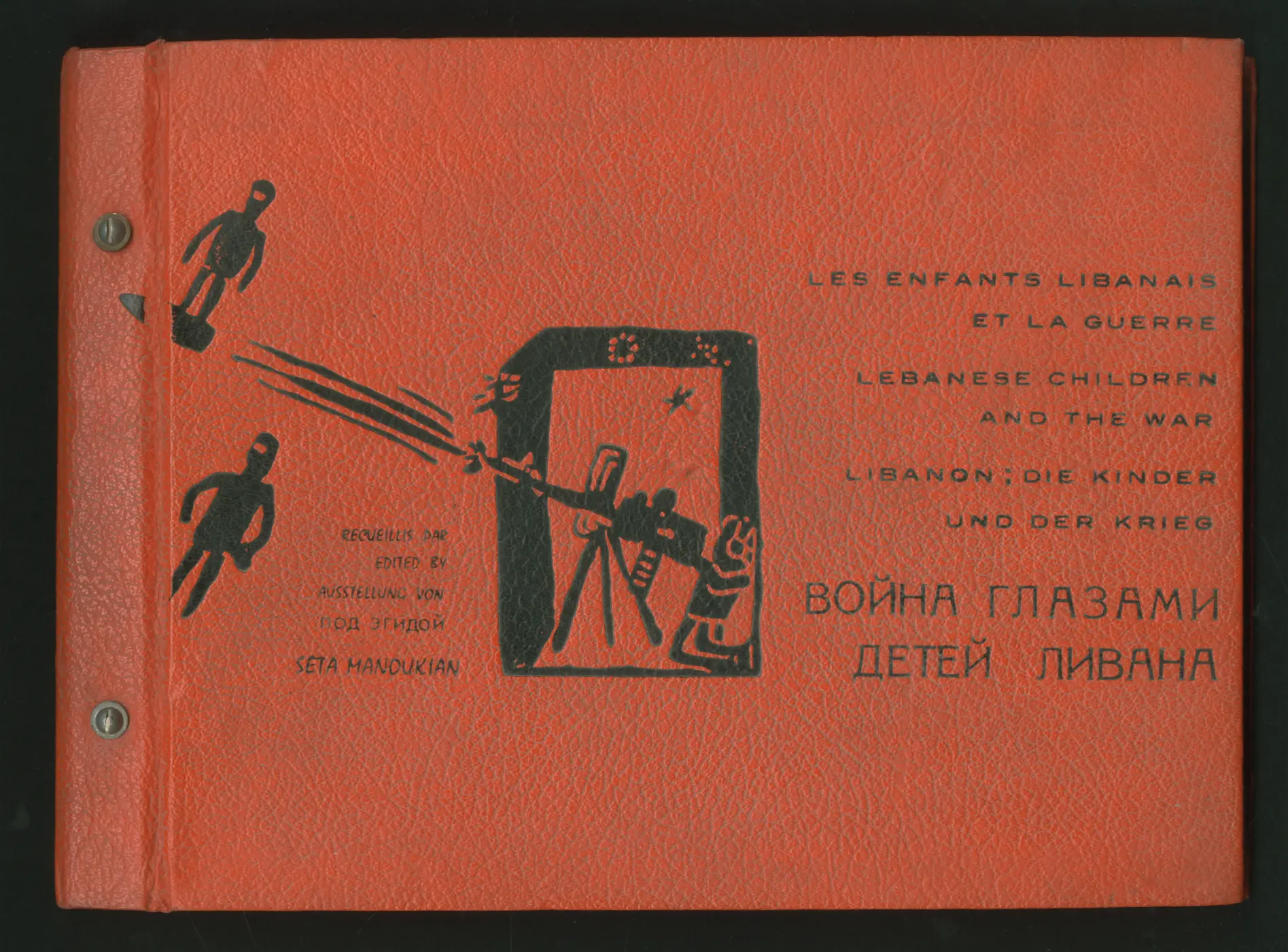
The book presents itself in a landscape format, with a bright orange leather cover (figs 1 and 2). Designed to be opened and read from both sides (Arabic from right to left and Latin-script languages from left to right), it has neither a front nor a back cover, but rather two front covers. The cover on the right-hand side reads:
اطفال لبنان يرسمون الحرب
And the left side:
LES ENFANTS LIBANAIS ET LA GUERRE
LEBANESE CHILDREN AND THE WAR
LIBANON: DIE KINDER UND DER KRIEG
ВОЙНА ГЛАЗАМИ ДЕТЕЙ ЛИВАНА
The multiplicity of languages, particularly German and Russian, which are scarcely spoken in Lebanon, reveals the publisher’s ambition to reach a broad international audience. Remarkably, the Russian text is set in a font more than twice the size of that used for the other languages, a design choice that recalls Dar al-Farabi’s close affiliation with the Lebanese Communist Party. Alongside the titles on both covers, part of a child’s drawing by Jacques Abou Nawas, from Lycée Abdel Kader, is debossed into the leather cover, depicting, within a frame, a kneeling fighter firing a machine gun, while two other figures appear suspended in mid-air, one above a flying artillery shell (fig. 4).
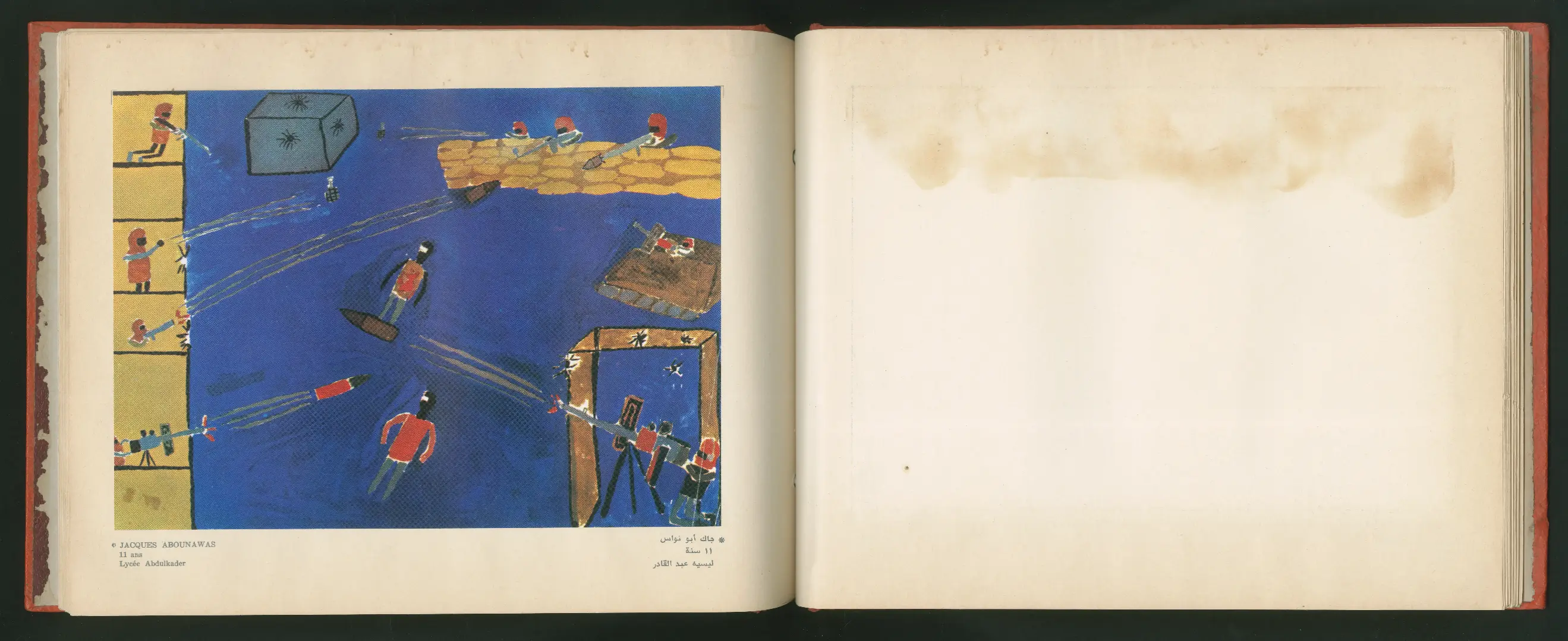
Among the collection gathered in Decolonizing the Page, Lebanese Children and the War is exceptional on two levels: the extent of its multilingualism and its atypical design. The volume appears to have been assembled in such a way as to evoke a photographic album, commonly used as a school yearbook, lending the object the character of a collective repository of childhood memories. The pages are bound together by two screws along one side, while the complete absence of page numbers, irrespective of language or reading sequence, further distinguishes the volume from a conventional book.
Inside the book
The opening pages contain an introductory text in five languages. Differences between the Arabic version and the French and English translations suggest that the text was originally written in Arabic and later translated. Although the introduction is unsigned, historian Nova Robinson attributes it to Walid Safi.13 Manoukian, however, has clarified that this was a pseudonym used by the artist Samir Khaddaje (b. 1938),14 whose work has been profoundly shaped by the Civil War and the successive cycles of violence that have unsettled the region. Together with Emile Menhem, Khaddaje and Manoukian belonged to the long 1960s generation of artists on the Left15 who extended their art to political posters (fig. 5) and ‘formed among themselves a collaborative workspace’.16
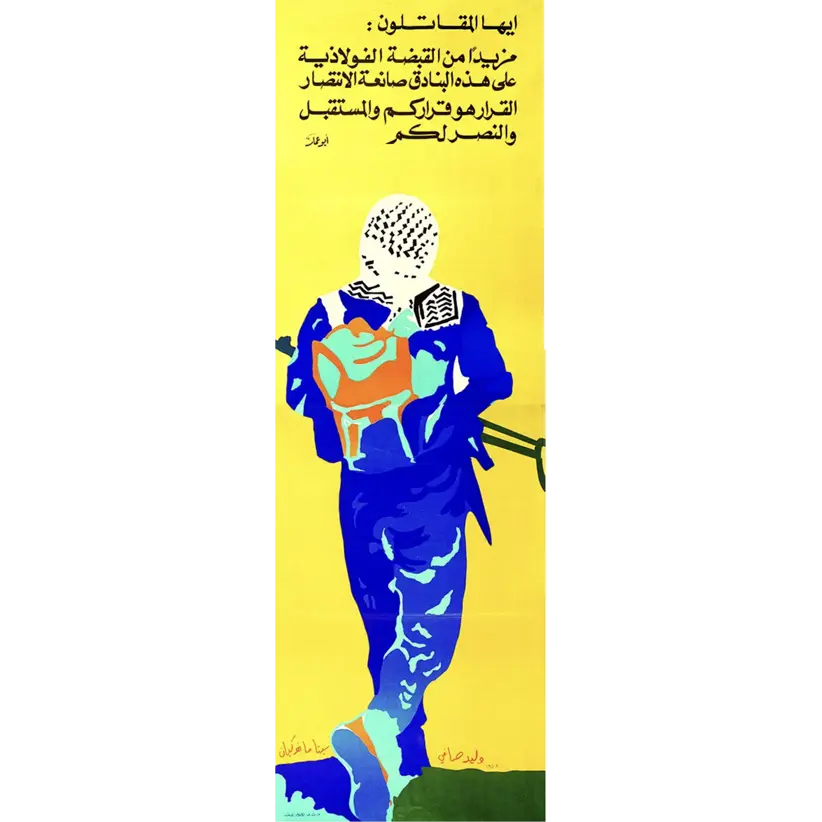
The opening sentence of Lebanese Children and the War introduces the initiative in striking terms, presenting children as having responded to the war with a sensitivity and creativity that presumably surpassed the inaction of many adult artists. The paintings were first exhibited by Seta Manoukian at the Arab Cultural Club before being reproduced in the volume. Khaddaje observes that war dominates both the exhibition and the children’s concerns, emerging as the principal subject of their artwork.
The drawings are divided into three groups: students from Lycée Fakhreddine, students from Lycée Abdel Kader, and children from Chiyah, a suburb in southern Beirut. The children came from diverse socioeconomic backgrounds, ranging from lower‑middle‑class families associated with schools in West Beirut to residents of the economically disadvantaged neighbourhood of Chiyah, which was home to a large Palestinian community.17
At the centre of the volume, between the Arabic introduction and its translations, are fifty drawings. Each is reproduced in colour, mounted on a full page, and accompanied by captions in French (on the left) and Arabic (on the right), indicating the artist’s name, age, and either their school (Lycée Fakhreddine or Lycée Abdel Kader) or neighbourhood (Chiyah).
Lycée Fakhreddine
Executed by girls aged eleven to thirteen, these sixteen drawings reveal a range of subjects typically associated with children’s imaginative worlds. Among them are a smiling sun over a boat (Najwa Mallah); sun over a dune (Wafa Saad); houses, figures and trees over a black background (Nergess Masri); merry figures in Lebanese traditional attire (Nahla Jamaleddine); and Antar and Abla(Basma Chibani). In an email exchange, Basma Chibani, who later became a librarian while continuing to paint, told me that her painting had been completed before the war under the supervision of Seta Manoukian, whom she described as ‘a wonderful teacher’.18
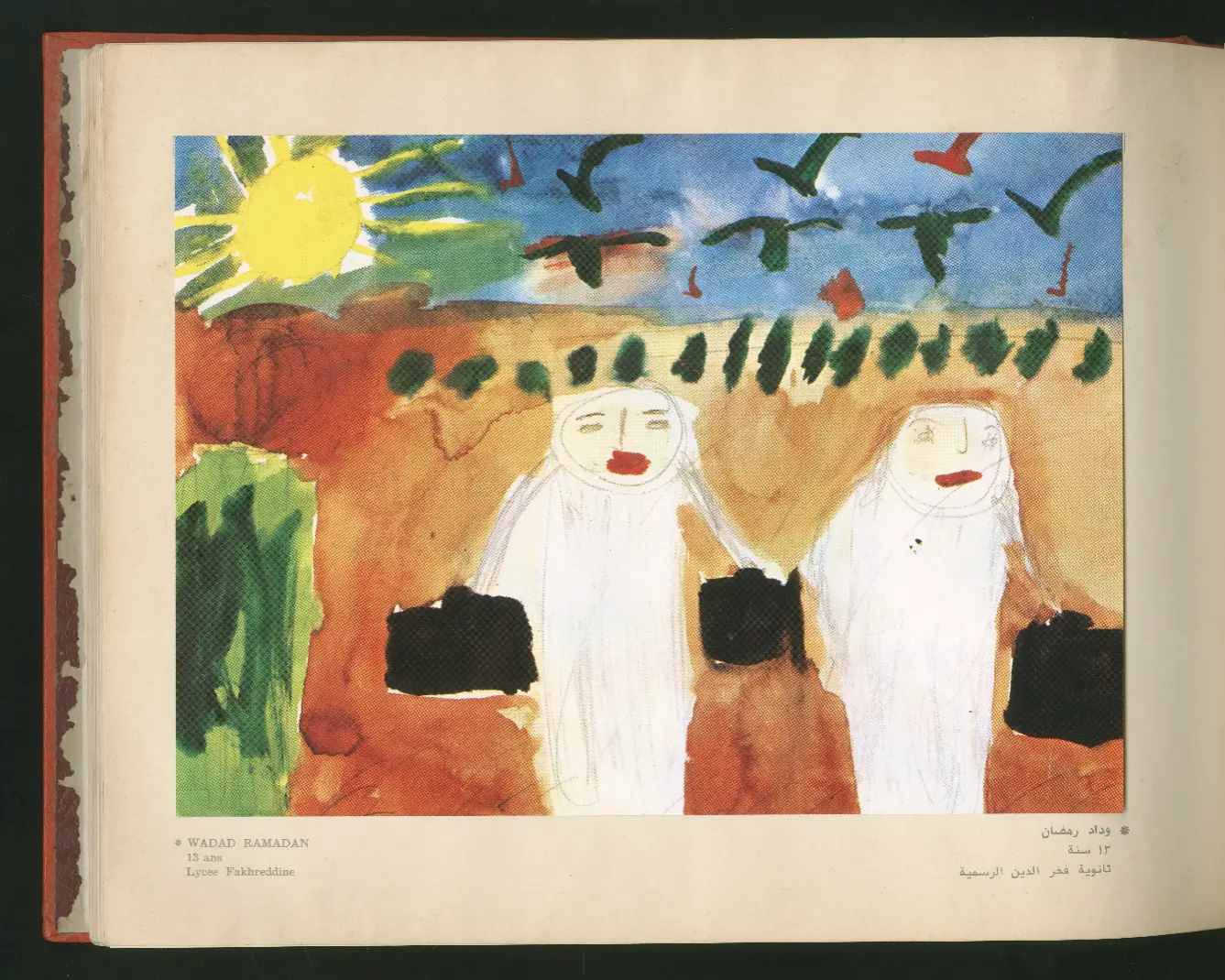
Nevertheless, the Lycée Fakhreddine corpus also includes works that are less placid and may well have been produced in the context of violence. These include a sorrowful woman walking through a dark, cloudy city (Ibtissam Zein); two smiling bearded men holding unidentified objects (Wafa Baghdadi), figures depicted between two houses and a hotel in the foreground and trees in the background, perhaps militiamen; two figures carrying luggage, set within a landscape populated by a sun and black birds, possibly refugees (Wadad Ramadan, fig. 6); and a series of dark, totemic faces (Sabah Dimechkie and Najwa Zarif).
More than fifty years later, and despite the difficulty of dating the paintings precisely, it is tempting to see them as bearing witness to the gradual transition from everyday life to a state of war during the course of 1975. This interpretation may help explain the seemingly incongruous and unexpected inclusion of paintings executed before the outbreak of the conflict.
Lycée Abdel Kader
Khaddaje notes that ‘subjects change abruptly with Lycée students’, adding that he ‘cannot tell how children grew up all of a sudden during the war’. He goes on to describe how the conflict transformed the children’s perception of their surroundings: the city appears silent and abandoned; it trembles under the impact of rockets; the streets become sites of death; and the urban landscape gradually turns pale, depleted, and perhaps lifeless against a backdrop of flames. Even the sky seems to disappear behind the silhouettes of burnt buildings. For many of the Lycée students, violence and destruction emerge as the dominant themes. Yet each child articulates these experiences through distinct aesthetic choices, compositional strategies, and sensibilities, at times with a striking degree of precision. This raises the question of whether the paintings were based on direct observation, media images circulating in the press and on television, or, more likely, a combination of both. Robinson likewise addresses this issue:
‘We do not know whether the battle images were scenes the children witnessed, figments of their war-soaked imaginations, or depictions of stories they heard at home. Regardless, such images provide a window into how the children absorbed and understood the war around them. The children feared how the war might affect them, and the paintings present an affective record of those fears’. 19
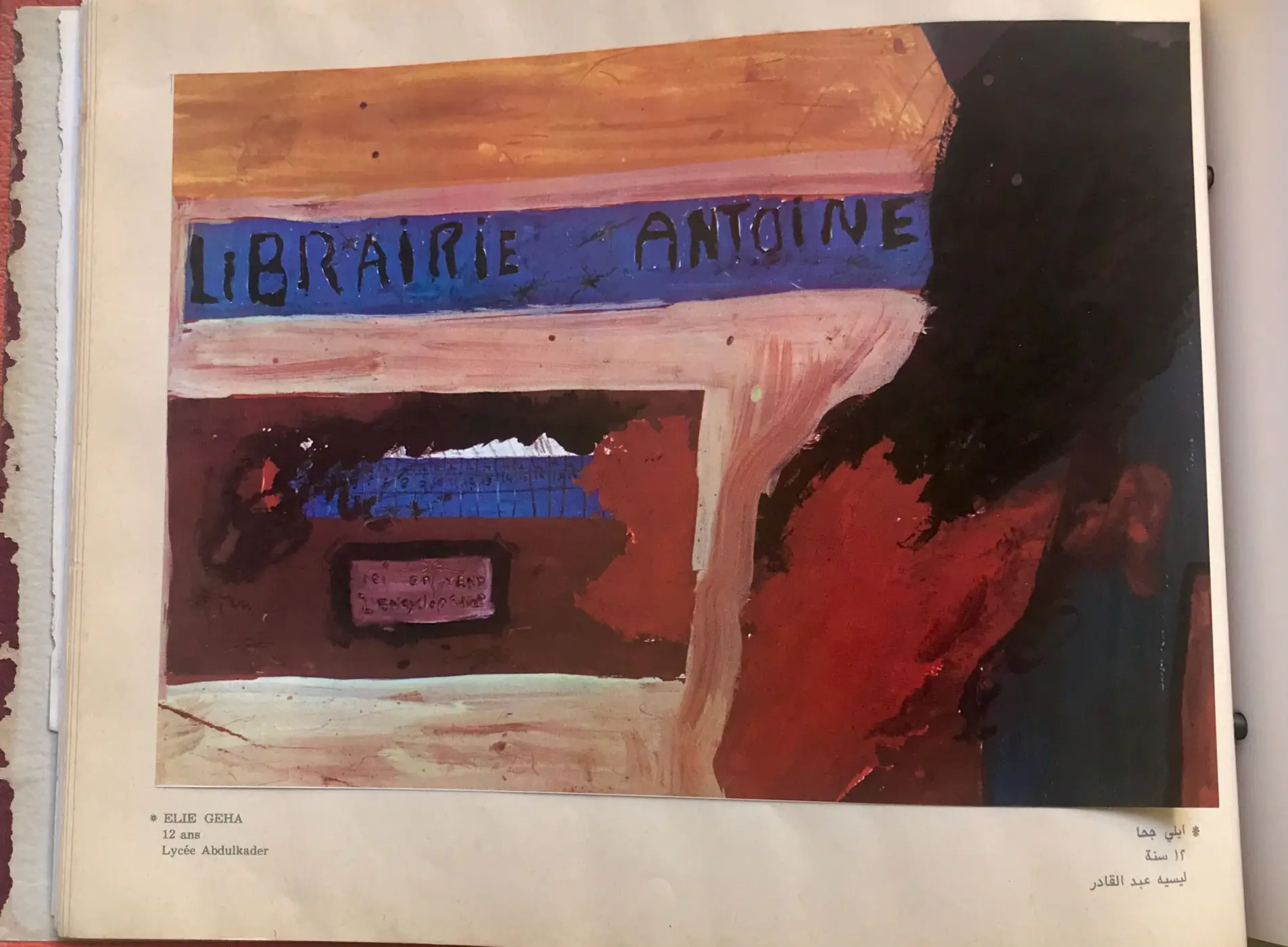
In terms of its connection to reality, Elie Geha’s painting is particularly noteworthy. It presents a close‑up view of a façade bearing the sign ‘Librairie Antoine’ against a blue background (fig. 7). Other inscriptions are visible in the shop window, including ‘L’encyclopédie’. Geha is the only Lycée student to depict a static scene, devoid of human figures or action, focusing instead on a fragment of the built environment, reminiscent of Edward Hopper’s representations of deserted storefronts. He is also the only student to portray a recognisable landmark: the Antoine bookshop in Bab Idriss, in the heart of downtown Beirut. Before the war, this intersection was among the city’s most vibrant urban spaces and was frequently photographed and filmed.
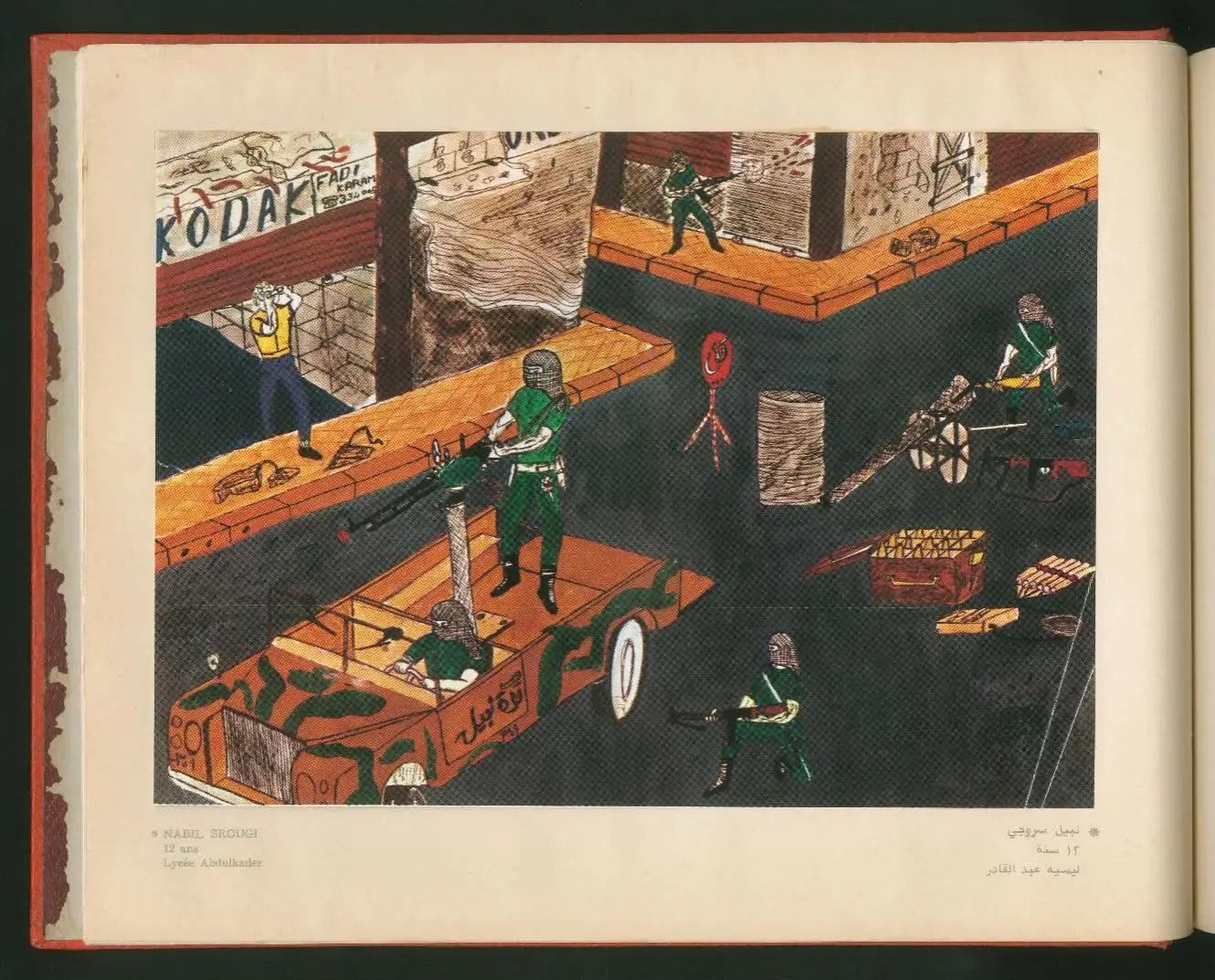
Two other paintings are remarkable for depicting what appears to be the same scene of urban warfare from different perspectives. Nabil Srouji portrays a street in oblique perspective, featuring a Kodak photography shop belonging to a man named Fadi Karam, whose name and telephone number (334005) appear on the signboard (fig. 8). Whether these details refer to an actual business or an imagined one remains unclear. The shop’s front door stands open, its shelves emptied and its merchandise seemingly looted. A neighbouring shop has a damaged metal shutter. Around them are fighters wearing keffiyehs, presumably members of Palestinian organisations: one fires a rifle, while others perch atop armoured vehicles. At the centre of the battlefield, a young man in a yellow shirt photographs the scene with a Kodak camera. Srouji’s classmate and probable friend Fouad Beckdache depicts what may be the same event from a frontal viewpoint (fig. 9). In the foreground, a keffiyeh‑clad fighter launches a mortar round from the pavement. At the centre of the composition, an armoured vehicle, its surface marked by inscriptions and a skull motif, opens fire in the street, while other fighters engage in combat on the opposite pavement. Nearby stands another photographer, this time carrying a reflex camera and a red backpack, positioned before the shattered façade of a grocery shop named Mahallat Abu al‑Izz.
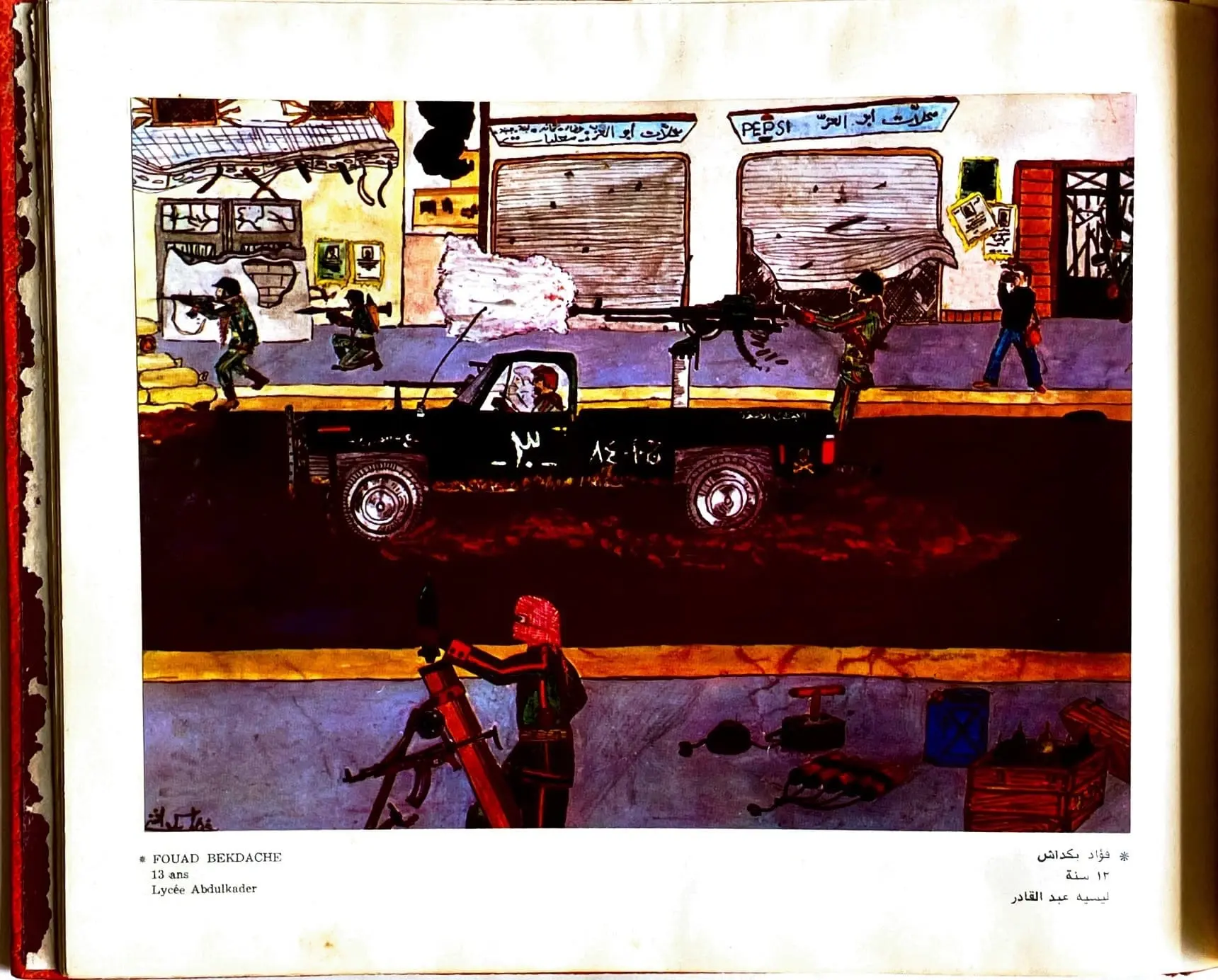
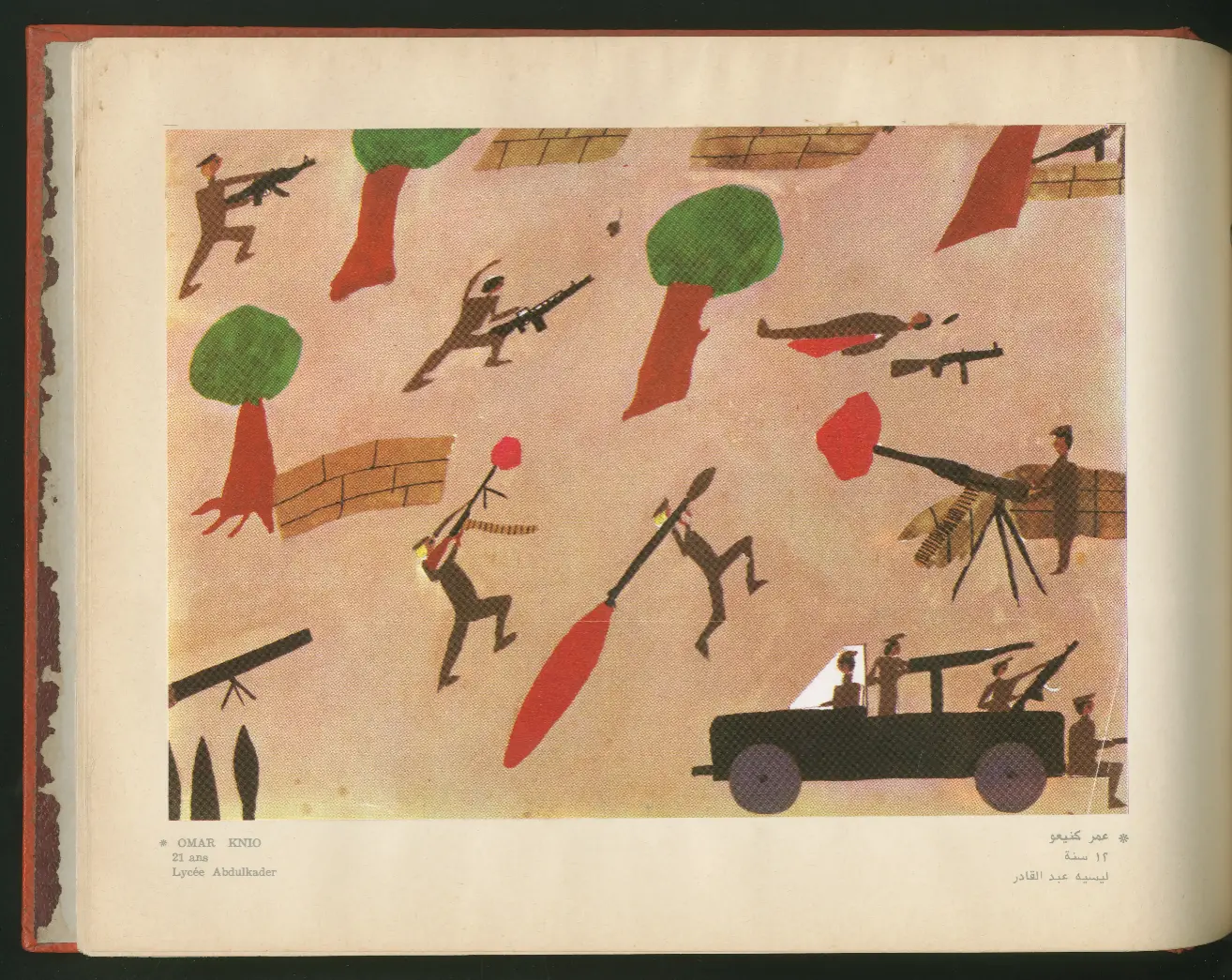
The urban battlefield is the most recurrent subject in the paintings produced by the Lycée students. At times, it is rendered in a highly stylized manner, as in Philippe Makhoul’s sketches of tanks and barricades, executed in bold, brightly coloured strokes; Samer Dimechkie’s city in flames, with military outposts painted in white against a black background and bearing the inscription ‘al-Mourabitoun’20; and Omar Knio’s composition, in which fighters, weapons, and vehicles float across a blank surface in a tribal-like dance (fig. 10).21
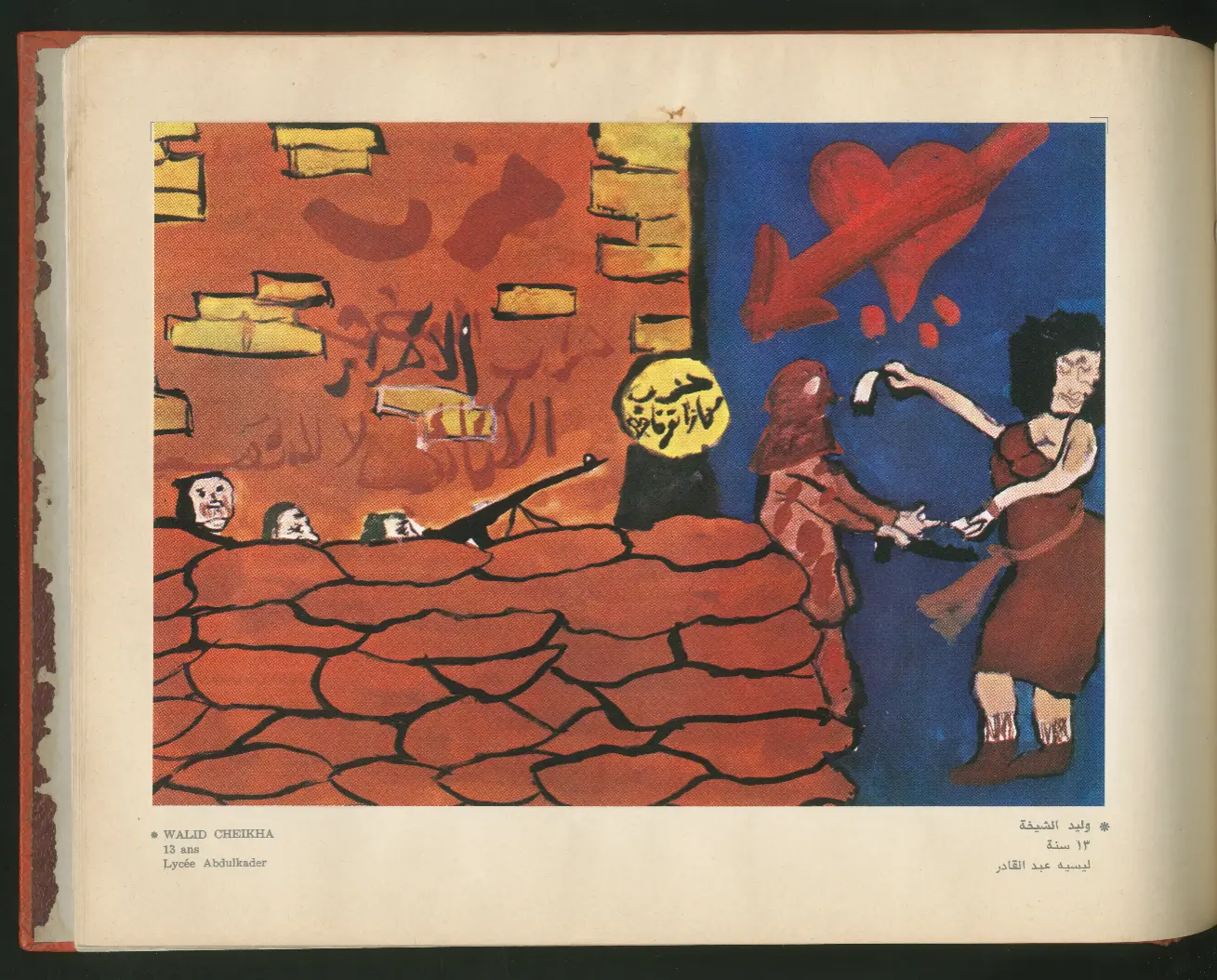
Rania Dada depicts an avenue suspended within a red landscape, its black asphalt lined with rows of streetlights. On the right, two men are engaged in combat, while on the left, a woman carries her child to safety; in the background, a car emerges, driven by a ghostly figure. In Hiba Karout’s painting, an oversized fighter stands amid ruined buildings while, in the foreground, two women flee, one of them carrying a red bag. Maria Kebbe imagines an apocalyptic scene of explosions from which emerges a woman holding flowers, a sign of hope amid destruction. Leila Hassan presents a city seen from above, with smoke rising across the urban landscape and a broad street receding into the distance. At either end stand barricades, indicating that the scene is set along a front line. At the exact centre of the composition, midway between the two barricades, lies the body of a man surrounded by a pool of blood. Equally striking is Walid Cheikha’s painting of a barricade manned by three fighters positioned behind sandbags and in front of a wall covered with graffiti reading ‘Hezb al-Ahrar’22 and ‘al-Kataeb al-Lubnaniyya’, alongside a yellow sign marked ‘Hezb Kaza’ [unreadable] (fig. 11). In the upper right corner, a large red symbol of a heart pierced by an arrow appears, while below, a fighter dances with a woman who appears to be a sex worker.
Only two of the seventeen Lycée Abdel Kader do not represent warfare but symbolic images of war-torn Lebanon. Hayat Sidawi drops a black spot from which emerges a face, within it are drawn two similar edifices with cupolas, a mosque and a church, connected by oblique structures reminiscent of drawbridges. Wadad Kebbeh organizes, around a scattered map of Lebanon, figures in traditional dress, leaving East and West and, on the top, a group of sorrowful characters seated in front of a ruined skyline.
Reviewing the paintings in this book fifty years later, particularly those by the Lycée students, reveals something uncanny in their techniques, aesthetic approaches, and artistic maturity. Moreover, these works display a fascinating correspondence with those of Seta Manoukian and Samir Khaddage from the same period, suggesting an influence that may have passed from the teacher to her pupils and, perhaps, vice versa.
Chiyah
The book includes drawings by fifteen children from Chiyah, a disadvantaged suburb of Beirut, also home to Palestinian refugees, and known for its association with the outbreak of the Lebanese Civil War and the violence that subsequently unfolded along the nearby demarcation line.23 Khaddaje observes that, with the children of Chiyah, the image becomes less defined and the street largely disappears, surfacing only intermittently in the form of a bakery, a vegetable pushcart, a face marked by tragedy, or a house—the dreamworld of the Chiyah youngsters—set against a gloomy sky. Comparing these drawings with those produced by the Lycée students, he further notes that the Chiyah children pay little attention to perspective and the division of pictorial space, while working with more limited artistic materials.
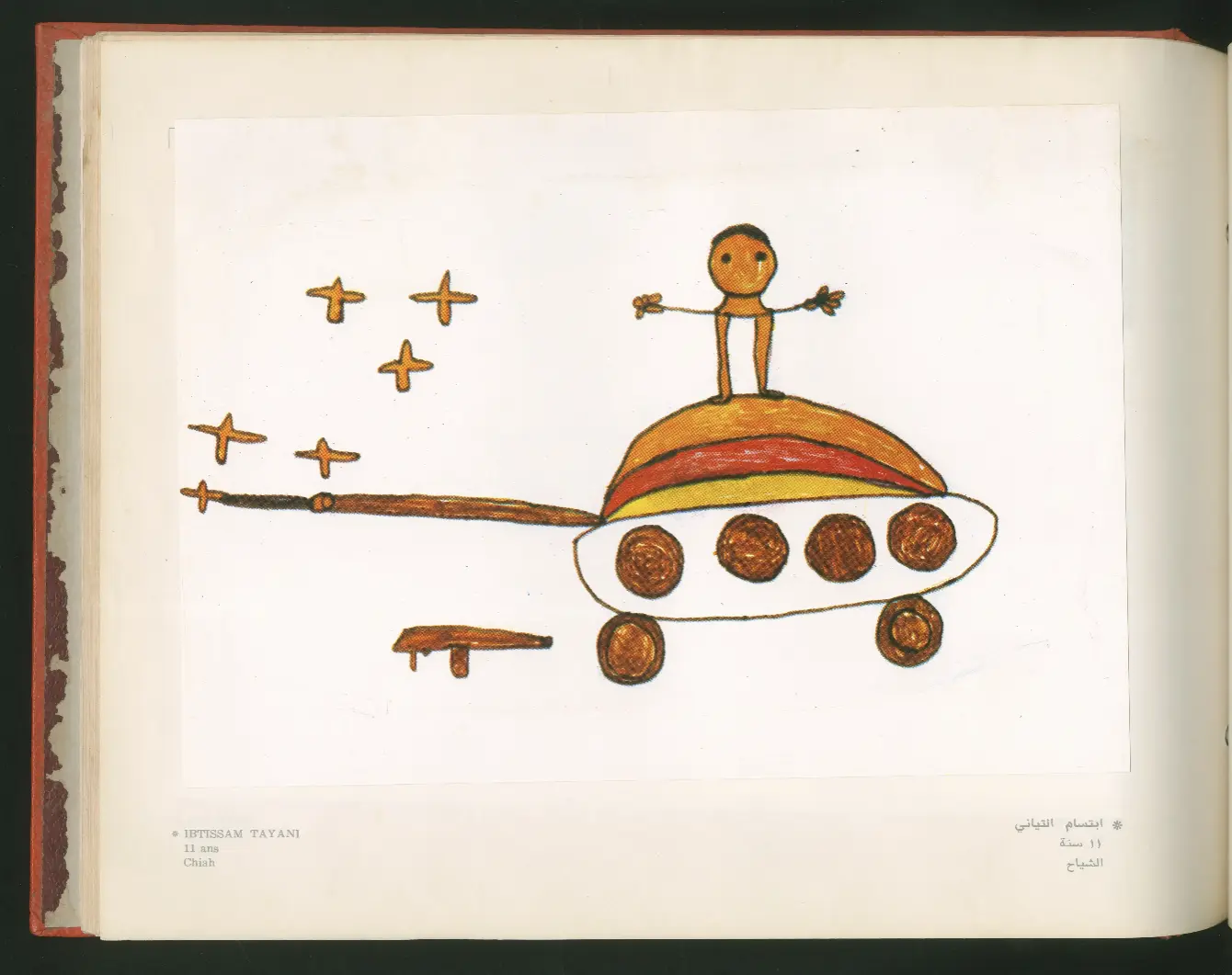
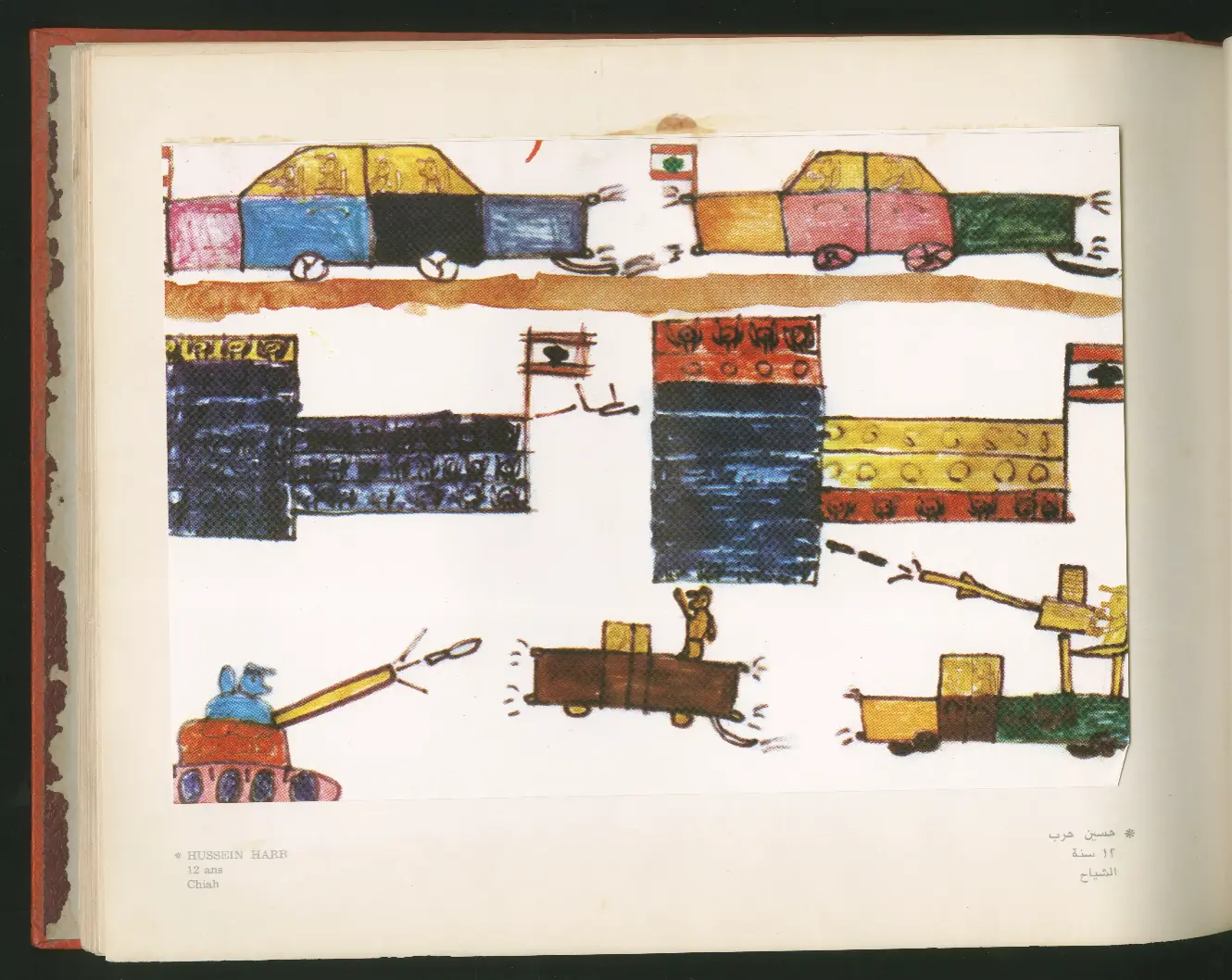
Among the seventeen drawings produced by children from Chiyah, direct representations of conflict are less common than in the Lycée corpus and are generally rendered in a more naïve and less detailed style. Ibtissam Tayani depicts a tank resembling a whimsical UFO (fig. 12), while Ali Raad portrays a convoy of armoured vehicles, one bearing the inscription ‘al‑Quwat al‑Mushtaraka’.24 Hussein Hamze narrates an aerial bombardment over a deserted landscape inhabited by only two figures and a flag. Hussein Harb adopts a three-tiered composition, with a battle between armoured vehicles in the lower register, a convoy of official cars flying Lebanese flags in the upper register, and, in the middle, a structure bearing the inscription ‘Matar’ (‘Airport’) (fig. 13). Najat Charafeddine’s drawing displays a level of care and precision that recalls some of the Lycée students’ works. It portrays a man moving through a devastated neighbourhood strewn with corpses and debris, against a backdrop of bullet‑ridden walls bearing inscriptions such as ‘Aashat al‑Haraka al‑Wataniyya’ (‘Long Live the National Movement’).
As noted in the introductory text, the house is a recurring motif in the Chiyah group, appearing in at least five drawings. These houses correspond to a stereotyped and simplified vision of home: a square or rectangular structure with a central door, windows on either side, and a triangular roof. They appear in idyllic landscapes populated by trees (Ali Raad, Mouhamad Ibrahim, Hussein Ibrahim), sometimes accompanied by human figures (Hassan Abass, Hussein Abdullah), yet are invariably rendered in a dark and dramatic palette. A more complex drawing by Hassan Ibrahim combines such a prototypical house with an armoured vehicle, cars, animals, and clouds of dark smoke. In one of the most surprising contributions, Mouhammed Wazneh aligns seven house‑like forms, each painted a different colour and topped by a cross. According to Manoukian, the image expresses the child’s preference for peace over war.25 Equally emblematic is Hassan Raad’s depiction of a figure shedding red tears—perhaps blood, perhaps bullets—while smoking a cigarette.
Framing children’s testimonies
Lebanese Children and the War was not an isolated experience. In the aftermath of the 1967 Arab-Israeli War (Naksa),26 the artist Mona Saudi engaged with Palestinian refugee children in Jordan. The encounter resulted in an exhibition and a book, In Time of War Children Testify (Ref. MK001), published in 1970, which also inspired filmmakers to incorporate Palestinian children’s drawings into film.27 When she initiated Lebanese Children and the War, Manoukian, who knew Saudi, was aware of In Time of War but did not seek to replicate it.28 Despite handling subjects of violence and displacement experienced by children, the two books differ in their designs and their visual contents.
In the early 1980s Manoukian was involved in another initiative with the League for Lebanese Women’s Rights. Traces rouges et bleues exprimées par les enfants durant l’occupation brings together children’s artwork executed during the Israeli siege and occupation of Beirut in 1982 and the Mountain War in 1983.29 A review observes that:
‘Seta Manoukian and Moufid Zeitouni accompanied children in their work. Lebanese, Palestinians or Kurds, whatever their religious, economic or ethnical backgrounds, the children of the war endure and express one single world. The elements of this cruel and fierce universe that constitutes the world of war recur in the different drawings. Explosions, bombardments, shells, planes, soldiers, militias, populations, ruins’.30
Needless to say, innumerable conflicts and episodes of violence and terror have, since then, shattered societies across the globe. Here and there, initiatives emerged to give a voice to the youngest and most vulnerable. In 2013, Zérane S. Gireaudeau created, with a group of artists and intellectuals, the collective Déflagrations – detonations. The horrors of the war that was at the time raging in Syria prompted her to assemble a ‘corpus of graphic expressions by children in times of war and mass crime’.31 Since then, the collection has grown with contributions from around the world, spanning more than a century, from the First World War to the present day, including Lebanese Children and the War and In Time of War Children Testify. Gireaudeau explains that among the sources for collecting are museum and archival holdings, international organizations and NGOs and published materials:
‘mainly dated between 1960 and 2000 — artists committed to a people and their cause who carried out editorial projects after having had children, most often displaced or refugees, draw (in the contexts of wars in Algeria, Palestine and Western Sahara). These drawings born under the impulse of artists often stand out pictorially. I am thinking here of the drawings collected by the artists Seta Manoukian, Mona Saudi and Kamal Boullata’.32
Since its inception, Déflagrations has organized exhibitions that create a space for dialogue between children’s raw, spontaneous visions and those of established artists. These encounters invited debate and ultimately raised the question of whether children’s visual expressions might one day be granted legal and procedural value. Déflagrations and Decolonizing the Page share a commitment to a social, humanist, and political vision that extends beyond the artistic and aesthetic value of their contents. In an era marked by genocide, unabashed racism, corruption, and dispossession, these principles have become an essential moral foundation. Both also have in common a non-definitive, always growing structure, which makes the platforms alive rather than frozen. Both provide new platforms, visibility and modes of reading for Lebanese Children and the War and other initiatives of this kind that might otherwise have fallen into oblivion. Revisiting this book half a century after its release allows us not only to appreciate it as a moving human testimony from dire times, but also to apprehend it both as a complete object and as a constellation of written, drawn and painted elements, and to recognize it as a remarkable contribution to the production of thought and visual culture during the early years of the Lebanese Civil War.
Gregory Buchakjian is an interdisciplinary artist and art historian, and Associate Professor at Académie Libanaise des Beaux-Arts (Alba), University of Balamand. His practice is based on archives, archaeology and narration. His PhD dissertation generated the book Abandoned Dwellings, A History of Beirut and the exhibition Abandoned Dwellings at theSursock Museum. He is credited with the attribution to Artemisia Gentileschi of two paintings damaged in the 4 August 2020 Beirut port explosion: Magdalene and Hercules and Omphale.
Acknowledgments:
All my gratitude to Ani Pema Tsultrim Drolma (Seta Manoukian) for her loving support, to Zeina Maasri for her trust and patience and Carine Chelhot Lemyre for her proofreading.
- ‘Lebanon: 12 children killed, maimed daily, despite Hezbollah-Israel truce’, UN News, 17 June 2026. Accessed 27/07/2026. ↩︎
- ‘“The essence of childhood has been destroyed”: Israel’s deliberate targeting of Palestinian children in the Occupied Palestinian Territory since 7 October 2023’ – Report (A/HRC/62/CRP.2). Accessed 27/07/2026. ↩︎
- Inka Weissbecker, Sandra E. Sephton, Meagan B. Martin, and David M. Simpson, ‘Psychological and Physiological Correlates of Stress in Children Exposed to Disaster: Current Research and Recommendations for Intervention’, Children, Youth and Environments 18, no. 1 (2008): 30–70. ↩︎
- Mona S. Macksoud and J. Lawrence Aber, ‘The War Experiences and Psychosocial Development of Children in Lebanon’, Child Development67, no. 1 (February 1996): 82. ↩︎
- Debra Kaminer and Gillian Eagle, Traumatic Stress in South Africa (Johannesburg: Wits University Press, 2010), 124. ↩︎
- I found many songs online containing this phrase, but I have been unable to locate the specific song that we learned and sang at the time. ↩︎
- Cynthia Rose,‘Drawing on Disaster: Children, Art and Trauma 1914–2020’, The Comics Journal, 15 April 2021, (accessed 7 July 2026). ↩︎
- Anne-Laure Pineau, ‘Dessiner les traumatismes’, La Déferlante, 22 April 2024, (accessed 7 July 2026). ↩︎
- Gregory Buchakjian,‘Painting in Levitation. Painting for Healing’, in Seta Manoukian: Painting in Levitation (Beirut: Kaph Books and Saradar Collection, 2018), 16. ↩︎
- Aline Manoukian, ‘Seta Manoukian: A Chronology’, in Seta Manoukian: Painting in Levitation, 167. ↩︎
- Kristine Khouri, ‘In Conversation with Seta Manoukian (Ani Pema Tsultrim Drolma)’, in Seta Manoukian: Painting in Levitation, 152. ↩︎
- Nova Robinson, ‘“I Was Beirut”: Seta Manoukian and Art as Therapy during and after the Lebanese Civil War’, in Michelle Hartman and Malek Abisaab, eds., Women’s War Stories (Syracuse, NY: Syracuse University Press, 2022), 80–108. ↩︎
- Robinson, ‘“I Was Beirut”’, 99. ↩︎
- ‘Online Cultural Majlis: Seta Manoukian’, YouTube video, 28 June 2026 (accessed 29 July 2026). ↩︎
- See Zeina Maasri, ‘Activism and the history of graphic design: the 1960s generation of Arab artist-designers’ in this Learning Hub, published on 29/06/2026. ↩︎
- Zeina Maasri, Off the Wall: Political Posters of the Lebanese Civil War (London: I.B. Tauris, 2009), 44. ↩︎
- Robinson, ‘“I was Beirut”’, 93. ↩︎
- Basma Chibani, email to the author, 29 January 2026. ↩︎
- Robinson, ‘“I was Beirut”’, 98. ↩︎
- The Independent Nasserite Movement, known as al-Mourabitoun, was one of the parties and armed groups that formed part of the National Movement, allied to the Palestinian Organizations, at the beginning of the Lebanese War. ↩︎
- Omar Knio is mistakenly listed in French as being 21 years old, placing him well outside the age range of the other participants, who are all between 5 and 14 years old. We assume this is a typographical error, with his age inadvertently given as 21 instead of 12, since the Arabic version lists him as 12 years old. ↩︎
- ‘Hezb al-Ahrar’ – National Liberal Party and Al-Kataeb were the two main parties of the Christian right-wing coalition opposed to the National Movement in 1975. ↩︎
- Marwan Chahine, Beyrouth, 13 avril 1975: Autopsie d’une étincelle (Paris: Belfond, 2024), 101. ↩︎
- ‘Al Quwat al-Mushtaraka’ – Combined Forces of the National Movement and the Palestinian Resistance. ↩︎
- Robinson, 100. ↩︎
- Naksa – Setback is the name given to the displacement of Palestinian People after the 1967 war during which the Israelis took control of Jerusalem, the West Bank, the Gaza Strip, the Golan Heights and the Sinai. ↩︎
- See Anaïs Farine, ‘From page to screen: the afterlives of In time of war children testify (1970)’ in Decolonizing the Page: Learning Hub, 13/07/2026. ↩︎
- Robinson, 87. ↩︎
- Part of the 1982 Israeli Invasion of Lebanon, the Siege of Beirut lasted more than two months, leaving the population isolated under heavy bombardments. The Mountain War opposed the Christian Lebanese Forces to the Druze Progressive Socialist Party after the withdrawal of the Israeli forces from the Aley and Chouf Districts. ↩︎
- Mahmoud Zibawi, ‘Traces rouges et bleues ou la guerre racontée par ses enfants’, L’Orient-Le Jour, 12 September 1985. ↩︎
- Déflagrations, About Déflagrations (accessed 7 July 2026). [accessed 7 July 2026] ↩︎
- ‘Déflagrations: Children’s Drawings and Mass Violence. Interview with Zérane S. Gireaudeau, Curator of the Exhibition’, Mucem: Museum of European and Mediterranean Civilisations, 2021, Exhibition Interview [accessed 7 July 2026]. ↩︎